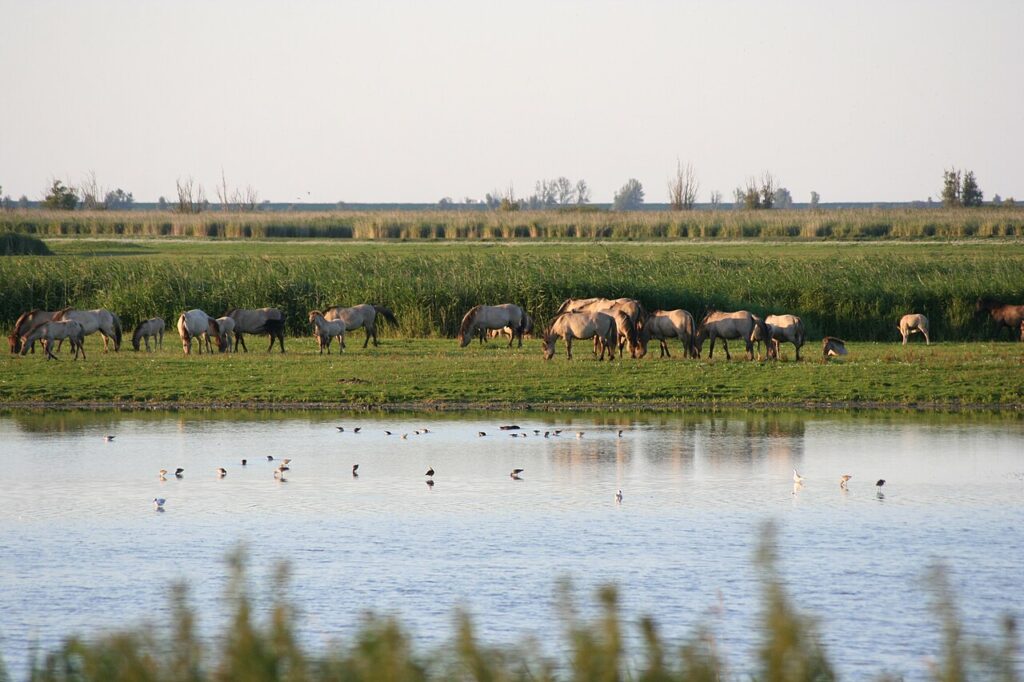
Europe is experiencing a remarkable wildlife comeback. Legal protection, the abandonment of farmland, reintroductions and changing attitudes have allowed species that were once rare or extinct in many countries to return. Studies by conservation groups have documented big increases in populations of bison, beavers, wolves, bears, lynx, vultures and many birds over the last half-century. Rewilding, an approach that restores natural processes and lets nature take care of itself, is helping to accelerate the recovery.
Species making a comeback
| Species | Recovery | Where to see |
|---|---|---|
| European bison | Extinct in the wild in the 1920s; now several thousand | Białowieża (Poland), the Southern Carpathians (Romania), Kraansvlak (Netherlands). See our bison guide |
| Grey wolf | Recolonising much of Europe | Spain, Italy, Poland, Germany, Romania. See our wolf watching guide |
| Eurasian lynx and Iberian lynx | Reintroductions and recovery | Andújar (Spain), the Carpathians, Bavarian Forest. See our Iberian lynx guide |
| Brown bear | Stable or growing in several regions | Romania, Finland, Slovenia, Spain’s Cantabrian Mountains. See our Romania guide |
| Eurasian beaver | From about 1,200 animals in 1900 to more than a million | Across Europe, including the UK. See our Eurasian beaver profile |
| Griffon, cinereous and bearded vultures | Reintroductions and protection | Spain, the French Alps and Pyrenees, the Balkans. See our Extremadura guide |
| White-tailed eagle | Reintroduced to Scotland, England and Ireland | Scotland’s Isle of Mull. See our Scotland guide |
| White stork | Recovered in western Europe | Spain, Alsace, the Netherlands and a reintroduction at Knepp (England) |
| Alpine ibex | From fewer than 100 to around 50,000 | The Alps. See our Gran Paradiso guide |
Rewilding landscapes to visit
- The Côa Valley (Portugal): abandoned farmland returning to nature, with Garrano horses, Tauros (cattle bred to resemble the extinct aurochs), roe deer, wolves and vultures. Also famous for prehistoric rock art.
- The Southern Carpathians (Romania): free-roaming bison, wolves and bears.
- The Oder Delta (Germany/Poland): white-tailed eagles, beavers, elk and wisent.
- The Velebit Mountains (Croatia): chamois, bears and griffon vultures.
- The Danube Delta (Romania/Ukraine): pelicans and wetland restoration. See our Danube Delta guide.
- Knepp Estate (England): a farm transformed into a rewilding project with free-roaming ponies, cattle, deer, pigs, beavers and white storks.
- The Iberian Highlands (Spain): vultures, ibex and restoration of grazing.
Tips for visiting
- Stay in nature-based tourism businesses that support rewilding.
- Use local guides who can find wildlife responsibly.
- Respect access rules, especially during breeding seasons.
- Support organisations working to restore wildlife.
Frequently asked questions
What is rewilding? An approach to conservation that restores natural processes and missing species, allowing nature to manage itself with minimal human intervention.
Which European animals are making a comeback? Bison, wolves, lynx, bears, beavers, vultures, white-tailed eagles, white storks and ibex, among others.
Where can I see wild bison in Europe? Białowieża Forest in Poland is the best-known site, and bison have been reintroduced in Romania, the Netherlands and elsewhere.
Is rewilding controversial? Sometimes, especially where large carnivores come into conflict with livestock farming. Successful projects work closely with local communities.
Related guides
- Białowieża Forest and its bison
- Iberian lynx watching in Sierra de Andújar
- Iberá Wetlands: rewilding jaguars in Argentina
- Animal profiles: European bison, Eurasian beaver, Grey wolf
Cover photo: EM Kintzel, I Van Stokkum, CC BY-SA 3.0, via Wikimedia Commons