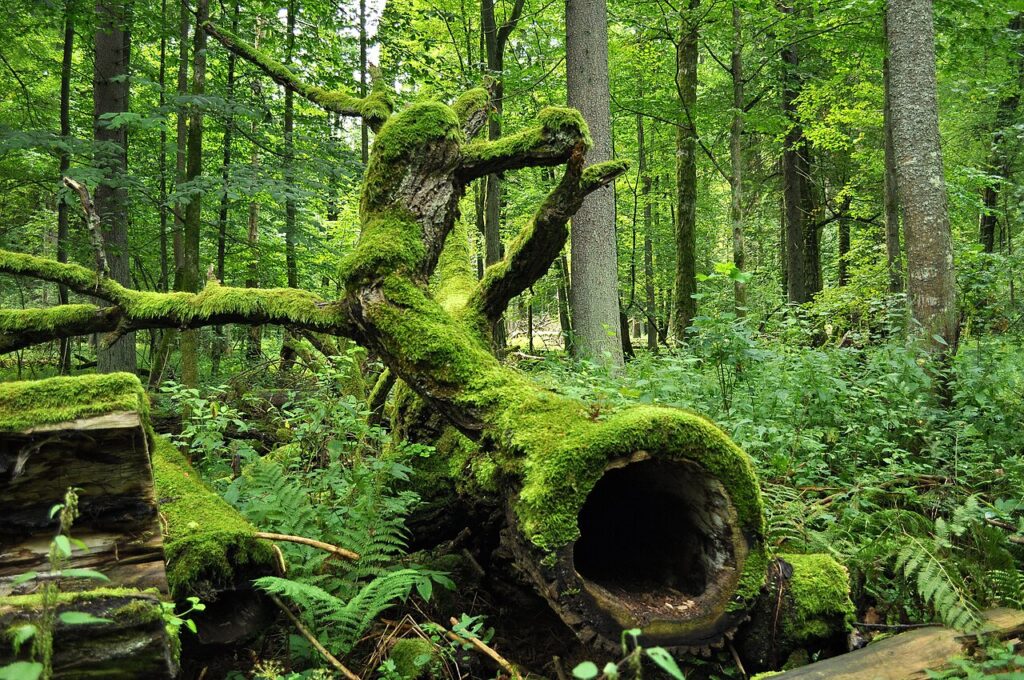
Białowieża Forest, straddling the border between Poland and Belarus, is one of the last and largest remnants of the primeval forest that once covered much of lowland Europe. Oaks, limes and spruces hundreds of years old stand among fallen trunks left to decay, supporting a wealth of fungi, insects and birds. It is also the home of the European bison, which was brought back from extinction in the wild here.
At a glance
| Best time | Winter (bison) and May to June (birds) |
| Getting there | About 3.5 hours by road from Warsaw |
| Time needed | 3 to 4 days |
| Big draws | European bison, woodpeckers, primeval forest, wolves, lynx |
| Good for | Nature lovers, birders, photographers |
European bison
- Europe’s largest land animal was hunted to extinction in the wild; the last wild bison in Białowieża was killed in 1921. See our European bison profile.
- A breeding programme using a few dozen bison in zoos led to reintroductions from 1952. Today, Białowieża holds several hundred free-ranging bison, and the species numbers several thousand worldwide, most of them now living in the wild.
- Bison are easiest to see in winter, when they gather at feeding sites in meadows at the forest edge. In summer they move deeper into the forest.
- The European Bison Show Reserve near Białowieża village has bison and other animals in large enclosures.
The forest
- Białowieża National Park’s Strict Reserve can only be entered with a licensed guide on set routes. It protects the oldest part of the forest.
- The forest is a UNESCO World Heritage Site.
- Logging in parts of the Polish forest outside the national park led to a European Court of Justice ruling against Poland in 2018. On the Belarusian side, the border fence built in 2021–2022 has divided the forest for wildlife.
Other wildlife
- Woodpeckers: all ten European species, including white-backed and three-toed woodpeckers.
- Birds: collared and red-breasted flycatchers, hazel grouse, pygmy and Tengmalm’s owls, and corncrakes in the meadows.
- Mammals: wolves, lynx, elk (moose), red deer, roe deer, wild boar and beavers. See our Eurasian lynx and Eurasian beaver profiles.
When to go
- January to March: bison at feeding sites in the snow; tracks of wolves and lynx.
- May to June: birdsong, woodpeckers, flycatchers and flowers.
- September to October: red deer rut and autumn colours.
Border situation
Since 2021, the Polish–Belarusian border has been heavily guarded, and access to border areas may be restricted. Check current rules before planning a visit.
Frequently asked questions
Can I see wild bison in Białowieża? Yes, especially in winter at the forest edges, with a local guide.
Do I need a guide for the Strict Reserve? Yes. Entry is only allowed with a licensed guide.
How many bison live in Białowieża? Several hundred in the Polish part of the forest, with more on the Belarusian side.
Is Białowieża good for birdwatching? Excellent, especially in May and June.
Related guides
- Rewilding Europe: where to see returning wildlife
- Bear watching in the Romanian Carpathians
- Danube Delta birding guide
- Animal profiles: European bison, Eurasian lynx, Grey wolf
Cover photo: Jacek Karczmarz, CC BY-SA 3.0, via Wikimedia Commons