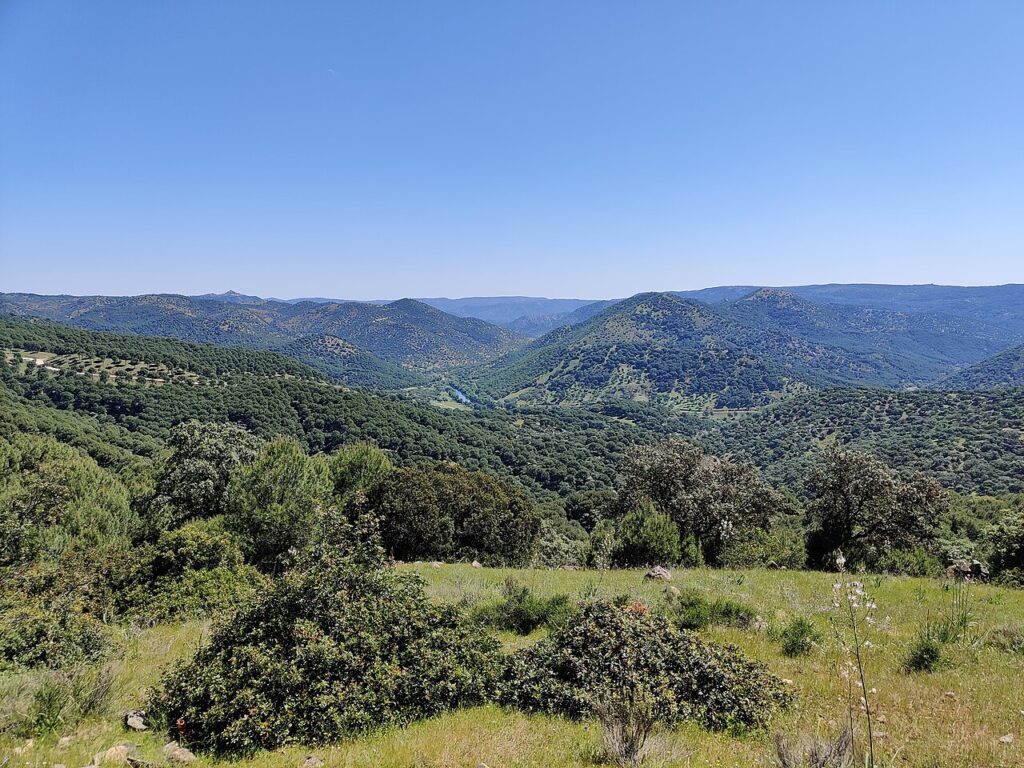
The Iberian lynx was once the world’s most endangered cat. In 2002, fewer than 100 remained, in two isolated populations in Andalusia. Thanks to habitat protection, breeding programmes, rabbit recovery and reintroductions, the population passed 2,000 in 2023, and the IUCN downgraded the species to Vulnerable in 2024. The Sierra de Andújar Natural Park, in the province of Jaén, is the best place in the world to see one. See our Iberian lynx profile.
At a glance
| Best time | December to February (mating season) and May to June |
| Getting there | About 1 hour from Jaén or Córdoba; 3 to 4 hours from Madrid or Málaga |
| Time needed | 3 to 4 days |
| Big draws | Iberian lynx, Spanish imperial eagles, black vultures, red deer |
| Good for | Wildlife enthusiasts, photographers |
How to see a lynx
- Most visitors watch from viewpoints along the public road near the Encinarejo reservoir and the Jándula River, scanning slopes of Mediterranean scrub and granite outcrops with binoculars and scopes.
- Early mornings and late afternoons are best.
- Local guides know individual lynx territories and recent sightings, which improves your chances considerably.
- Patience is key: many visitors spend two or three days before a sighting.
Other wildlife in Andújar
- Spanish imperial eagles: an endangered eagle found only in Iberia.
- Cinereous (black) vultures and griffon vultures. See our griffon vulture profile.
- Red deer: the autumn rut (September to October) is spectacular. See our red deer profile.
- Mouflon, wild boar, otters and, rarely, wolves (now very scarce in Andalusia).
Doñana National Park
Doñana, the other historic lynx stronghold, is a UNESCO World Heritage wetland near Seville. Lynx are harder to see here, but Doñana is excellent for birds: flamingos, spoonbills, imperial eagles and, in winter, huge flocks of geese and ducks. Water shortages and illegal wells have put the wetland under severe pressure.
Lynx reintroductions
Lynx have been released in Portugal’s Guadiana Valley, Extremadura, Castilla-La Mancha (Montes de Toledo) and Murcia. They are expanding across Iberia.
When to go
- December to February: the mating season, when lynx are most active and vocal; cold mornings.
- March to May: kittens are born; females stay hidden.
- May to June: mothers with young kittens begin to appear.
- Summer: very hot; lynx are active only at dawn and dusk.
Frequently asked questions
Where is the best place to see an Iberian lynx? Sierra de Andújar Natural Park in Jaén, Andalusia.
How many Iberian lynx are there? More than 2,000 in 2023, up from fewer than 100 in 2002.
Is a lynx sighting guaranteed? No, but with local guides and several days in winter, chances are good.
Is the Iberian lynx still endangered? It was downgraded to Vulnerable by the IUCN in 2024, a major conservation success.
Related guides
- Wolf watching in Spain’s Sierra de la Culebra
- Birding in Extremadura and Monfragüe
- Rewilding Europe
- Animal profiles: Iberian lynx, European rabbit, Griffon vulture
Cover photo: Veinticuatro de Jahén, CC BY-SA 4.0, via Wikimedia Commons