Antarctica is the coldest, windiest, highest and driest continent. About 98 percent of it is covered by ice that averages nearly 2 km thick, and the lowest natural temperature ever recorded on Earth, −89.2 °C, was measured at Russia’s Vostok Station in 1983. No native land mammals live here, and the largest animal that spends its whole life on land is a wingless midge about 6 mm long.
Yet the waters surrounding Antarctica are among the most productive on Earth. In summer, near-constant daylight fuels huge blooms of algae that feed Antarctic krill, and krill in turn feed penguins, seals, whales, fish and seabirds. For wildlife lovers, a trip to Antarctica means penguin colonies in their hundreds of thousands, whales feeding in the bays and seals hauled out on the ice.
Antarctica at a glance
| Area | About 14.2 million km², doubling in winter as sea ice forms |
| Countries | None; governed by the Antarctic Treaty (signed 1959, in force 1961) |
| Habitats | Ice sheet, ice-free coasts and nunataks, sea ice, Southern Ocean, sub-Antarctic islands |
| Signature animals | Emperor, Adélie, chinstrap and gentoo penguins; Weddell, leopard and crabeater seals; blue, humpback and minke whales; orcas; wandering albatross; Antarctic krill |
| Visitor season | November to March |
| Research presence | About 70 permanent research stations run by around 30 countries |
How life survives in Antarctica
Antarctic animals use a set of shared strategies to survive extreme cold:
- Insulation. Seals and whales have thick layers of blubber. Penguins combine blubber with tightly packed, waterproof feathers, about four layers deep.
- Heat exchange. Blood vessels in the flippers and feet of penguins and seals run side by side so that warm blood leaving the body heats cold blood returning to it, limiting heat loss.
- Huddling. Emperor penguin males huddle in groups of thousands during the winter, taking turns on the cold outer edge.
- Antifreeze. Many Antarctic fish produce antifreeze glycoproteins that stop ice crystals growing in their blood. Icefish have no red blood cells or haemoglobin at all; they rely on the high oxygen content of cold water.
- Migration. Most seabirds and whales leave in winter, heading north to warmer waters.
Penguins
Five penguin species breed on the Antarctic continent or peninsula, and several more breed on sub-Antarctic islands.
| Species | Scientific name | IUCN status | Notes |
|---|---|---|---|
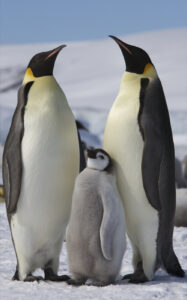
| Emperor penguin | Aptenodytes forsteri | Near Threatened | The largest penguin, up to about 1.2 m tall; breeds on sea ice through the Antarctic winter |
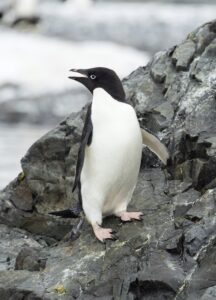
| Adélie penguin | Pygoscelis adeliae | Least Concern | Truly Antarctic; builds nests of stones |
| Chinstrap penguin | Pygoscelis antarcticus | Least Concern | Named for the thin black line under its chin; declining on the Peninsula |
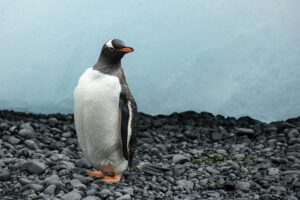
| Gentoo penguin | Pygoscelis papua | Least Concern | The fastest swimming penguin, reaching about 36 km/h; expanding south as the Peninsula warms |
| Macaroni penguin | Eudyptes chrysolophus | Vulnerable | Mostly sub-Antarctic, with a small population on the Peninsula |
The emperor penguin has one of the most extraordinary breeding cycles of any animal. Females lay a single egg in May or June, at the start of winter, and pass it to the male. He balances it on his feet under a fold of skin for about two months, fasting throughout, in temperatures that can fall below −40 °C with winds over 100 km/h. By the time the chick hatches and the female returns, he may have gone up to about four months without eating. Emperor penguins need stable sea ice until their chicks fledge in December or January; in 2022 several colonies in the Bellingshausen Sea lost almost all their chicks when the ice broke up early.
King penguins, the second-largest species, breed on sub-Antarctic islands such as South Georgia, where colonies at Salisbury Plain and St Andrews Bay hold hundreds of thousands of birds.
Seals
| Species | Scientific name | Notes |
|---|---|---|
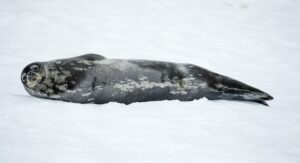
| Weddell seal | Leptonychotes weddellii | Breeds further south than any other mammal; keeps breathing holes open in the ice by grinding with its teeth; can dive over 600 m and stay under for over an hour |
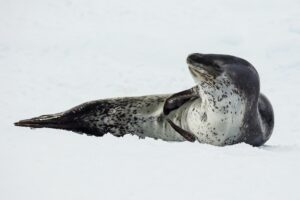
| Leopard seal | Hydrurga leptonyx | A top predator that hunts penguins, other seals and krill |
| Crabeater seal | Lobodon carcinophaga | Despite its name it eats krill, filtered through lobed teeth; possibly the most numerous seal on Earth |
| Ross seal | Ommatophoca rossii | Rarely seen, living in dense pack ice |
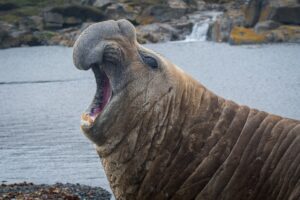
| Southern elephant seal | Mirounga leonina | The largest seal; males can weigh up to about 4 tonnes |
| Antarctic fur seal | Arctocephalus gazella | Hunted almost to extinction in the 19th century; now numbers in the millions, mostly on South Georgia |
Whales and dolphins
The Southern Ocean was the centre of industrial whaling in the twentieth century, when over 2 million whales were killed in the Southern Hemisphere. Many populations are now recovering.
- Antarctic blue whale, Critically Endangered as a subspecies. The largest animal ever known to have lived, up to about 30 m. Whaling reduced it to well under 1 percent of its original numbers; it is recovering slowly.
- Humpback whale, now common around the Antarctic Peninsula in late summer, where it feeds on krill using bubble nets.
- Antarctic minke whale, the most commonly seen baleen whale in the pack ice.
- Orca. Several distinct Antarctic types exist, including one that hunts seals by creating waves to wash them off ice floes.
- Southern right whale, fin whale and sperm whale, mainly further north.
Krill: the engine of the Southern Ocean
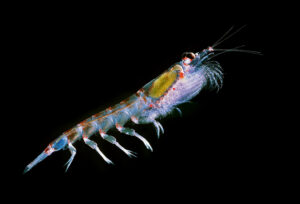
Antarctic krill (Euphausia superba) are small crustaceans about 6 cm long, and there are hundreds of millions of tonnes of them, making them one of the most abundant animals on Earth by biomass. They graze algae, including algae growing on the underside of sea ice, and almost every larger animal in the Southern Ocean depends on them directly or indirectly. A single blue whale can eat several tonnes of krill a day in summer. Krill also help store carbon by producing sinking faecal pellets.
Birds
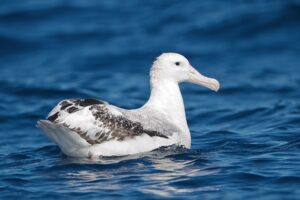
- Wandering albatross, Vulnerable, with the largest wingspan of any living bird, up to about 3.5 m. It can fly thousands of kilometres on a single foraging trip, barely flapping its wings.
- Snow petrel, a pure white bird that nests further inland than almost any other bird.
- South polar skua, which preys on penguin eggs and chicks and has been recorded near the South Pole.
- Southern giant petrel, cape petrel, Antarctic prion and Antarctic shag.
- Arctic tern, which travels from the Arctic to Antarctic waters each year, the longest regular migration of any animal.
Life on land
Only a few percent of Antarctica is free of ice, mostly along the coast and the Antarctic Peninsula. Here life is small: mosses, lichens, algae, two native flowering plants (Antarctic hair grass and Antarctic pearlwort), and invertebrates such as mites, springtails, nematode worms, tardigrades and the wingless midge Belgica antarctica, which can survive being frozen for months.
Visiting Antarctica
| Season | What to expect |
|---|---|
| November | Courtship and nest building; pristine snow and sea ice; seals on the ice |
| December to January | Penguin chicks hatch; almost 24-hour daylight; warmest months |
| February to March | Chicks fledge; best months for whale watching; fewer visitors |
Most visitors travel on expedition ships from Ushuaia in Argentina, crossing the Drake Passage in about two days to the Antarctic Peninsula. Others fly from Punta Arenas in Chile to King George Island. Longer voyages combine the Peninsula with the Falkland Islands and South Georgia. A smaller number of ships visit the Ross Sea from Hobart or New Zealand.
The International Association of Antarctica Tour Operators (IAATO) sets rules for responsible tourism: no more than 100 visitors ashore at a site at one time, ships carrying more than 500 passengers may not land anyone, and visitors must keep at least 5 m from wildlife. Boots and clothing are cleaned to avoid bringing seeds or diseases.
Conservation: threats and protections
The main threats
- Climate change. The Antarctic Peninsula has been one of the fastest-warming places on Earth. Antarctic sea ice reached record lows in 2023, threatening emperor penguins, Adélie penguins and krill.
- Krill fishing, which is increasing and can overlap with the feeding areas of penguins and whales.
- Disease. Highly pathogenic avian influenza (H5N1) reached the sub-Antarctic in 2023 and the Antarctic region in 2024, affecting seals and seabirds.
- Pollution and plastics, including microplastics now found in Antarctic snow and sea ice.
- Invasive species carried by visitors and research programmes.
Protections
- The Antarctic Treaty (1959) reserves the continent for peace and science, and the Madrid Protocol (1991) bans mining.
- The Commission for the Conservation of Antarctic Marine Living Resources (CCAMLR) manages fishing using an ecosystem-based approach.
- The Ross Sea Region Marine Protected Area, agreed in 2016, covers about 1.55 million km² and is one of the largest marine protected areas in the world.
- The International Whaling Commission’s moratorium on commercial whaling (from 1986) and the Southern Ocean Whale Sanctuary (1994).
For researchers
- Scientific Committee on Antarctic Research (SCAR), which coordinates international research.
- British Antarctic Survey, the Australian Antarctic Division, the US Antarctic Program and many national programmes.
- Ice cores such as EPICA Dome C, which preserve about 800,000 years of climate history.
- Data sources: SCAR Antarctic Biodiversity Portal, Mapping Application for Penguin Populations and Projected Dynamics (MAPPPD), CCAMLR fisheries data and GBIF.
Test yourself
How well do you know the wildlife of Antarctica? Take the quick quiz.
Frequently asked questions
What animals live in Antarctica? Penguins, seals, whales, seabirds, fish, krill and small invertebrates such as mites and midges. There are no land mammals.
Do polar bears live in Antarctica? No. Polar bears live only in the Arctic. Antarctica’s top predators are leopard seals and orcas.
What is the best time to visit Antarctica? November to March. December and January offer penguin chicks and long daylight; February and March are best for whales.
How many penguins live in Antarctica? Tens of millions of penguins breed in the Antarctic and sub-Antarctic region. Most of them are macaroni, Adélie, chinstrap and king penguins; emperors are far fewer, with roughly a quarter of a million breeding pairs.
Can anyone visit Antarctica? Yes, on regulated expedition cruises and flights. Around 100,000 or more tourists now visit each season.
Explore more
- Animal profiles: Emperor Penguin, Blue Whale, Orca, Leopard Seal
- Learn: Energy flow and food chains, Climate change ecology