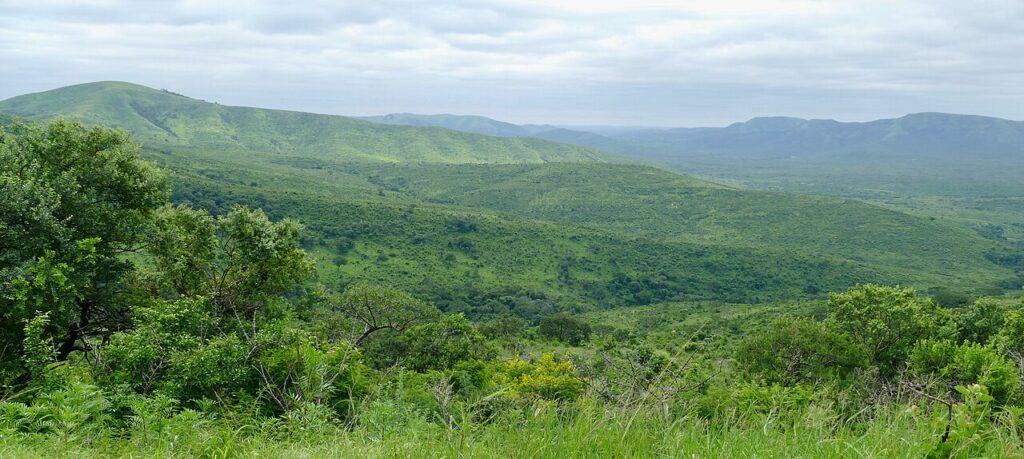
In northern KwaZulu-Natal, two very different protected areas lie just an hour apart. Hluhluwe-iMfolozi Park is a hilly Big Five reserve with a special place in conservation history: it is where the southern white rhino was saved from extinction. iSimangaliso Wetland Park, South Africa’s first UNESCO World Heritage Site, is a coastal world of lakes, estuaries, dunes, coral reefs and turtle beaches.
At a glance
| Best time | May to October for game viewing; November to March for turtles |
| Getting there | About 3 hours by road from Durban |
| Time needed | 3 to 5 nights for both |
| Big draws | White and black rhinos, hippos, turtles, whales |
| Good for | Self-drive safaris, combining bush and beach |
Hluhluwe-iMfolozi Park
Proclaimed in 1895, Hluhluwe-iMfolozi (often shortened to HiP) is one of the oldest protected areas in Africa and covers about 960 km².
- Rhinos: by the early 1900s, the southern white rhino had been reduced to perhaps a few dozen animals, most of them here. Careful protection, and from the 1960s “Operation Rhino”, which moved rhinos to parks across Africa, brought the species back. HiP is still one of the best places to see both white and black rhinos, although poaching remains a serious threat. See our white rhinoceros profile.
- Big Five: lions, leopards, elephants and buffalo also live here, along with wild dogs, cheetahs, giraffes and nyala.
- Wilderness trails: the iMfolozi wilderness area was one of Africa’s first areas set aside for walking-only wilderness trails, pioneered by Ian Player and Magqubu Ntombela.
- Self-drive friendly: good roads, hides at waterholes and affordable camps.
iSimangaliso Wetland Park
iSimangaliso stretches for about 280 km along the coast to the Mozambique border.
- Lake St Lucia estuary: boat cruises pass hippos and crocodiles; hippos even wander the streets of St Lucia town at night.
- Eastern and Western Shores: game drives among buffalo, leopards, rhinos, zebras and antelope beside the lake and forested dunes.
- Turtle nesting: from about November to March, loggerhead and leatherback turtles nest on the northern beaches. Guided night tours from licensed operators are the only way to watch. See our leatherback turtle profile.
- Whales: humpback whales pass from June to November, visible from shore and on licensed boat trips.
- Sodwana Bay: the southernmost coral reefs in Africa, with excellent diving and snorkelling. Coelacanths were found in deep canyons off Sodwana in 2000.
- Kosi Bay: lakes and traditional fish traps close to the Mozambique border.
When to go
- May to October (dry winter): best for game viewing in HiP, and whale season on the coast.
- November to March (summer): turtle nesting, lush landscapes, heat and humidity.
Getting there
HiP is about 3 hours north of Durban’s King Shaka airport, and St Lucia about 2.5 hours. Self-driving is easy, and many visitors combine the two with a few days in the Drakensberg or eSwatini.
Where to stay
HiP has Ezemvelo KZN Wildlife camps such as Hilltop and Mpila, plus private lodges near its boundaries. St Lucia town has guesthouses and hotels; there are also lodges and campsites across iSimangaliso.
Frequently asked questions
Is Hluhluwe-iMfolozi good for rhinos? Yes, it is one of the best places in Africa to see both white and black rhinos, especially on self-drive routes near waterholes.
Is there malaria in KwaZulu-Natal’s parks? Northern KwaZulu-Natal is a low-risk malaria area. Seek current medical advice before travel.
When can I see turtles at iSimangaliso? Nesting is from about November to February, with hatchlings from January to March. Only licensed night tours are allowed on the beaches.
Can I do both parks in one trip? Yes. They are about an hour apart, so three to five nights allows game drives in HiP and boat trips, beaches and turtles in iSimangaliso.
Related guides
- Best places to see rhinos in Africa
- Kruger self-drive guide
- The Sardine Run
- Animal profiles: White rhinoceros, Black rhinoceros, Hippopotamus
Cover photo: Bernard DUPONT from FRANCE, CC BY-SA 2.0, via Wikimedia Commons