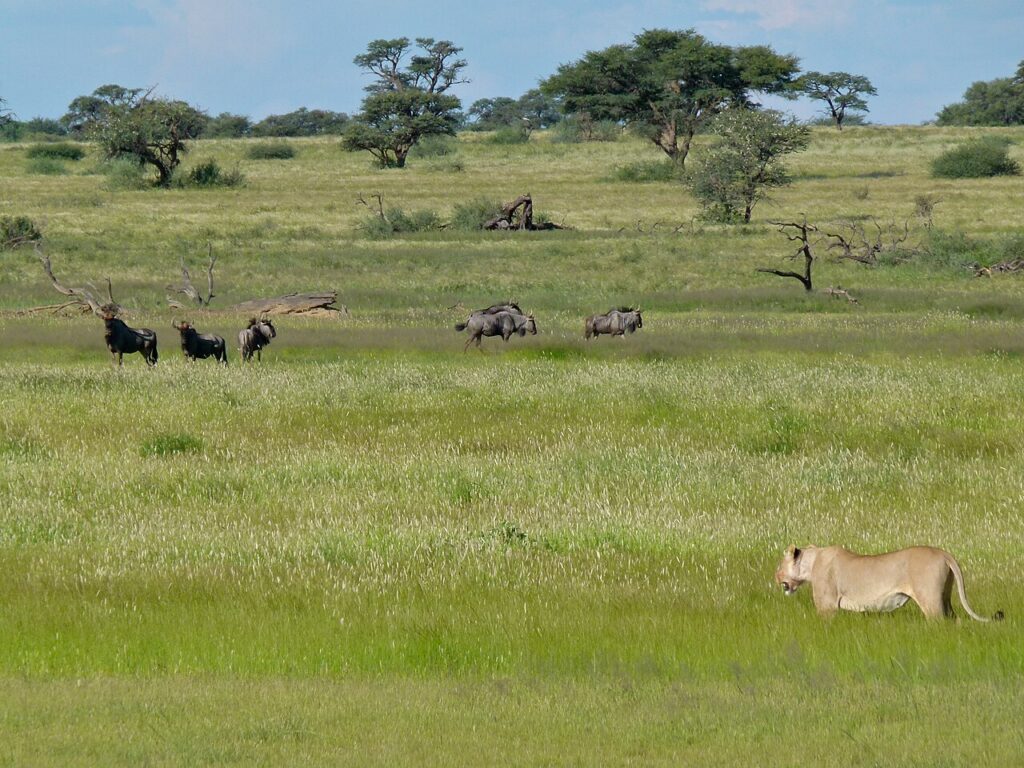
The Kgalagadi Transfrontier Park straddles South Africa and Botswana in the southern Kalahari. Formally opened in 2000 as Africa’s first transfrontier park, it covers more than 35,000 km² of red dunes and dry river valleys. Wildlife is less abundant than in wetter parks, but the open landscape makes predators easy to see and photograph, and the black-maned Kalahari lions are legendary.
At a glance
| Best time | March to May (after the rains) and June to August (cool and dry) |
| Getting there | About 3 hours by road from Upington, or 10 to 12 hours from Cape Town or Johannesburg |
| Time needed | 4 to 7 nights |
| Big draws | Black-maned lions, cheetahs, brown hyenas, raptors, meerkats |
| Good for | Self-drive safaris, photographers, wilderness lovers |
Wildlife highlights
- Lions: Kalahari lions are large, and males often have dark, black-fringed manes. See our lion profile.
- Cheetahs: the open riverbeds are among the best places in Africa to see cheetahs hunting. See our cheetah profile.
- Leopards, brown hyenas, spotted hyenas, caracals, bat-eared foxes and Cape foxes.
- Grazers: gemsbok (oryx), springbok, red hartebeest, blue wildebeest and eland gather in the riverbeds after rain.
- Meerkats and ground squirrels at their burrows.
- Raptors: martial eagles, bateleurs, secretary birds, pale chanting goshawks and owls. Huge sociable weaver nests hang in camelthorn trees.
The two riverbeds
Most driving follows two dry rivers, the Auob and the Nossob, which meet at Twee Rivieren. Waterholes along both roads, many solar-pumped, attract wildlife. The Auob road to Mata-Mata is known for cheetahs and lions; the longer Nossob road leads to the remote north.
When to go
- March to May: after the summer rains, the grass is green, antelope have young and predators are active. Many visitors consider this the best season.
- June to August: cool, dry days and very cold nights (below freezing). Animals concentrate at waterholes.
- September to November: hot and dry; good predator viewing at waterholes.
- December to February: very hot (often above 40°C), with dramatic afternoon storms.
Camps
- Rest camps: Twee Rivieren (the main camp at the entrance), Mata-Mata and Nossob have chalets, campsites, shops and fuel.
- Wilderness camps: small unfenced camps such as Kieliekrankie, Urikaruus, Grootkolk, Gharagab and Bitterpan, with a few units each, offer a real sense of solitude. They book up far ahead.
- Botswana side: basic campsites for self-sufficient 4×4 travellers.
Practical tips
- Book SANParks camps up to 11 months ahead, especially for school holidays.
- A 2WD car can manage the main riverbed roads; a 4×4 is needed for the Botswana side and some wilderness camps.
- Distances are long and speed limits low (50 km/h). Allow plenty of time to reach camp before the gates close.
- If you plan to enter in one country and leave through another (for example into Namibia at Mata-Mata), you must stay at least two nights in the park. Check current border rules.
- Carry extra water and food, and fill up with fuel at every camp.
Frequently asked questions
Is the Kgalagadi good for a first safari? It suits travellers who enjoy long, patient drives and open landscapes. For the widest variety of animals in a short time, Kruger may be better; for predators and photography, the Kgalagadi is superb.
Do I need a 4×4? Not for the main roads on the South African side. A 4×4 is required for the Botswana side and certain camps.
Are there elephants in the Kgalagadi? No. The park has no elephants, rhinos or buffalo; its highlights are predators, antelope and birds.
How many days do I need? At least four nights, ideally a week, split between the Auob and Nossob areas.
Related guides
- Where to see cheetahs in the wild
- Central Kalahari Game Reserve
- Namibia self-drive itinerary
- Animal profiles: Lion, Meerkat, Gemsbok
Cover photo: Bernard DUPONT from FRANCE, CC BY-SA 2.0, via Wikimedia Commons