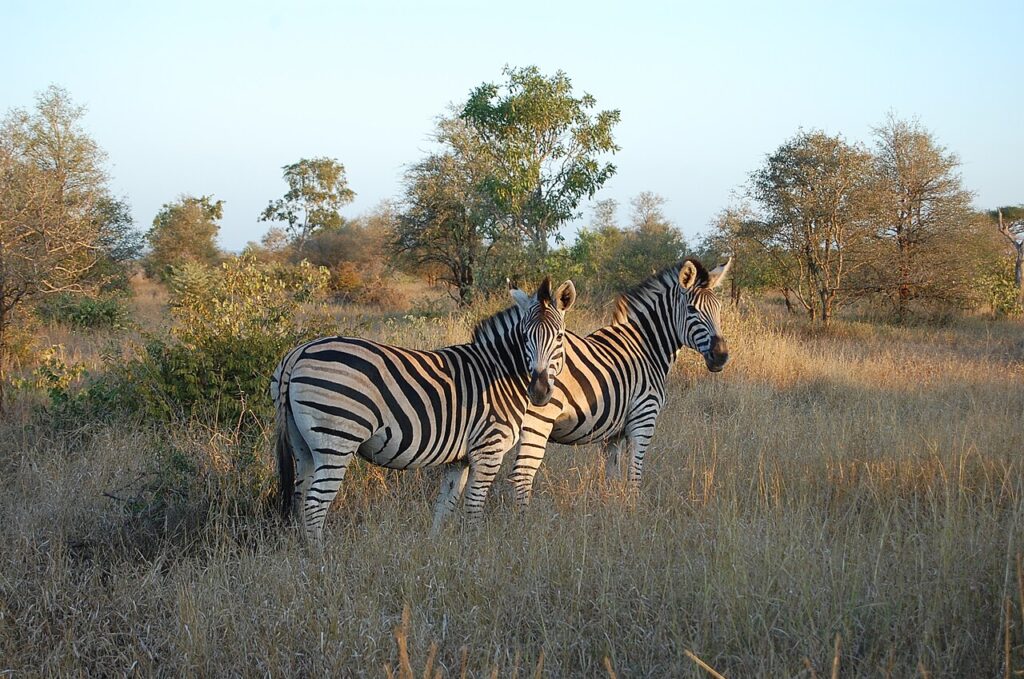
Kruger National Park in South Africa is one of the few great African parks where you can safari independently in your own car, on good roads, staying in affordable rest camps. It holds the Big Five and more than 140 mammal species, and it is a superb choice for a first safari, families and travellers on a budget.
Kruger at a glance
| Location | Northeastern South Africa, bordering Mozambique |
| Area | About 19,500 km², roughly 350 km from north to south |
| Best for | Self-drive safaris, the Big Five, value |
| Best time | May to September (dry winter) |
| Conservation fee | R602 per international adult per day (1 November 2025 to 31 October 2026) |
| Nearest airports | Kruger Mpumalanga International (Nelspruit), Skukuza, Hoedspruit, Phalaborwa |
Regions of the park
- The south (Skukuza, Lower Sabie, Crocodile Bridge, Berg-en-Dal, Pretoriuskop): the most wildlife and the most visitors. Excellent for lions, leopards, rhinos and elephants. The H4-1 along the Sabie River and the S28 and H4-2 near Lower Sabie are famous roads.
- The centre (Satara, Olifants, Orpen): open grassy plains with large herds and many lions and cheetahs. Olifants camp has spectacular river views.
- The north (Letaba, Mopani, Shingwedzi, Punda Maria, Pafuri): quieter and wilder, with big elephant bulls, baobabs and excellent birding around Pafuri.
With a week, many visitors spend a few nights in the south and a few in the centre.
Where to stay
- Main rest camps offer cottages, huts, safari tents and campsites, with shops, restaurants and fuel. Skukuza is the largest.
- Bushveld camps are smaller and quieter, without shops or restaurants.
- Satellite camps and bush lodges for groups.
- Private lodges and concessions inside Kruger and in the adjoining private reserves, such as the Sabi Sands and Timbavati, offer guided game drives, off-road tracking and walking.
Book SANParks accommodation well in advance, especially for school holidays; popular camps sell out many months ahead.
Rules of the road
- Gate and camp times: you must be inside a camp or out of the park by gate closing time, which changes with the season. Arriving late can lead to a fine.
- Speed limits: 50 km/h on tar and 40 km/h on gravel roads.
- Stay in your vehicle except at designated spots, and keep arms and heads inside.
- Do not feed animals or litter.
- Do not drive off-road.
How to find wildlife on your own
- Go out early and late. The first two hours after gates open and the last two before closing are best.
- Drive slowly, around 20 to 30 km/h, and scan both sides.
- Follow the water. Rivers, dams and waterholes are wildlife magnets in the dry season.
- Check the sightings boards at rest camps, and ask other visitors.
- Look for clues: vultures circling, stopped cars, alarm calls from impala and baboons.
- Book guided activities such as sunrise walks and night drives run by SANParks for experiences you cannot do alone.
- Bring binoculars for everyone and a field guide or app.
When to go
- May to September: winter dry season. Vegetation thins and animals gather at water. Days are warm, early mornings cold.
- October to November: hot, with the first rains; animals give birth.
- December to March: summer rains, lush green bush, migrant birds and newborn animals, but denser vegetation and higher malaria risk.
Health and safety
Kruger is in a malaria area, with the highest risk during the wet summer months. Take advice from a travel clinic. Stay alert on roads and never approach elephants closely, especially bulls in musth or breeding herds with calves.
Costs
A self-drive Kruger safari can be excellent value. Main costs are car hire, accommodation (from campsites to cottages), fuel, food and the daily conservation fee. The Wild Card annual pass can save money for longer or repeat visits to South African parks.
Suggested itinerary (7 days)
- Days 1–3: Lower Sabie (Sabie River, Crocodile River and the southern plains).
- Days 4–5: Satara (central plains, lions and cheetahs).
- Days 6–7: Olifants or Letaba, then exit via Phalaborwa or return south.
Frequently asked questions
Is it safe to self-drive in Kruger? Yes, if you follow park rules: stay in your vehicle except at designated points, respect speed limits and gate times, and keep a safe distance from animals.
Do I need a 4×4 for Kruger? No. Most main roads are tarred, and gravel roads are suitable for normal cars in dry weather.
How many days do I need in Kruger? Four to seven days allows you to explore the southern and central regions. Add more time to reach the far north.
Can I see the Big Five on a self-drive? Yes. Lions, elephants and buffalo are common; leopards and rhinos need more luck. Early morning drives give the best chances.
Related guides
- Where to see the Big Five in Africa
- First African safari planning guide
- How much does a safari cost?
- Animal profiles: African Elephant, Leopard, White Rhinoceros
Cover photo: Nithin bolar k, CC BY-SA 3.0, via Wikimedia Commons