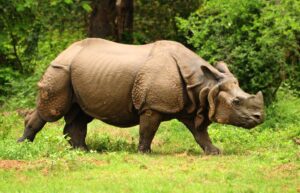
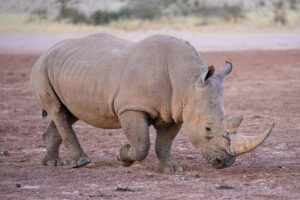
The black rhino is the smaller of Africa’s two rhinos. Once found across much of sub-Saharan Africa, it was devastated by poaching for its horn in the late twentieth century. Translocation to secure sanctuaries, armed protection and community conservation have driven a slow recovery.
Interesting facts
- Black and white rhinos are both grey; the names do not describe colour.
- The black rhino’s pointed lip is adapted for browsing, while the white rhino’s square lip suits grazing.
- Black rhinos are solitary and more aggressive than white rhinos.
- Calves run behind their mothers, whereas white rhino calves run ahead.
- Desert-adapted black rhinos in Namibia survive with very little water.
- Around 6,000 or more black rhinos survive today.
Behaviour
Black rhinos are mostly solitary and browse at dawn, dusk and night. They have poor eyesight but excellent hearing and smell, and communicate through dung middens and urine spraying.
Breeding and young
Females give birth to a single calf after about 15 months and usually calve every two and a half to four years.
Threats and conservation
Poaching for horn, small and fragmented populations, and habitat loss.
Where to see it
- Etosha National Park and Damaraland, Namibia
- Hluhluwe-iMfolozi, South Africa
- Ngorongoro Crater, Tanzania
- Ol Pejeta and Lewa, Kenya
- Akagera, Rwanda
Status source: IUCN Red List. Profile last reviewed September 2026.
Where to see the black rhinoceros
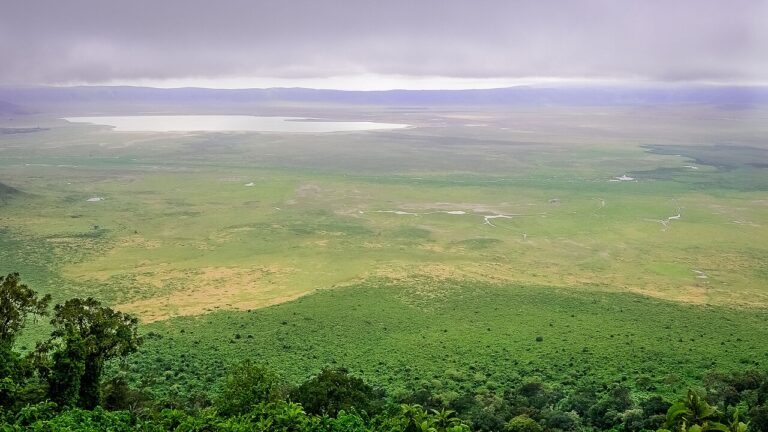 Ngorongoro Crater Guide: Africa’s Garden of EdenA collapsed volcano packed with lions, rhinos, elephants and flamingos. How to plan the perfect crater day and…
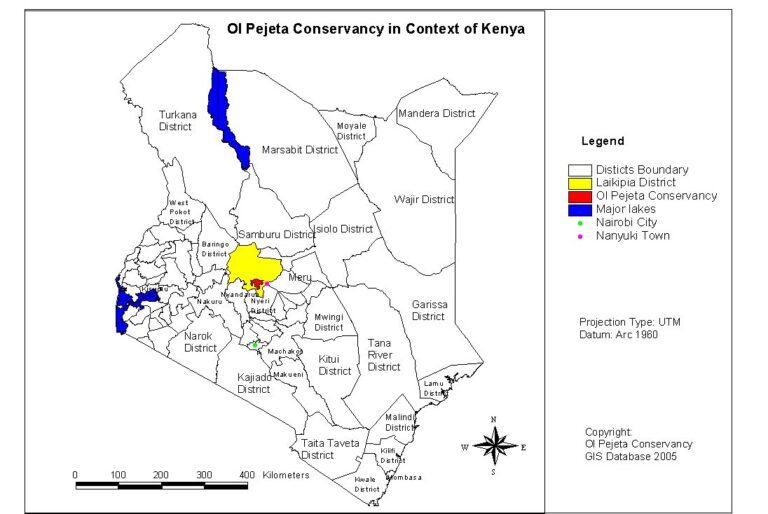 Laikipia and Ol Pejeta: Rhinos, Wild Dogs and Walking SafarisKenya's Laikipia Plateau is a patchwork of private and community conservancies with rhinos, wild dogs, night drives and…
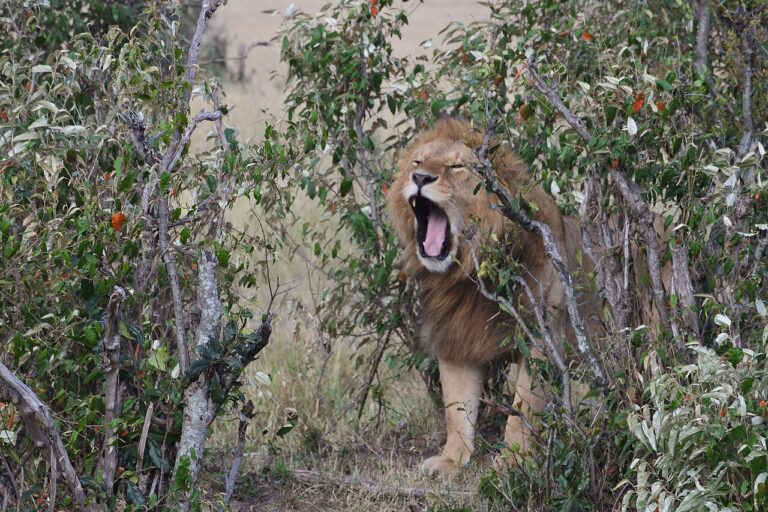 Nairobi National Park: A Safari on the City’s EdgeWhere else can you watch rhinos and lions with skyscrapers on the horizon? How to make the most…