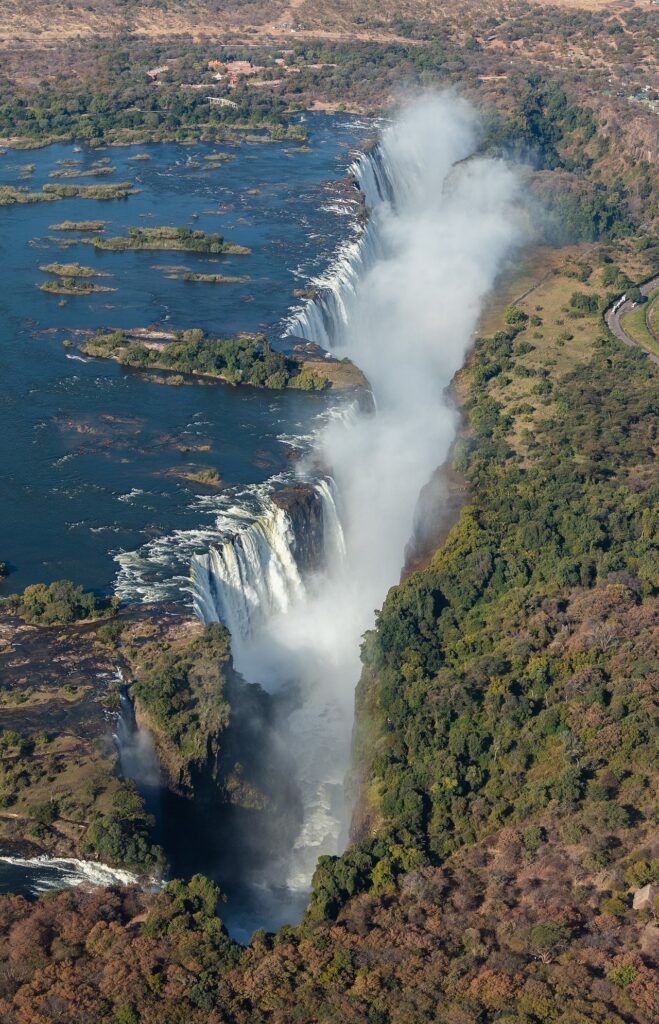
Victoria Falls, known locally as Mosi-oa-Tunya (“the smoke that thunders”), is where the Zambezi River plunges about 108 metres into a narrow chasm along a front of about 1.7 km. It is the largest sheet of falling water in the world and a UNESCO World Heritage Site shared by Zimbabwe and Zambia. It is also the natural starting point for safaris in Chobe, Hwange, the Okavango and the Lower Zambezi.
At a glance
| Best time | February to May for the fullest falls; June to October for safaris and clearer views |
| Getting there | Airports at Victoria Falls (Zimbabwe) and Livingstone (Zambia) |
| Time needed | 2 to 3 nights |
| Big draws | The falls, river cruises, rhino walks, adventure activities |
| Good for | Starting or ending a southern Africa safari |
Seeing the falls
- Zimbabwe side: a rainforest trail with about 16 viewpoints faces most of the falls, including the Main Falls.
- Zambia side: closer views of the Eastern Cataract, the Knife-Edge Bridge and, in low water, access to Livingstone Island.
- Devil’s Pool: a natural rock pool on the lip of the falls, reached from Livingstone Island when the water is low (roughly August to January), only with licensed guides.
- From the air: helicopter and microlight flights give the best overall view.
When the water is high or low
- February to May: peak flow after the rains. The spray is enormous, sometimes hiding the falls and soaking you completely.
- June to August: still impressive, with clearer views and less spray.
- September to December: lowest water; parts of the Zambian side can be almost dry, but the Zimbabwean side still flows and Devil’s Pool is open.
Wildlife experiences
- Sunset cruises on the upper Zambezi pass hippos, crocodiles, elephants and many birds.
- Rhino walks in Zambia’s Mosi-oa-Tunya National Park, where armed rangers guard a small population of white rhinos that you can view on foot.
- Zambezi National Park (Zimbabwe): game drives just upstream of the town, with elephants, buffalo, sable and occasionally lions.
- Vulture feeding: a lodge in Victoria Falls town runs a daily vulture feeding linked to conservation and research.
- Batoka Gorge: raptors such as the rare Taita falcon and Verreaux’s eagle nest on the cliffs.
Adventure activities
White-water rafting (best from about August to December), bungee jumping from the Victoria Falls Bridge, gorge swings, zip lines and kayaking.
Ethical choices
Avoid elephant-back rides and “walking with lions” experiences, which rely on captive animals and have been linked to the lion breeding industry. Choose wildlife experiences that observe wild animals in their natural habitat. See our guide to wildlife tourism to avoid.
Visas
The KAZA UNIVISA, when available, covers Zambia and Zimbabwe and day trips to Botswana’s Chobe National Park. Check current visa rules before travelling.
Combining with a safari
- Chobe (Botswana): about 1.5 hours by road. See our Chobe guide.
- Hwange (Zimbabwe): about 2 hours. See our Hwange guide.
- Okavango Delta: via Kasane or a short flight to Maun.
- Lower Zambezi and South Luangwa (Zambia): via Lusaka.
Frequently asked questions
Which side of Victoria Falls is better? The Zimbabwe side has more of the falls in view. The Zambia side offers closer views and Devil’s Pool. If you can, see both.
When is the best time to visit Victoria Falls? For the biggest flow, March to May. For clearer views and safaris, June to October.
Can I see wildlife at Victoria Falls? Yes, on river cruises, rhino walks and game drives in nearby parks.
Is Devil’s Pool safe? It is only open in low water and with licensed guides who manage safety, but it carries some risk.
Related guides
- Chobe National Park guide
- Hwange National Park guide
- Wildlife tourism to avoid
- Animal profiles: Hippopotamus, White rhinoceros, African elephant
Cover photo: Diego Delso, CC BY-SA 4.0, via Wikimedia Commons