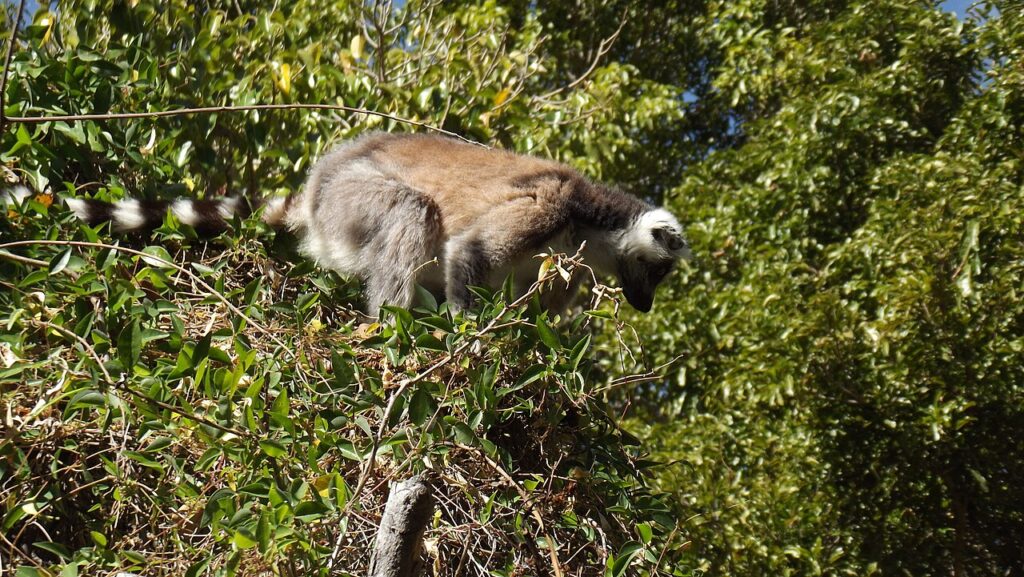
Madagascar split from the Indian subcontinent around 88 million years ago and has evolved in isolation ever since. The result is one of the most distinctive wildlife destinations on Earth. Roughly 90 percent of its plants and animals are found nowhere else. More than 100 species of lemur live here, along with around half of the world’s chameleon species, the puma-like fossa and six of the world’s eight baobab species. Travel here is slower and more adventurous than on a classic safari, but it is unforgettable.
Madagascar at a glance
| Best time | April to November (dry season); October and November for baby lemurs |
| Avoid | January to March (cyclone season, flooded roads, some lodges close) |
| Trip length | 12 to 18 days for a varied route |
| Gateway | Ivato International Airport, Antananarivo |
| Getting around | Private car and driver, domestic flights; roads are slow |
| Guides | Local guides are compulsory in national parks |
The best places to see wildlife
Andasibe-Mantadia National Park (east)
Three to four hours east of Antananarivo, this is the easiest rainforest park to reach and the best place to hear and see the indri, the largest living lemur. Indri families sing a haunting, wailing song that carries for kilometres at dawn. Other species include the diademed sifaka, the common brown lemur and the tiny mouse lemurs seen on night walks. Look for Parson’s chameleon, leaf-tailed geckos and the Madagascar tree boa.
Ranomafana National Park (south-central highlands)
Ranomafana is a misty montane rainforest created partly to protect the golden bamboo lemur, discovered in 1986. It is also home to the greater bamboo lemur, the Milne-Edwards’s sifaka and many frogs and chameleons. The trails are steep and slippery, but the biodiversity is superb.
Isalo National Park (south)
Isalo is a dramatic landscape of sandstone canyons, natural pools and grassland. Ring-tailed lemurs and Verreaux’s sifakas are found in the canyons, and the scenery makes it a highlight of the popular road trip along RN7.
Berenty Reserve (far south)
This private reserve in spiny forest near Fort Dauphin is famous for its habituated ring-tailed lemurs and for Verreaux’s sifakas that bound sideways across open ground on their hind legs, the so-called “dancing” lemurs.
Kirindy Forest and the Avenue of the Baobabs (west)
Kirindy’s dry deciduous forest is the best place in Madagascar to see the fossa, the island’s largest predator, especially during its mating season in October and November. At night you may find the giant jumping rat and the world’s smallest primate, Madame Berthe’s mouse lemur. Nearby, the Avenue of the Baobabs near Morondava is the island’s most photographed sunset.
Tsingy de Bemaraha (west)
A UNESCO World Heritage Site of razor-sharp limestone pinnacles, with suspension bridges, caves and lemurs such as Decken’s sifaka. Access is only possible in the dry season.
Masoala and Nosy Mangabe (northeast)
Wild, remote rainforest meeting the sea. This is the best area to look for the red ruffed lemur and, with luck, the elusive aye-aye. Humpback whales gather in Antongil Bay from about July to September.
Ankarana, Amber Mountain and Nosy Be (north)
The north offers tsingy, caves and crowned lemurs at Ankarana, dense forest and the tiny Brookesia leaf chameleons at Amber Mountain, and beaches, reefs and black lemurs on and around Nosy Be.
Wildlife highlights
- Lemurs: indri, sifakas, ring-tailed, ruffed, bamboo and mouse lemurs, plus the aye-aye.
- Chameleons: from the huge Parson’s chameleon to the colourful panther chameleon and the fingertip-sized Brookesia.
- Fossa: a cat-like carnivore related to mongooses.
- Reptiles and amphibians: leaf-tailed geckos, tree boas, tomato frogs and colourful mantella frogs.
- Birds: around 300 species, many endemic, including vangas, couas and ground-rollers.
- Marine life: humpback whales, whale sharks around Nosy Be (roughly September to December) and coral reefs.
Suggested two-week route
- Days 1–3: Antananarivo, then Andasibe for indri and night walks.
- Days 4–9: south along RN7 via Antsirabe to Ranomafana, Anja Community Reserve (ring-tailed lemurs) and Isalo.
- Days 10–11: continue to the coast at Ifaty or Anakao for spiny forest and beaches, or fly back to the capital.
- Days 12–14: fly to Morondava for Kirindy and the Avenue of the Baobabs.
Keep your plan realistic. A 400 km drive can take a full day.
Practical tips
- Hire a reputable local operator with a driver-guide. Self-driving is not recommended because of road conditions.
- Book domestic flights with flexibility, as schedules change often.
- Night walks are essential for mouse lemurs, chameleons and frogs. Take a good headlamp.
- Bring cash in euros or US dollars to exchange for ariary; card acceptance is limited outside cities.
- Health: take malaria precautions and use insect repellent.
- Do not handle wildlife. Some roadside stalls offer chameleons or lemurs for photos. This encourages illegal capture.
Conservation
Madagascar has lost a large share of its original forest to slash-and-burn agriculture, logging and charcoal production. In its 2020 assessment, the IUCN found that about 98 percent of lemur species are threatened with extinction, with nearly a third Critically Endangered. Visiting community reserves and national parks with local guides puts money directly into conservation and gives local people a reason to protect forests.
Frequently asked questions
Is Madagascar good for a first-time wildlife trip? Yes, if you enjoy adventure. Wildlife is spectacular and easy to see with guides, but roads are slow, and facilities outside the main parks can be basic. A good local operator makes a big difference.
How many days do I need in Madagascar? At least 12 to 14 days to combine the rainforests of the east, the RN7 road trip south and one other region. Three weeks allows a more relaxed pace.
Can you see lemurs without going on a tour? You can visit parks independently, but a local guide is compulsory inside national parks. Guides also find far more wildlife than you would alone.
When is the best time to see baby lemurs? Most lemurs give birth between about September and November, depending on the species, so October and November are good months to see young.
Related guides
- Wildlife of Africa
- Responsible wildlife tourism
- Wildlife photography for beginners
- Animal profiles: Panther Chameleon, Whale Shark, Humpback Whale
Cover photo: Smiley.toerist, CC BY-SA 4.0, via Wikimedia Commons