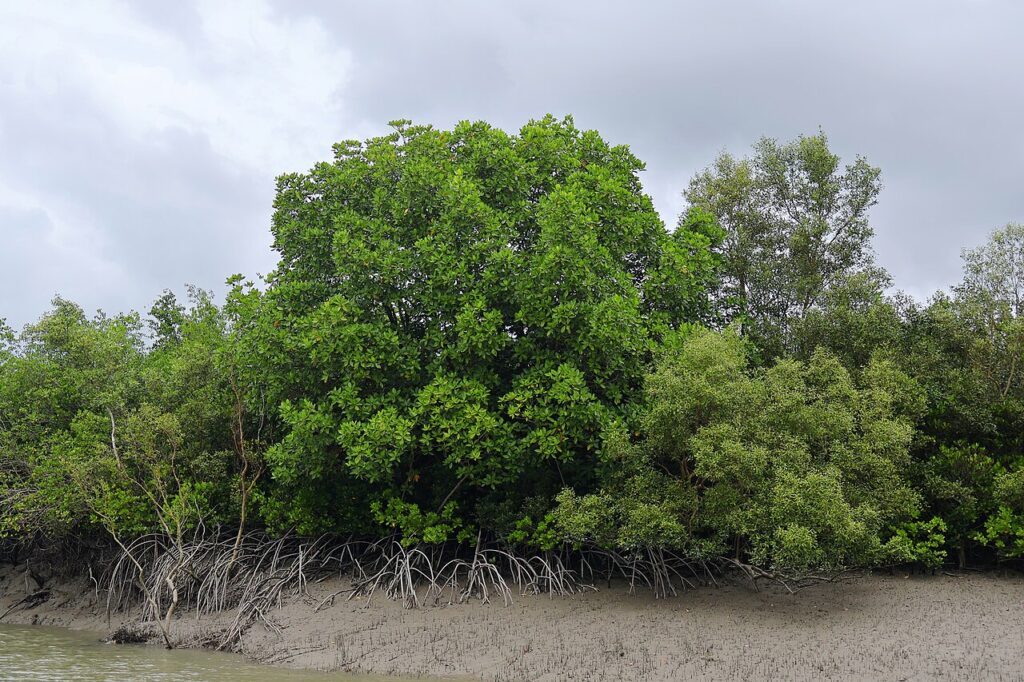
The Sundarbans, spread across India and Bangladesh at the mouths of the Ganges, Brahmaputra and Meghna rivers, is the largest mangrove forest in the world, covering about 10,000 km². Tidal rivers, creeks and islands form a labyrinth where Bengal tigers have adapted to a life of swimming, drinking brackish water and hunting in the mud. Both the Indian and Bangladeshi parts are UNESCO World Heritage Sites.
At a glance
| Best time | November to February |
| Getting there | India: about 3 hours by road from Kolkata to the boat jetty. Bangladesh: from Khulna or Mongla |
| Time needed | 2 to 4 days on a boat |
| Big draws | Mangrove landscapes, tigers (rarely seen), crocodiles, dolphins, birds |
| Good for | Adventurous travellers, birders, photographers |
Tigers
- The Sundarbans holds one of the world’s largest tiger populations in a single forest, split between India and Bangladesh. See our tiger profile.
- Sightings are rare, because the tigers live in dense mangroves and visitors must stay on boats or in fenced watchtowers. Many visitors see pugmarks on the mud but not the cat itself. Treat a sighting as a bonus.
- Human–tiger conflict is a serious issue: honey collectors, fishers and woodcutters who enter the forest are sometimes killed. Villagers pray to Bonbibi, the forest goddess, for protection.
Other wildlife
- Saltwater crocodiles basking on mudbanks. See our saltwater crocodile profile.
- Irrawaddy and Gangetic dolphins in the rivers.
- Water monitor lizards, spotted deer, wild boar, rhesus macaques and fishing cats. See our fishing cat profile.
- Birds: kingfishers (including brown-winged and collared kingfishers), lesser adjutants, white-bellied sea eagles and the elusive masked finfoot.
- Mudskippers and fiddler crabs on the mudflats. See our mudskipper profile.
How to visit
India (Sundarban Tiger Reserve, West Bengal)
- Trips usually start from Godkhali or other jetties about 3 hours from Kolkata.
- Visitors travel by boat along permitted channels and stop at fenced watchtowers such as Sajnekhali, Sudhanyakhali and Dobanki, where a canopy walk crosses the mangroves.
- Permits are required; operators arrange them.
- Stays are in lodges on the islands or on overnight boats.
Bangladesh (Sundarbans reserve forests)
- Multi-day boat trips leave from Khulna or Mongla and visit areas such as Kotka and Kochikhali, where guided walks are possible with armed guards.
- The Bangladeshi side is larger and more remote.
When to go
- November to February: cool, dry and pleasant; the best time.
- March to May: hot and humid; tigers may come to freshwater ponds, but the heat is intense.
- June to October: monsoon and cyclone season; many trips stop.
Tips
- Choose a reputable operator with good boats and experienced naturalists.
- Bring binoculars, sun protection and insect repellent.
- Do not expect to see a tiger; enjoy the mangroves, birds and river life.
- Respect local communities and their relationship with the forest.
Frequently asked questions
Can you see tigers in the Sundarbans? Yes, but rarely. The dense mangroves and rules requiring visitors to stay on boats make sightings uncommon.
Is the Sundarbans worth visiting? Yes, for the unique landscape, boat journeys, birds and river life. Go with realistic expectations about tigers.
Which side is better, India or Bangladesh? The Indian side is easier to reach from Kolkata. The Bangladeshi side is larger, wilder and allows some guided walks.
Do Sundarbans tigers really swim? Yes. They swim between islands and across wide channels, sometimes for several kilometres.
Related guides
- Best places to see tigers in India
- Tiger safari in India vs Nepal
- Kaziranga National Park
- Animal profiles: Tiger, Saltwater crocodile, Fishing cat
Cover photo: Kingshuk Mondal, CC BY 4.0, via Wikimedia Commons