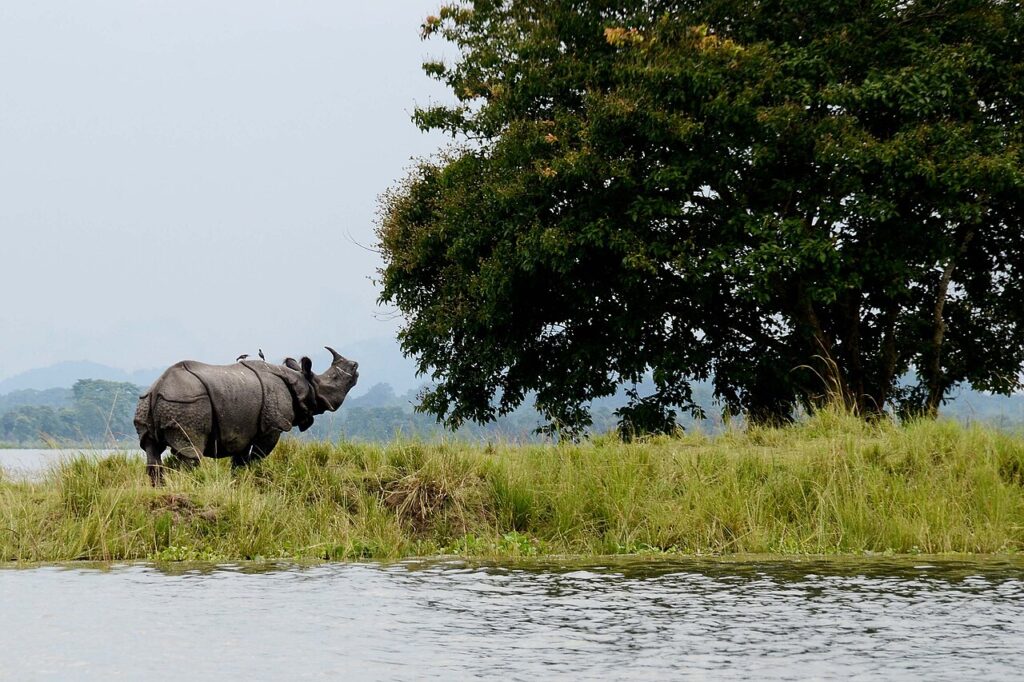
Kaziranga National Park lies on the floodplain of the Brahmaputra River in Assam, northeast India. Its tall elephant grass, marshes and forests are home to about two-thirds of the world’s greater one-horned rhinoceroses. The 2022 census counted 2,613 rhinos in the park. Kaziranga also has one of the highest tiger densities of any protected area, the world’s largest population of wild water buffalo and large herds of Asian elephants. It was declared a UNESCO World Heritage Site in 1985 and a tiger reserve in 2006.
Kaziranga at a glance
| Location | Golaghat and Nagaon districts, Assam, India |
| Best time | November to April; February to April for the best visibility as grass is burned or dries |
| Closed | Usually May to October for the monsoon and floods |
| Safaris | Jeep safaris in four ranges, morning and afternoon |
| Gateways | Jorhat Airport (about 2 hours), Guwahati (about 4 to 5 hours) |
| Famous for | One-horned rhinos, wild water buffalo, swamp deer, tigers, grassland birds |
Safari ranges
Kaziranga is divided into four main tourist ranges, each with its own character:
- Central Range (Kohora): the most popular, with open grassland, wetlands and a high density of rhinos, buffalo and elephants.
- Western Range (Bagori): short grasslands and wetlands with excellent rhino and buffalo viewing. It is often the best for photography.
- Eastern Range (Agaratoli): large wetlands such as Sohola beel, with outstanding birdlife, including pelicans and storks.
- Burapahar Range: forested hills in the west, with fewer visitors and chances of primates and forest birds.
Book at least three drives in different ranges.
Wildlife highlights
- Greater one-horned rhinoceros: seen on almost every drive. Rhinos wallow in marshes, graze in grassland and sometimes charge vehicles.
- Tigers: present in high density but hard to see in the tall grass; sightings are a bonus.
- Wild water buffalo: a majority of the world’s remaining wild population lives here.
- Eastern swamp deer (barasingha), hog deer, sambar and wild boar.
- Asian elephants, often in large family groups near water.
- Ganges river dolphins in the Brahmaputra.
- Primates in nearby forests: hoolock gibbons (India’s only ape) at Hollongapar Gibbon Sanctuary near Jorhat, as well as capped langurs.
Birding in Kaziranga
Kaziranga is an Important Bird Area with around 480 recorded species. The grasslands support rare species such as the Bengal florican, swamp francolin and finn’s weaver. The wetlands draw spot-billed pelicans, greater adjutant storks, black-necked storks and huge numbers of migratory waterfowl in winter. Forest areas hold hornbills, woodpeckers and barbets.
Floods and conservation
Every monsoon, the Brahmaputra floods much of the park, renewing its grasslands and wetlands. Animals move to artificial highlands built inside the park and to the Karbi Anglong hills to the south, crossing National Highway 715. Speed limits and wildlife corridors help reduce road deaths. Kaziranga’s rhinos have recovered from perhaps only a few dozen animals in the early 20th century, but poaching for rhino horn remains a constant threat. Heavily armed forest guards patrol the park.
A note on elephant-back safaris
Elephant-back safaris have long been offered in Kaziranga. Many welfare organisations now advise against riding elephants because of concerns about training and captivity. Jeep safaris provide excellent viewing without these issues.
Where to stay
Most lodges are along the highway near Kohora (Central Range) and Bagori (Western Range). They range from simple guesthouses to eco-resorts and tea-estate bungalows. Stay near your chosen range to save time.
Getting there
- Jorhat Airport: about 95 km from Kohora.
- Guwahati (Lokpriya Gopinath Bordoloi International Airport): about 200 km, roughly 4 to 5 hours by road.
- Rail: Furkating station is the nearest major railhead.
Tips
- Take morning drives for mist and soft light.
- Bring binoculars. The grasslands are huge, and many animals are distant.
- Combine Kaziranga with Manas National Park (golden langurs, pygmy hogs), Nameri (river birding) or Majuli river island.
- Follow park rules and never leave your vehicle. Rhinos and wild buffalo are dangerous.
Frequently asked questions
Will I definitely see a rhino in Kaziranga? Almost certainly. Kaziranga holds more than 2,600 greater one-horned rhinos, and most visitors see several on each drive.
Can I see tigers in Kaziranga? Tigers are present at high density, but the tall grass makes them hard to see. Consider any sighting a bonus.
How many days do I need in Kaziranga? Two to three days allows drives in the Central, Western and Eastern ranges, which have different landscapes and wildlife.
When does Kaziranga open? The park usually opens around November and closes around the end of April, depending on flood conditions. Check dates before travelling.
Related guides
- Best places to see tigers in India
- Chitwan National Park safari guide
- Birdwatching in Nepal
- Animal profiles: Greater One-horned Rhinoceros, Tiger, Asian Elephant
Cover photo: Diganta Talukdar, CC BY-SA 4.0, via Wikimedia Commons