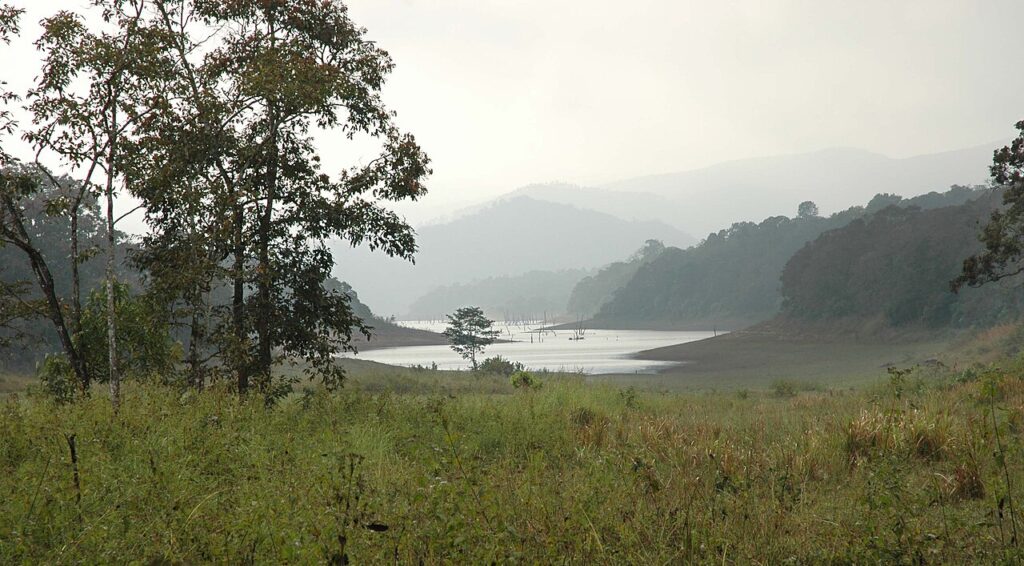
The Western Ghats, a chain of mountains running down India’s west coast, are older than the Himalayas and one of the world’s biodiversity hotspots. Their rainforests and grasslands hold thousands of species found nowhere else, from lion-tailed macaques to purple frogs. In Kerala, Periyar Tiger Reserve and the hills around Munnar are the easiest places to explore them.
At a glance
| Best time | October to March (also April to May for some wildlife) |
| Getting there | Periyar is about 4 to 5 hours by road from Kochi or Madurai |
| Time needed | 4 to 6 days for Periyar, Munnar and a birding site |
| Big draws | Elephants, Nilgiri tahr, lion-tailed macaques, endemic birds |
| Good for | Families, birders, combining with Kerala’s backwaters |
Periyar Tiger Reserve
Periyar covers about 925 km² around an artificial lake created by a dam in 1895.
- Boat safaris on Periyar Lake are the classic experience: elephants, gaur, sambar and wild boar come to the water’s edge. See our Asian elephant profile.
- Guided nature walks, bamboo rafting and border hikes, run through community-based eco-tourism programmes that employ former poachers and forest-dependent people, are a highlight. You may see Nilgiri langurs, Malabar giant squirrels and many birds on foot.
- Tigers are present but very rarely seen. Leopards, dholes and sloth bears are also present.
Munnar and Eravikulam National Park
- Eravikulam National Park protects the largest population of the Nilgiri tahr, an endangered mountain goat found only in the Western Ghats. The tahr are habituated in the visitor zone and easy to see.
- Rolling tea estates and shola forests surround Munnar and are excellent for birds.
- Eravikulam usually closes for a few months in the calving season (around February to April); check dates.
Other sites
- Thattekad Bird Sanctuary: one of India’s best birding sites, famous for the Sri Lanka frogmouth, Malabar trogon and many Western Ghats endemics.
- Chinnar Wildlife Sanctuary: dry forest in the rain shadow, with grizzled giant squirrels and star tortoises.
- Silent Valley and the Anamalai hills (Valparai): lion-tailed macaques in rainforest fragments.
- Nagarhole, Bandipur and Mudumalai further north: excellent for elephants, gaur, dholes and tigers.
Endemic wildlife
- Lion-tailed macaque: a black macaque with a silver mane, found only in the Western Ghats.
- Birds: Malabar grey hornbill, Nilgiri flycatcher, white-bellied treepie, Malabar whistling thrush and dozens more.
- Amphibians: the Western Ghats are home to hundreds of frog species, many only described in recent decades.
When to go
- October to March: pleasant weather and good birding.
- April to May: hot; animals gather at water in Periyar.
- June to September: heavy monsoon rain; lush, but leeches and closures.
Getting there
Kochi and Madurai airports are the gateways. Periyar (Thekkady) is about 4 to 5 hours by road from either, and Munnar is about 3 hours from Thekkady.
Frequently asked questions
Can you see tigers in Periyar? Rarely. Periyar is better for elephants, gaur and forest walks. For tigers, visit Nagarhole, Bandipur or the central Indian parks.
What is special about the Western Ghats? They are a biodiversity hotspot with thousands of endemic species, including many frogs, birds and plants found nowhere else.
Where can I see Nilgiri tahr? In Eravikulam National Park near Munnar.
Is Periyar good for families? Yes. Boat safaris, gentle walks and bamboo rafting suit families.
Related guides
- Best places to see tigers in India
- Asian elephants: choosing an ethical experience
- Yala National Park
- Animal profiles: Asian elephant, Gaur, Great hornbill
Cover photo: Wouter Hagens, Public domain, via Wikimedia Commons