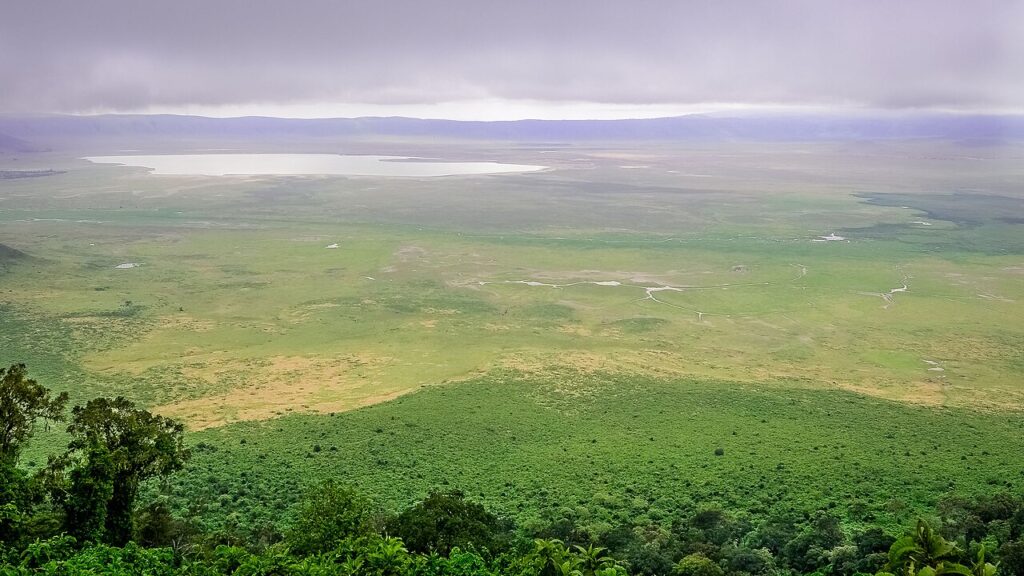
Ngorongoro Crater in northern Tanzania is the world’s largest unbroken, unflooded volcanic caldera. It formed two to three million years ago, when a huge volcano collapsed in on itself. Today its floor, about 260 km² and roughly 600 metres below the rim, is a natural enclosure of grassland, swamps, forest and a soda lake. Its unusually dense population of large mammals has earned it the nickname “Africa’s Garden of Eden”.
Ngorongoro at a glance
| Location | Ngorongoro Conservation Area (NCA), between Arusha and the Serengeti |
| Status | UNESCO World Heritage Site (1979) and part of a UNESCO biosphere reserve |
| Crater floor | About 260 km², around 16 to 19 km across |
| Rim altitude | About 2,200 to 2,400 metres, cold at night |
| Best for | Black rhinos, lions, big herds, a full Big Five-style day |
| Time needed | One full day on the crater floor |
How the Ngorongoro Conservation Area works
Ngorongoro is not a national park. It is a multiple-use conservation area where Maasai pastoralists and their livestock share the land with wildlife. The NCA includes the crater itself, the Olmoti and Empakaai craters, the Ndutu plains of the southern Serengeti ecosystem and Olduvai Gorge, one of the world’s most important sites for human evolution. How to balance conservation, tourism and Maasai land rights remains a sensitive and contested issue.
Wildlife on the crater floor
The crater supports a concentrated population of resident wildlife, including:
- Black rhinos: Ngorongoro is one of the most reliable places in Tanzania to see this critically endangered species, usually on the open grassland.
- Lions: prides on the crater floor are easy to find; the population is small and relatively isolated.
- Spotted hyenas, golden jackals, servals and occasionally cheetahs and leopards.
- Elephants: mostly old bulls with large tusks, often seen near the Lerai Forest and swamps.
- Buffalo, wildebeest, plains zebras, Grant’s and Thomson’s gazelles, eland and hippos at pools.
- Flamingos on Lake Magadi when water and algae levels are right.
- Birds: kori bustards, grey crowned cranes, ostriches and many raptors.
Two species you will not find on the crater floor are giraffes and impalas. The steep walls and habitat do not suit them, although both occur on the rim and outside the crater.
When to go
Ngorongoro is excellent all year because its wildlife is largely resident.
- June to October (dry season): short grass, clear views, cooler days; busiest months.
- November to May (green season): lush scenery, fewer vehicles and lower prices; March to May brings the long rains. From about December to March, the migration herds calve on the nearby Ndutu plains, making a combined visit special.
How a crater day works
- Start early. Descend as soon as the gates open to enjoy the best light and fewest vehicles.
- Descent and ascent roads are one-way in parts: the Seneto road on the western side is used for descending, and the Lerai road for climbing out.
- Time on the crater floor is limited, usually to about six hours per vehicle per visit, so a packed lunch at the Ngoitokitok Springs picnic site is standard.
- Stay on the tracks. Off-road driving is not allowed, and vehicles can bunch up around rhino and lion sightings.
- Take layers. Early mornings on the rim are cold; the floor warms quickly.
Fees
Visitors pay daily conservation fees for the NCA and a separate per-vehicle crater service fee for each descent. Fees have risen several times in recent years, so check the current NCA rates with your operator. A crater day is usually one of the most expensive days of a Tanzanian safari.
Where to stay
- On the crater rim: several lodges and tented camps have extraordinary views over the caldera. They allow the earliest possible descent.
- Karatu and the highlands: coffee farm lodges 30 to 60 minutes from the gate, often better value.
- Public campsite on the rim: Simba campsite, basic and cold, but atmospheric.
Combine it with
- Tarangire National Park: elephants and baobabs, two to three hours away.
- Lake Manyara National Park: forest, flamingos and tree-climbing lions (sometimes).
- Serengeti National Park: a five to eight hour drive through the conservation area, passing Olduvai Gorge.
- Empakaai Crater: a lake-filled crater with a steep hike to the shore and flamingos.
- Lake Eyasi: meet Hadzabe and Datoga communities with an ethical guide.
Frequently asked questions
Is Ngorongoro Crater worth the cost? For most visitors, yes. In a single day you can see black rhinos, lions, elephants, buffalo, hippos and flamingos against a spectacular backdrop. It is especially valuable if rhinos are a priority.
How long do you spend in the crater? Visits are limited, usually to about six hours on the crater floor, so most tours spend a full morning and early afternoon there, with a picnic lunch.
Can you stay overnight in the crater? No. There is no accommodation on the crater floor. Lodges and a public campsite are on the rim, and more lodges are in the Karatu highlands.
Is it cold at Ngorongoro? Yes, on the rim. At over 2,200 metres, nights and early mornings are cold, especially from June to August. Bring a warm jacket.
Related guides
- Serengeti great migration guide
- 10-day African safari itinerary
- Where to see the Big Five
- Animal profiles: Black Rhinoceros, Lion, Spotted Hyena, Greater Flamingo
Cover photo: Grahampurse, CC BY-SA 4.0, via Wikimedia Commons