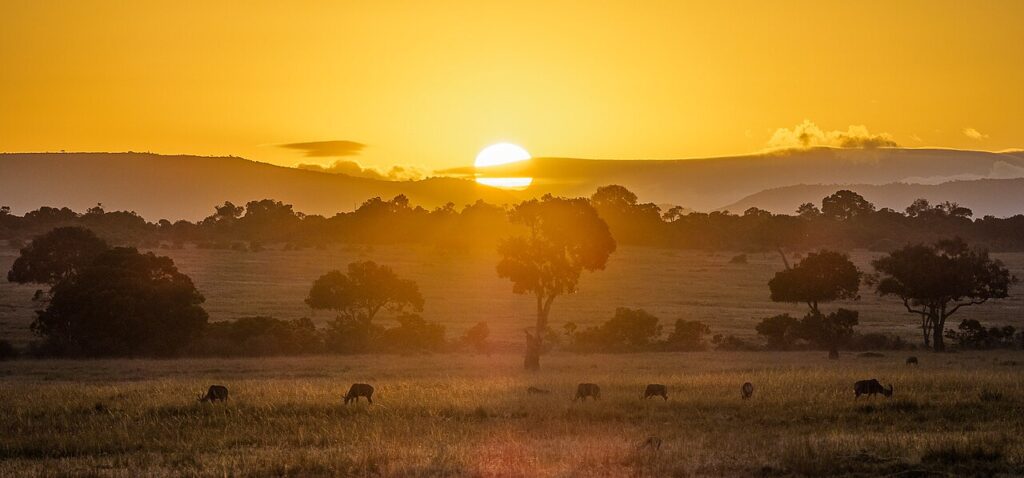
The Maasai Mara is Kenya’s most famous wildlife area and one of the best places in Africa to see big cats. Its open, rolling grasslands hold high densities of lions, cheetahs, leopards and hyenas all year, and from about July to October it hosts the Great Migration, with dramatic crossings of the Mara River. This guide explains how the Mara works, how to choose between the national reserve and the private conservancies, and how to plan your safari.
The Mara at a glance
| Location | Southwest Kenya, bordering Tanzania’s Serengeti |
| Area | About 1,510 km² for the national reserve, plus large community conservancies |
| Best for | Big cats, the Great Migration, open-plain game viewing |
| Best time | July to October for the migration; January to March for fewer crowds |
| Getting there | 45 to 60 minutes by light aircraft from Nairobi, or 5 to 6 hours by road |
The reserve and the conservancies
The Maasai Mara National Reserve is managed by Narok County, apart from the Mara Triangle in the west, which is managed by a non-profit, the Mara Conservancy. The reserve contains the famous river crossing points and the largest concentrations of migrating wildebeest.
Surrounding the reserve are community conservancies, such as Mara North, Olare Motorogi, Naboisho, Ol Kinyei, Lemek and Enonkishu. Maasai landowners lease their land to tourism partners, earning income in return for keeping it open for wildlife.
| National reserve | Private conservancies | |
|---|---|---|
| Vehicle numbers | Can be crowded at sightings, especially in peak season | Strict limits on vehicles per sighting |
| Off-road driving | Not allowed | Allowed in some conservancies at sightings |
| Night drives and walks | Not allowed | Usually available |
| River crossings | Main crossing points are here | Visits to the reserve can be arranged |
| Cost | Wider range, including budget options | Usually higher, all-inclusive camps |
| Community benefit | Park fees to the county | Direct lease payments to landowners |
Many travellers combine both: a few nights in a conservancy for exclusive, low-density game viewing and day trips into the reserve during migration season.
When to go
- July to October: the migration arrives from the Serengeti. River crossings are most frequent from August to September, but timing varies each year.
- November to December: short rains, fewer visitors, good resident wildlife.
- January to March: hot and dry, excellent big cat viewing, fewer crowds and lower prices.
- April to May: long rains, some camps close, but lush landscapes and low-season rates.
The Mara’s resident predators mean there is no bad time for big cats.
Wildlife highlights
- Lions: the Mara has some of the highest lion densities in Africa, with famous prides studied for decades.
- Cheetahs: the open plains are ideal, and the Mara is one of the best places to watch cheetahs hunt.
- Leopards: often seen along the Talek and Mara rivers.
- Spotted hyenas, elephants, buffalo, giraffes, topi, eland and hippos.
- Birds: more than 450 species, including martial eagles, secretary birds, ground hornbills and crowned cranes.
- Black rhinos: present in small numbers in the Mara Triangle and elsewhere, but rarely seen.
Park fees
Non-resident adults pay US$100 per day from January to June and US$200 per day from July to December to enter the national reserve, with tickets valid for 12 hours. Children pay less. Conservancy fees are separate and usually included in camp rates. Fees change, so confirm with your operator.
Where to stay
- Inside the reserve: tented camps along the Mara and Talek rivers, convenient for crossings.
- Mara Triangle: quieter, well-managed, with good access to western crossing points.
- Conservancies: small, exclusive camps with low vehicle numbers.
- Budget: camps and lodges near the Sekenani, Talek and Oloolaimutiek gates.
Getting there
- By air: scheduled light aircraft from Nairobi’s Wilson Airport to several Mara airstrips, about 45 to 60 minutes. Luggage is usually limited to 15 kg in soft bags.
- By road: about 5 to 6 hours from Nairobi via Narok, partly on rough roads.
Tips for a better Mara safari
- Stay at least three nights, ideally four to five.
- Take a full-day drive with a picnic during migration season to wait at the river.
- Choose operators who follow the rules: in recent years, rangers have enforced stricter controls at crossings to stop vehicles blocking the herds.
- Consider a balloon safari at dawn for a spectacular view.
- Visit a Maasai community respectfully through a reputable programme that benefits local people.
Frequently asked questions
Is the Maasai Mara better than the Serengeti? The Mara is smaller, easier to reach and has very high predator densities; the Serengeti is vast and holds the migration for most of the year. See our Serengeti vs Maasai Mara comparison.
When are the river crossings? Usually from July to October, most often in August and September.
Can I see the Big Five? Lions, leopards, elephants and buffalo are common; rhinos are present but rarely seen.
Related guides
- Serengeti Great Migration month-by-month guide
- First African safari planning guide
- Wildlife of Africa
- Animal profiles: Lion, Cheetah, Spotted Hyena
Cover photo: Danijel Mihajlovic, CC BY-SA 4.0, via Wikimedia Commons