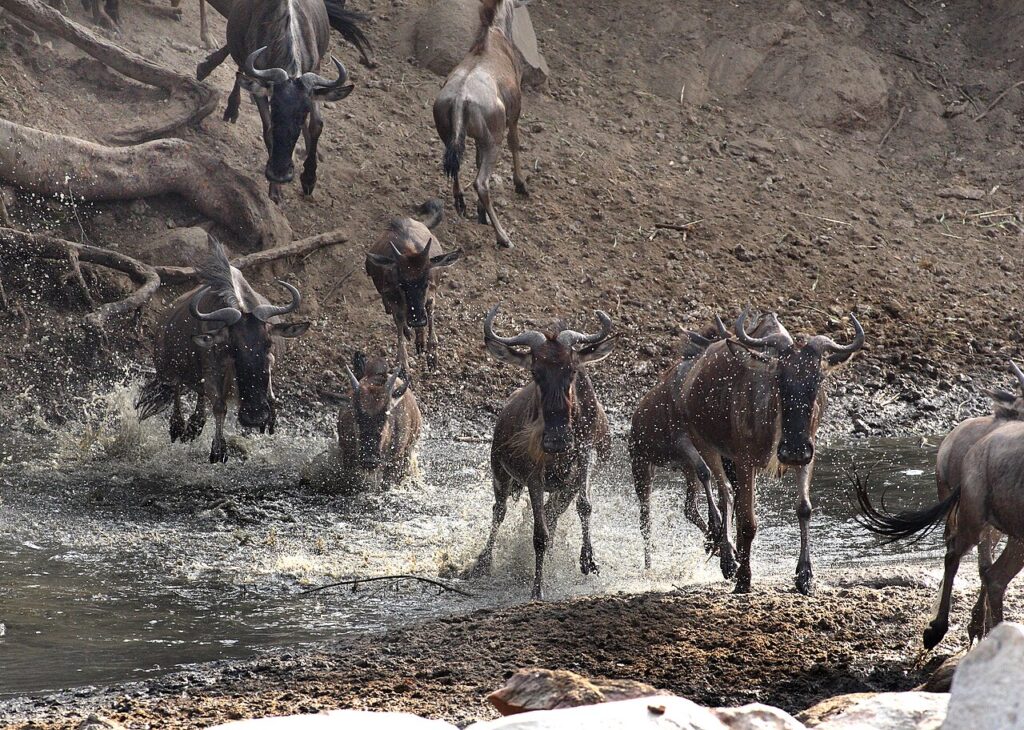
Every year, about 1.3 million wildebeest, together with hundreds of thousands of zebras and gazelles, travel a vast loop through the Serengeti ecosystem of Tanzania and Kenya. Predators follow them. Crocodiles wait at the rivers. It is often called the greatest wildlife show on Earth, and it is one of the few things that lives up to the description.
The migration never stops, but it does move, so where you should go depends entirely on when you travel. This guide explains how the migration works, where the herds usually are in each month, how to plan your trip and what it will cost.
What is the Great Migration?
The Great Migration is the year-round movement of wildebeest, zebras and gazelles around the Serengeti–Mara ecosystem, an area of about 25,000 km² that includes Serengeti National Park, the Ngorongoro Conservation Area and surrounding reserves in Tanzania, and the Maasai Mara National Reserve and its conservancies in Kenya.
The herds are following the rain. Rain produces fresh grass, and the short-grass plains of the southern Serengeti, which grow on nutrient-rich volcanic soils, are especially valuable for pregnant and nursing wildebeest. When those plains dry out, the herds move north and west towards permanent water and longer grass, returning south when the rains come back.
The route is roughly clockwise, but no two years are the same. Local rainfall can shift the herds by weeks and by tens of kilometres, and the herds often split into several large groups. Treat the calendar below as a guide to probabilities, not a timetable.
The migration month by month
| Month | Where the herds usually are | What’s happening |
|---|---|---|
| January | Southern Serengeti, Ndutu and the Ngorongoro Conservation Area | Herds graze the short-grass plains; calving begins |
| February | Ndutu and southern plains | Peak calving; around 8,000 calves can be born a day |
| March | Southern plains, starting to move | Calves growing; predators very active |
| April | Moving through central Serengeti (Seronera) | Long rains; herds on the move; low season prices |
| May | Central and Western Corridor | Rutting season; long columns of wildebeest |
| June | Western Corridor, Grumeti River | Grumeti River crossings; rut continues |
| July | Northern Serengeti; first herds reach the Mara | Mara River crossings begin |
| August | Northern Serengeti (Kogatende, Lamai) and Maasai Mara | Peak river crossings |
| September | Northern Serengeti and Maasai Mara | River crossings continue in both directions |
| October | Maasai Mara and northern Serengeti, starting south | Herds begin moving back as short rains approach |
| November | Moving south through eastern and central Serengeti | Short rains; herds on the move |
| December | Southern Serengeti | Herds arrive on the southern plains ahead of calving |
January to March: calving season
In the southern Serengeti and the neighbouring Ndutu area of the Ngorongoro Conservation Area, the herds spread across open grasslands. In a few weeks, usually peaking in February, around half a million calves are born. A wildebeest calf can stand within minutes and run with the herd within a day, because on these open plains any delay is fatal.
This concentration of vulnerable young attracts predators. Lions, cheetahs, spotted hyenas and jackals are all highly active, and Ndutu is one of the best places in Africa to watch cheetahs hunt. The landscape is green, the light is soft, and there are far fewer vehicles than in the north during river-crossing season.
Where to stay: lodges and seasonal mobile camps in Ndutu and the southern Serengeti (Kusini, Namiri Plains area).
April and May: the long rains and the rut
As the southern plains dry out after the short grasses have been grazed, the herds begin moving northwest through central Serengeti. April and May bring the long rains, and some camps close. For travellers who do not mind afternoon showers, this is a good time for lower prices and dramatic skies. In May the wildebeest rut begins: males fight, bellow and gather females, and columns of animals stretching for kilometres move through the Seronera area and into the Western Corridor.
Where to stay: central Serengeti around Seronera; Western Corridor from late May.
June: the Grumeti River
In June many herds reach the Grumeti River in the Western Corridor. Crossings here are smaller and less predictable than on the Mara, but the river holds some of the largest Nile crocodiles in Africa. The Singita Grumeti and Grumeti Game Reserve concessions border the park here.
Where to stay: Western Corridor and Grumeti concessions.
July to October: the Mara River crossings
The most famous scenes of the migration take place at the Mara River, which the herds must cross, sometimes several times, as they move between the northern Serengeti and Kenya’s Maasai Mara. Herds gather on the banks, sometimes for hours or days, until one animal commits and the rest pour down the bank after it. Crocodiles and currents take some; others are trampled. A single crossing can involve thousands of animals.
Crossings happen at a number of well-known points along the river. There is no guarantee of seeing one, but spending at least three full days in the area gives you a good chance in August and September.
Where to stay in Tanzania: northern Serengeti, around Kogatende and Lamai, which are quieter than the Kenyan side.
Where to stay in Kenya: the Maasai Mara National Reserve, or private conservancies such as Mara North, Olare Motorogi and Naboisho. The conservancies limit vehicle numbers and allow night drives and walks, but crossings mostly take place in the reserve itself and the northern Serengeti.
November and December: the return south
As the short rains begin in November, the herds move south through the eastern Serengeti and Loliondo area and back towards the southern plains, where they arrive in December. This is a quieter period, with good wildlife and fewer visitors.
How long should you spend?
Allow at least three nights in one migration area, and ideally five to seven nights split between two areas. Game drives in the Serengeti often cover long distances, and the herds may be a few hours’ drive from your camp. Flying between airstrips saves time and allows you to follow the herds more closely.
Getting there
Most visitors fly into Kilimanjaro International Airport (JRO) near Arusha, Tanzania. From Arusha, you can:
- Fly on a light aircraft to Serengeti airstrips such as Seronera, Kogatende, Lobo, Ndutu or Grumeti, usually one to two hours.
- Drive via Tarangire, Lake Manyara and the Ngorongoro Crater, a classic northern circuit route that takes a full day from Arusha to the central Serengeti.
For the Maasai Mara, fly into Nairobi (NBO) and take a scheduled light aircraft to one of the Mara airstrips (about 45 minutes to an hour), or drive in about five to six hours.
What it costs
Migration safaris range from mid-range group tours to some of the most expensive safaris in Africa. The largest costs are accommodation, flights and vehicles. Park fees are a significant addition:
- Serengeti National Park: the conservation fee for non-resident adults is about US$70 per person per day in peak season (US$60 in low season), plus 18 percent VAT. Camps inside the park also charge a concession fee per person per night.
- Maasai Mara National Reserve: non-resident adults pay US$100 per day from January to June and US$200 from July to December. Tickets are valid for 12 hours.
- Private Mara conservancies charge their own conservancy fees, usually included in the camp rate.
Fees change regularly, so always confirm current rates with your operator or the park authority.
Choosing the right time for you
| If you want… | Go in… | Where |
|---|---|---|
| Calving and big cat action | January to March | Ndutu and southern Serengeti |
| Fewer vehicles and lower prices | April, May, November | Central Serengeti |
| Mara River crossings | July to October | Northern Serengeti or Maasai Mara |
| Crossings without the crowds | August to September, on the Tanzanian side | Kogatende and Lamai |
| A mix of migration and other parks | June or December | Combine with Tarangire and Ngorongoro |
Tips for a better migration safari
- Choose a camp that moves with the herds. Seasonal mobile camps relocate two or three times a year to stay close to the action.
- Stay longer rather than moving often. More time in one area gives you more chances of seeing a crossing or a hunt.
- Take full-day game drives with a packed lunch during river-crossing season, so you can wait at the river.
- Be patient and respectful at crossings. Herds can abandon a crossing if vehicles block their path. In the Maasai Mara, rangers now enforce rules keeping vehicles back from the riverbanks. Good guides wait at a distance.
- Bring the right gear. A 100–400 mm lens or similar, binoculars for everyone, a beanbag for camera support, and warm layers for early morning drives.
- Remember the whole ecosystem. Some of the best moments are away from the herds: a leopard in a sausage tree, elephants at a waterhole or a rare pangolin.
The migration and conservation
The migration depends on a huge, connected landscape. Threats include proposals for roads across the northern Serengeti, fencing and farmland on the edges of the ecosystem, reduced river flows in the Mara as upstream forests are cleared, and climate change altering rainfall. Tourism fees are an important source of funding for protecting the ecosystem, and conservancies in Kenya provide income for Maasai landowners who lease their land for wildlife.
Frequently asked questions
When is the best time to see the Great Migration? It depends on what you want to see. For river crossings, go from July to October. For calving and predators, go from January to March.
Is the migration better in Tanzania or Kenya? The herds spend most of the year in Tanzania. Kenya’s Maasai Mara hosts them from about July to October. Both offer excellent crossings in peak season; the northern Serengeti tends to be quieter.
Can I guarantee seeing a river crossing? No. Crossings depend on the herds, the weather and chance. Staying at least three days near the river in August or September gives you a strong chance.
How many animals take part? Roughly 1.3 million wildebeest, along with around 200,000 zebras and several hundred thousand gazelles, according to widely cited estimates.
Is it safe? Safaris with reputable operators are generally very safe. Follow your guide’s instructions, stay in the vehicle unless told otherwise, and take standard health precautions, including malaria prevention.
Related guides
- Wildlife of Africa
- First African safari: the complete planning guide
- Animal profiles: Lion, Cheetah, Plains Zebra, Spotted Hyena
Cover photo: Wolves201, CC BY-SA 4.0, via Wikimedia Commons