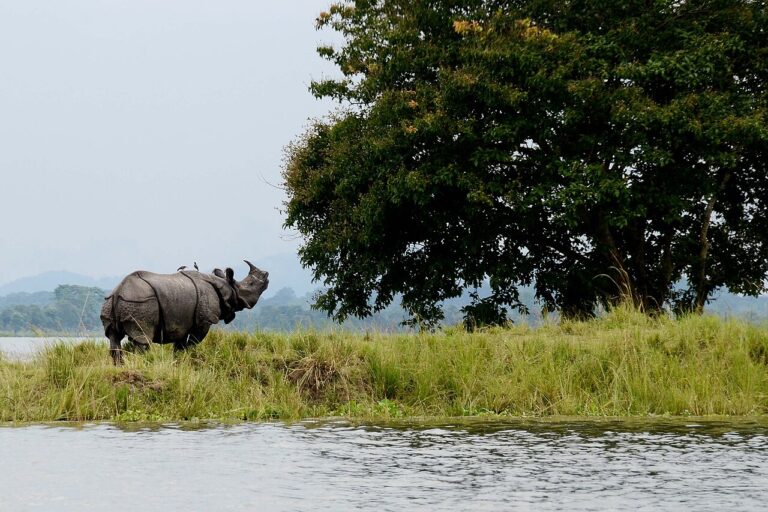
The greater one-horned, or Indian, rhinoceros is the largest of the three Asian rhinos. Once found across the northern Indian subcontinent, it was reduced to a few small populations by hunting and habitat loss. Strict protection in parks such as Kaziranga and Chitwan brought it back.
Interesting facts
- Its skin has deep folds that look like plates of armour.
- Both sexes have a single horn, up to about 60 cm long.
- It is a good swimmer and often wallows in water and mud.
- Kaziranga National Park holds about two-thirds of the world population.
- Chitwan in Nepal holds the second-largest population.
- It defends itself mainly with its sharp lower incisors, not its horn.
Behaviour
Mostly solitary, although rhinos may gather at wallows and grazing areas. They use communal dung heaps that act as scent posts and are most active in the morning and evening.
Breeding and young
A single calf is born after about 16 months and stays with its mother for up to four years.
Threats and conservation
Poaching for horn, loss and degradation of floodplain grasslands, invasive plants, floods and the risks of having most animals in a few sites.
Where to see it
- Kaziranga National Park, India
- Chitwan National Park, Nepal
- Jaldapara and Gorumara, India
- Bardiya National Park, Nepal
Status source: IUCN Red List. Profile last reviewed September 2026.
Where to see the greater one-horned rhinoceros
 Best Places to See Rhinos in AfricaAfrica's rhinos have been pushed to the brink by poaching, but you can still see them in the…
 Bardiya National Park: Nepal’s Wild West Tiger CountryRemote, quiet and wild, Bardiya has the most tigers of any park in Nepal. How to plan a…
 Kaziranga National Park Guide: One-Horned Rhinos, Tigers and ElephantsKaziranga's tall grasslands hold the world's largest population of greater one-horned rhinos, plus tigers, wild buffalo and elephants.…