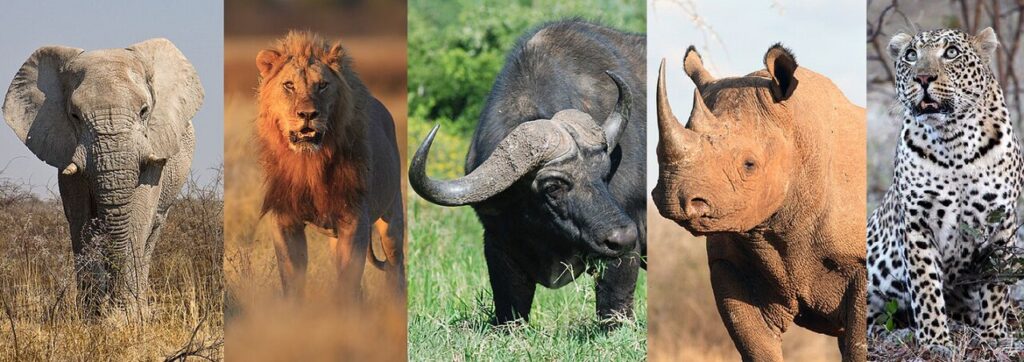
The “Big Five” were named by hunters as the most dangerous animals to track on foot: the lion, leopard, African elephant, African buffalo and rhinoceros. Today they are the dream checklist for photographers and first-time safari travellers. Lions, elephants and buffalo are relatively easy to find in many parks. Leopards and rhinos are the hardest, so choosing the right destination matters.
The best places to see all five
| Destination | Country | Why it works |
|---|---|---|
| Sabi Sands and private reserves of Greater Kruger | South Africa | Habituated leopards, off-road tracking, white rhinos; very high chances |
| Kruger National Park | South Africa | All five on a budget self-drive; rhinos and leopards need luck and patience |
| Ngorongoro Crater | Tanzania | Compact caldera with black rhinos, lions, buffalo and elephants; leopards less often |
| Hluhluwe-iMfolozi Park | South Africa | Famous rhino park with all five |
| Madikwe and Pilanesberg | South Africa | Malaria-free reserves with all five |
| Ol Pejeta and Lewa conservancies | Kenya | Both rhino species; excellent for all five |
| Maasai Mara conservancies | Kenya | Superb lions, leopards and elephants; rhinos rare |
| Etosha National Park | Namibia | Black rhinos at floodlit waterholes; buffalo absent from much of the park |
| Akagera National Park | Rwanda | All five restored through reintroductions |
| South Luangwa National Park | Zambia | Superb leopards, but no rhinos |
Tips for each of the Big Five
Lion
Lions are most active at dawn, dusk and night, and often rest in the shade during the day. Look for vehicles gathered at a sighting, vultures descending and alarm calls from zebras or impala. The Maasai Mara, Serengeti, Kruger and the Okavango Delta are all excellent.
Leopard
Leopards are solitary, secretive and often nocturnal. Scan large trees, particularly sausage and marula trees, for a dangling tail or a kill hanging in the branches. Private reserves with off-road driving and night drives, such as the Sabi Sands and South Luangwa, give the best chances.
African elephant
Elephants are usually the easiest of the five to find, especially near water in the dry season. Chobe, the Okavango Delta, Kruger, Amboseli and Tarangire are famous for large herds. Keep a respectful distance from breeding herds with young calves.
African buffalo
Buffalo herds can number hundreds in the dry season, while old bulls, known as “dagga boys”, often wallow alone in mud. They are common in Kruger, Chobe, the Okavango and the Serengeti.
Rhinoceros
Both white and black rhinos are found in southern and East Africa. White rhinos graze in open grassland and are easier to see; black rhinos browse in thicker bush and are shyer. Ngorongoro Crater, Ol Pejeta, Lewa, Hluhluwe-iMfolozi, Etosha and the private reserves of Greater Kruger offer the best chances.
Tips to improve your chances
- Choose a private reserve or conservancy for at least part of the trip. Off-road driving, radio communication between guides and habituated animals greatly increase leopard sightings.
- Stay longer: at least three nights at each camp.
- Go in the dry season (roughly June to October in most of southern and East Africa), when vegetation is thin and animals gather at water.
- Take night drives where allowed; leopards are most active after dark.
- Tell your guide your priorities, but do not pressure them to chase animals.
Remember the rest
Obsessing over the Big Five can mean missing some of Africa’s best wildlife. Cheetahs, wild dogs, hippos, giraffes, pangolins, aardvarks and hundreds of birds are all just as rewarding. Some guides now talk of the “Little Five” (elephant shrew, ant lion, rhino beetle, buffalo weaver and leopard tortoise) and the “Ugly Five” (warthog, hyena, vulture, marabou stork and wildebeest).
Conservation note
Rhinos are the most threatened of the five, and some parks do not reveal rhino locations publicly to protect them from poachers. Sighting rules may ask you not to geotag rhino photos on social media.
Frequently asked questions
Why are they called the Big Five? Big-game hunters coined the term for the five animals considered most dangerous and difficult to hunt on foot. Today it is mostly a wildlife-watching checklist.
Which of the Big Five is hardest to see? Leopards and rhinos. Leopards are solitary, nocturnal and well camouflaged, while rhinos are rare and heavily protected. Private reserves in Greater Kruger give some of the best chances of both.
Can I see the Big Five in one day? It is possible in places such as the Sabi Sands or Ngorongoro Crater, but it depends on luck. Plan at least three to four days to give yourself a realistic chance.
Are there malaria-free Big Five reserves? Yes. Madikwe Game Reserve, Pilanesberg and several reserves in the Eastern Cape in South Africa are malaria-free and have all five species.
Related guides
- Kruger self-drive guide
- Ngorongoro Crater guide
- First African safari planning guide
- Animal profiles: Lion, Leopard, African Elephant, White Rhinoceros, Black Rhinoceros
Cover photo: User:מנחם.אל, CC BY 4.0, via Wikimedia Commons