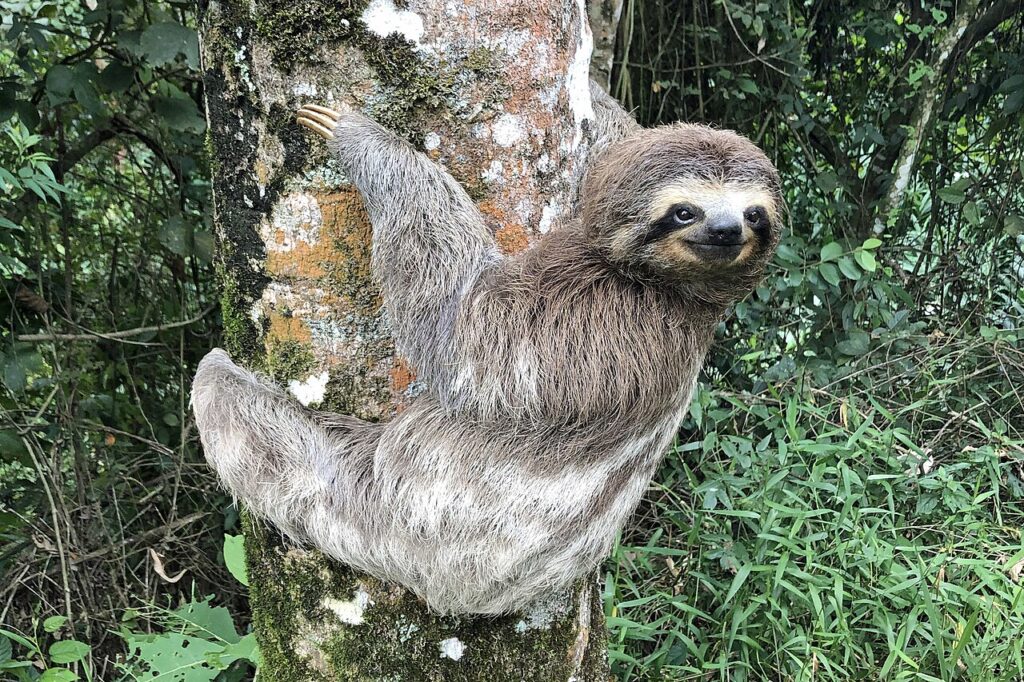
Sloths are among the most popular animals in the tropics: slow, gentle and famously relaxed. There are six living species, all found in Central and South America. They spend almost all their lives in trees, moving slowly to save energy on a low-nutrient diet of leaves. With a good guide and patience, they are surprisingly easy to see. See our brown-throated sloth profile.
Two-toed and three-toed sloths
| Three-toed sloths | Two-toed sloths | |
|---|---|---|
| Face | Dark “mask”, looks like it is smiling | Pig-like snout, paler face |
| Activity | Active by day and night | Mostly nocturnal |
| Diet | Almost entirely leaves | Leaves, fruit, flowers |
| Where | Central and South America | Central and South America |
The best places to see sloths
Costa Rica
- Manuel Antonio National Park: small and busy, but sloths are very common. Guides with spotting scopes find them easily.
- Cahuita National Park and Puerto Viejo (Caribbean coast): three-toed sloths along the coastal trail. The Jaguar Rescue Center nearby rehabilitates injured sloths.
- Tortuguero: sloths along the canals. See our Tortuguero guide.
- La Fortuna (Arenal): sloth-watching tours on private land.
- Monteverde: two-toed sloths on night walks. See our Monteverde guide.
- Corcovado: in a wilder setting. See our Corcovado guide.
Panama
Soberanía National Park, the Metropolitan Natural Park in Panama City and the islands of Bocas del Toro, home to the critically endangered pygmy three-toed sloth on Isla Escudo de Veraguas. See our Panama guide.
The Amazon and beyond
Sloths are common in the Amazon, in Ecuador, Peru and Brazil, as well as in Colombia and Brazil’s Atlantic Forest, home to the maned three-toed sloth.
Tips for spotting sloths
- Look for a ball of fur high in cecropia trees, a favourite of three-toed sloths.
- Hire a local guide with a spotting scope.
- Walk slowly and scan the canopy.
- Look in the early morning, when sloths often sunbathe on exposed branches.
Avoid sloth selfies
Holding sloths for photos causes them stress and has fuelled a trade in wild-caught animals. Never hold or touch a sloth, and avoid “sanctuaries” that allow handling. See our guide to wildlife tourism to avoid.
Frequently asked questions
Where is the best place to see sloths in Costa Rica? Manuel Antonio and Cahuita national parks, with a local guide.
Are sloths endangered? Most species are not, but the pygmy three-toed sloth is Critically Endangered and the maned three-toed sloth is Vulnerable.
Why do sloths come down from trees? Most sloths climb down about once a week to defecate at the base of the tree, a risky behaviour whose purpose scientists still debate.
Can I hold a sloth? No. Handling harms sloths and supports an exploitative trade.
Related guides
- Costa Rica wildlife guide
- Panama wildlife guide
- Wildlife tourism to avoid
- Animal profiles: Brown-throated sloth, Howler monkey, Giant anteater
Cover photo: Daniella Maraschiello, CC BY-SA 4.0, via Wikimedia Commons