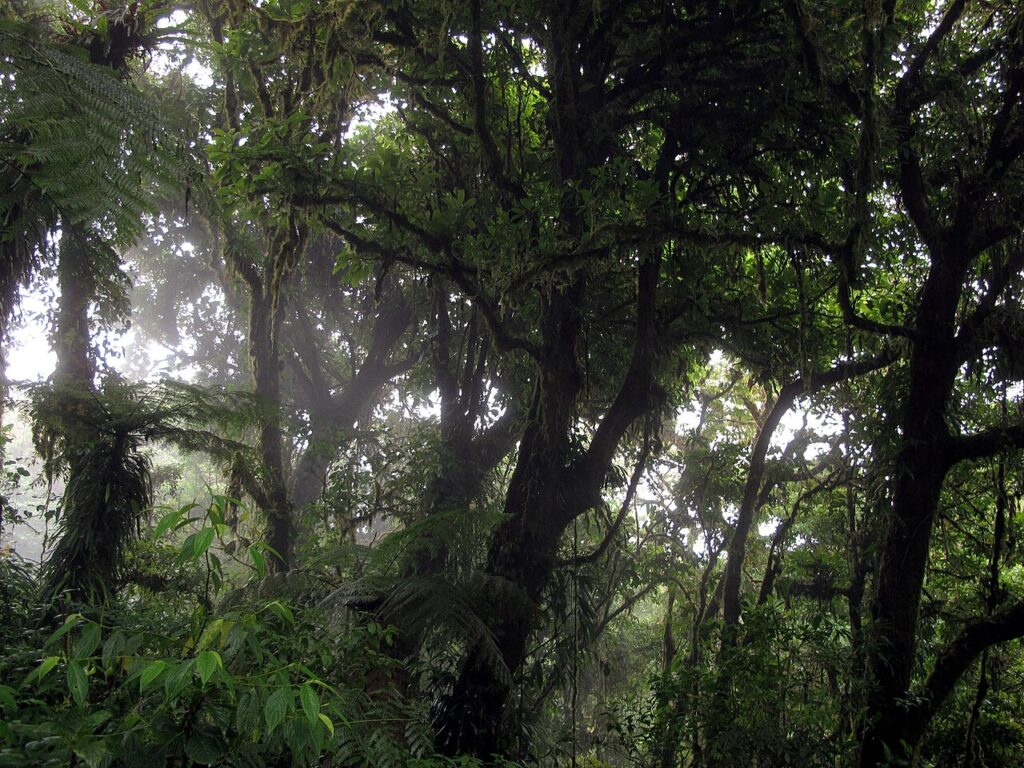
Monteverde, in the Tilarán mountains of Costa Rica, is one of the world’s most famous cloud forests. Constant mist feeds a forest dripping with mosses, orchids and bromeliads, home to hundreds of bird species, frogs, sloths and the legendary resplendent quetzal. Monteverde also has an unusual history: it was settled in the 1950s by American Quakers who set aside land to protect the watershed.
At a glance
| Best time | January to May; March to June for quetzal nesting |
| Getting there | About 3.5 to 4 hours by road from San José |
| Time needed | 2 to 3 nights |
| Big draws | Resplendent quetzal, hummingbirds, night walks, hanging bridges |
| Good for | Birders, families, first-time visitors to Costa Rica |
The resplendent quetzal
- Males have iridescent green plumage, a crimson belly and tail streamers up to about 60 cm long. The quetzal was sacred to the Maya and Aztecs. See our resplendent quetzal profile.
- Quetzals feed on wild avocados and other fruits of the laurel family, so guides look for fruiting trees.
- The nesting season (roughly March to June) is the best time, when pairs use holes in dead trees.
- Local guides know where quetzals are currently feeding and nesting; hiring one greatly improves your chances.
Reserves
- Monteverde Cloud Forest Biological Reserve: the original reserve, with well-maintained trails.
- Santa Elena Cloud Forest Reserve: community-owned, slightly higher and often quieter.
- Children’s Eternal Rainforest (Bosque Eterno de los Niños): Costa Rica’s largest private reserve, created with donations from children around the world.
- Curi-Cancha Reserve: a private reserve with excellent quetzal sightings.
Other wildlife and experiences
- Hummingbird gardens: violet sabrewings, purple-throated mountain-gems and many more at feeders. See our bee hummingbird profile for the smallest species.
- Night walks: two-toed sloths, tarantulas, stick insects, tree frogs, kinkajous and olingos.
- Hanging bridges and ziplines through the canopy.
- Three-wattled bellbirds: their loud, metallic calls ring through the forest in season.
The golden toad
Monteverde was the only home of the golden toad, a brilliant orange toad last seen in 1989. Its extinction, linked to climate change and the chytrid fungus, made it a symbol of the global amphibian crisis.
When to go
- January to May: drier season; good for birds and the quetzal nesting season.
- June to December: wetter and misty, but the forest is lush and quieter.
Getting there
Monteverde is about 180 km from San José. The final section of road is now paved, and the drive takes 3.5 to 4 hours. Shuttles connect with Arenal and the Pacific coast.
Frequently asked questions
When is the best time to see the resplendent quetzal? March to June, during the nesting season, though they are present year-round.
Is it better to hire a guide in Monteverde? Yes. Guides know where quetzals and other wildlife are and point out much you would miss.
What should I wear? Layers and a rain jacket: the cloud forest is cool and wet.
Monteverde or Santa Elena? Both are excellent; Santa Elena is often quieter.
Related guides
- Costa Rica wildlife guide
- Best hummingbird destinations
- Corcovado National Park
- Animal profiles: Resplendent quetzal, Glass frog, Brown-throated sloth
Cover photo: Haakon S. Krohn, CC BY-SA 3.0, via Wikimedia Commons