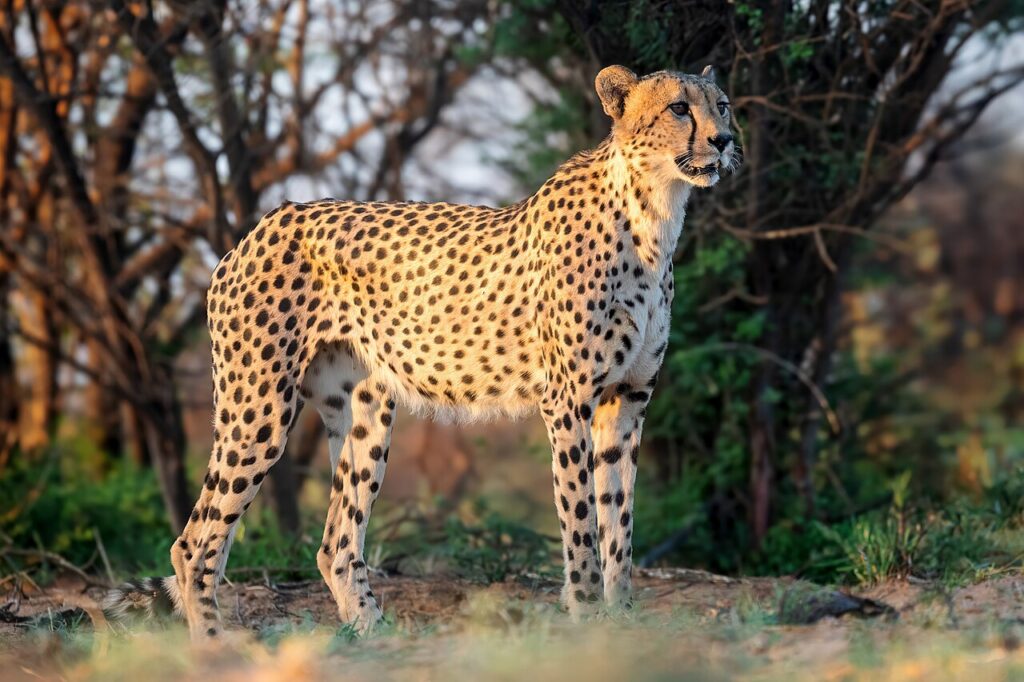
The cheetah is the fastest land animal on Earth, capable of sprinting at around 100 km/h in short bursts. Unlike other big cats, it hunts mainly by day, which makes it easier to watch. But cheetahs are in trouble: fewer than 7,000 adults remain, mostly in southern and East Africa, with a tiny population in Iran. See our cheetah profile.
The best places to see cheetahs
1. Maasai Mara, Kenya
The Mara’s open plains are superb for cheetahs, and the conservancies around the reserve are known for famous individuals and coalitions of males, such as the five males known as the Tano Bora. See our Maasai Mara guide.
2. Serengeti and Ndutu, Tanzania
During the calving season (roughly January to March), the short-grass plains of the southern Serengeti and the Ndutu area have a very high density of cheetahs hunting young gazelles and wildebeest. See our Serengeti guide.
3. Namibia
Namibia is home to one of the world’s largest cheetah populations, most living on farmland. The Cheetah Conservation Fund near Otjiwarongo works with farmers to reduce conflict, and cheetahs are regularly seen in Etosha. See our Etosha guide.
4. Kgalagadi and the Central Kalahari
The dry riverbeds of the Kgalagadi and the open valleys of the Central Kalahari offer excellent, uncrowded cheetah viewing.
5. South Africa’s reserves
Phinda (KwaZulu-Natal), Kruger’s southern plains and several smaller reserves have cheetah populations, some managed as part of a national metapopulation.
6. Other places
Liuwa Plain (Zambia), Kidepo Valley (Uganda), the Okavango and Botswana’s Linyanti all hold cheetahs.
Cheetahs outside Africa
- Iran: the last Asiatic cheetahs, fewer than 50, survive on the central plateau. They are almost never seen by visitors.
- India: cheetahs from Namibia and South Africa were introduced to Kuno National Park from 2022, a controversial project to restore the species decades after it was declared extinct in India.
Tips for finding cheetahs
- Open grassland: cheetahs need space to sprint, so look on open plains.
- Mornings and late afternoons: cheetahs hunt mostly during the day, avoiding the heat of midday.
- Scan termite mounds and fallen trees, which cheetahs use as lookouts.
- Keep your distance: vehicles crowding cheetahs can disrupt hunts. Good guides hang back.
Why cheetahs are declining
Habitat loss, conflict with livestock farmers, loss of prey, road accidents, and the illegal trade in cubs for pets, especially in the Horn of Africa and the Middle East. Cheetahs also have low genetic diversity, which may make them more vulnerable.
Frequently asked questions
Where is the best place to see cheetahs in Africa? The Maasai Mara and the southern Serengeti (in the calving season) are the most reliable, with Namibia and the Kalahari also excellent.
Are cheetahs endangered? The cheetah is listed as Vulnerable by the IUCN, though many scientists argue it should be Endangered. The Asiatic cheetah is Critically Endangered.
How fast can a cheetah run? Around 100 km/h in short sprints of a few hundred metres.
What is the difference between a cheetah and a leopard? Cheetahs are lighter, with solid round spots, black “tear lines” on the face and long legs built for speed. Leopards are stockier, with rosettes, and climb trees.
Related guides
- Where to see leopards in Africa
- Serengeti vs Maasai Mara
- Liuwa Plain
- Animal profiles: Cheetah, Thomson’s gazelle, Leopard
Cover photo: AfricanConservation, CC BY-SA 4.0, via Wikimedia Commons