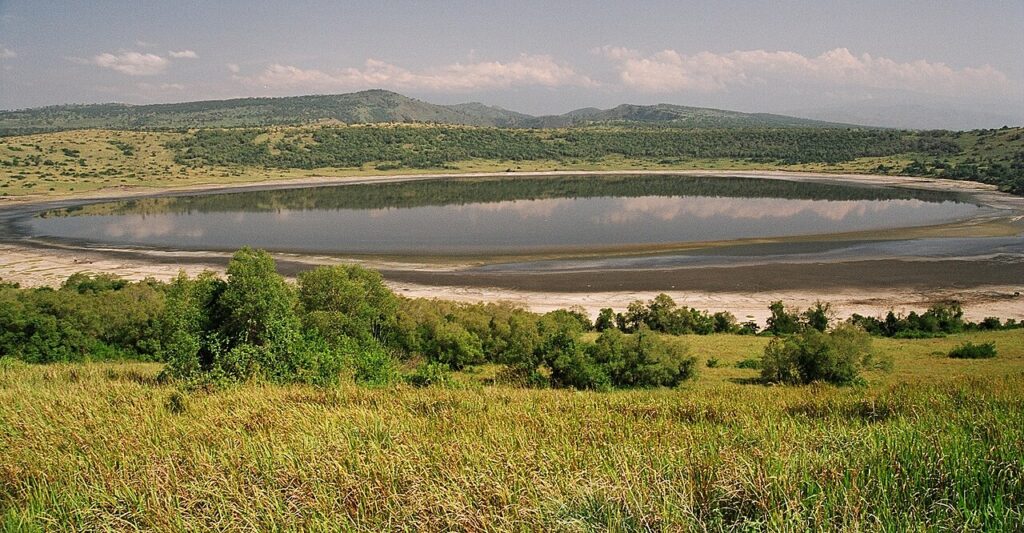
Queen Elizabeth National Park stretches across about 1,978 km² of western Uganda, from the crater lakes near the Rwenzori Mountains in the north to the Ishasha plains on the Congolese border in the south. With savanna, wetlands, forest and two lakes joined by the Kazinga Channel, it has one of the highest bird counts of any park in Africa and fits perfectly between chimpanzee trekking in Kibale and gorilla trekking in Bwindi.
At a glance
| Best time | June to September and December to February |
| Getting there | About 6 to 7 hours by road from Kampala, or fly to Mweya or Kasese |
| Time needed | 2 to 3 nights |
| Big draws | Kazinga Channel boat trip, Ishasha tree-climbing lions, Kyambura chimps |
| Good for | Combining with Kibale and Bwindi on a Uganda circuit |
Highlights
- Kazinga Channel boat trip: a two-hour cruise along the 32-km channel between Lakes George and Edward passes one of Africa’s densest hippo populations, Nile crocodiles, buffalo and elephants drinking at the water’s edge, and huge numbers of waterbirds.
- Ishasha’s tree-climbing lions: in the southern Ishasha sector, lions often rest in the branches of large fig trees. Sightings are not guaranteed, and the population has suffered from poisoning.
- Kyambura Gorge: a forested gorge sunk into the savanna, where a small community of chimpanzees lives. Trekking here is less predictable than in Kibale but atmospheric.
- Mweya Peninsula: the park’s hub, with views over the channel.
- Crater lakes: the Katwe explosion craters and Lake Katwe, where salt has been mined by hand for centuries.
- Maramagambo Forest: a forest walk to a bat cave where pythons hunt.
Wildlife
Uganda kob (on their lekking grounds), topi (in Ishasha), buffalo, elephants, warthogs, waterbuck, leopards, lions and spotted hyenas. More than 600 bird species include shoebills (rarely seen), African skimmers, martial eagles and many kingfishers.
When to go
- June to September and December to February: drier, with easier driving and animals near water.
- March to May and October to November: rains; green landscapes and good birding.
Getting there
The park is about 400 km from Kampala. Many visitors drive from Kibale (2 to 3 hours) and continue south to Bwindi (3 to 4 hours from Ishasha to Buhoma). Scheduled flights serve Kasese and Mweya.
Where to stay
Lodges range from budget options near Katunguru to lodges on the Mweya Peninsula, the Kyambura Gorge rim and private camps in Ishasha.
Sample itinerary: Uganda primates and savanna, 8 days
| Day | Plan |
|---|---|
| 1 | Arrive in Entebbe |
| 2–3 | Kibale: chimpanzee trek and Bigodi Wetland |
| 4–5 | Queen Elizabeth: game drives, Kazinga Channel, Kyambura Gorge |
| 6 | Ishasha for tree-climbing lions, then on to Bwindi |
| 7 | Gorilla trek in Bwindi |
| 8 | Fly back to Entebbe |
Frequently asked questions
Where are the tree-climbing lions? In the Ishasha sector in the far south of the park. They are best looked for in the heat of the day, when they rest in fig trees.
Is the Kazinga Channel boat trip worth it? Yes. It is one of Uganda’s best wildlife experiences, with close views of hippos, elephants, buffalo and birds.
Can I see chimpanzees in Queen Elizabeth? Yes, in Kyambura Gorge, but sightings are less reliable than in Kibale.
How many days do I need? Two to three nights, including one in or near Ishasha.
Related guides
- Kibale chimpanzee trekking
- Bwindi gorilla trekking guide
- Murchison Falls National Park
- Animal profiles: Lion, Hippopotamus, African elephant
Cover photo: Robert Weinkove using Minolta Dynax 4 camera, CC BY-SA 3.0, via Wikimedia Commons