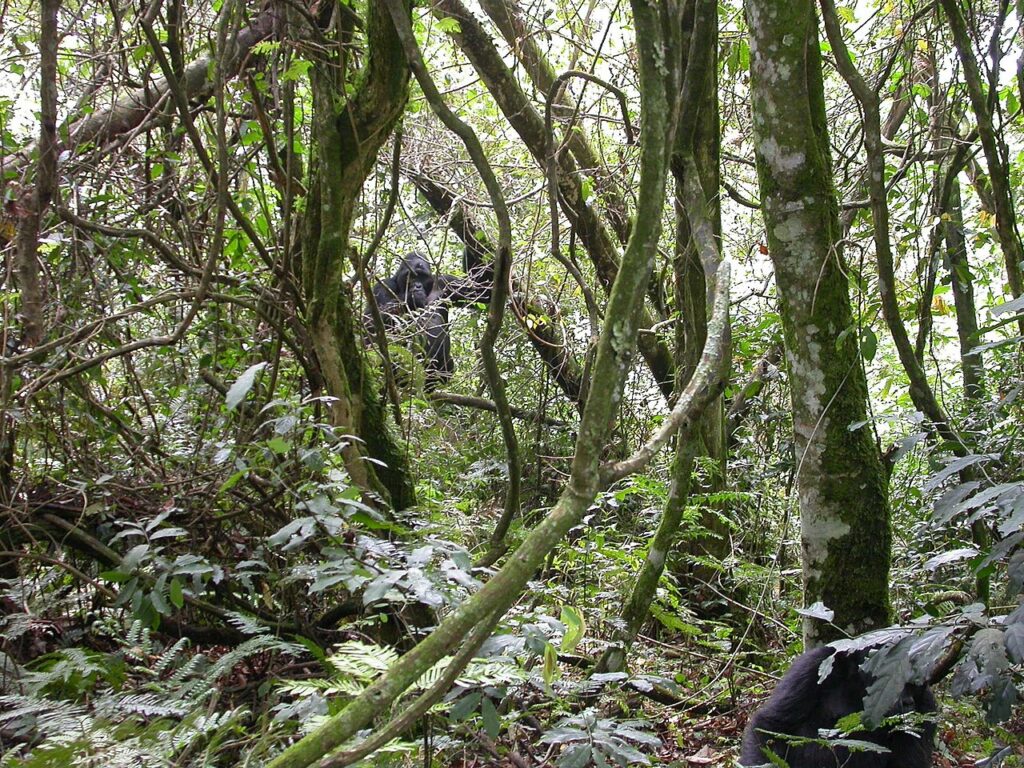
Bwindi Impenetrable National Park, in south-western Uganda, protects about 321 km² of steep, mist-covered rainforest that has survived for tens of thousands of years. It is home to roughly 460 mountain gorillas, close to half of the world’s total, and more habituated gorilla families than anywhere else. Sitting quietly for an hour with a gorilla family is one of the most moving wildlife experiences on Earth.
At a glance
| Best time | June to August and December to February (drier months) |
| Getting there | Flights to Kihihi or Kisoro, or a long drive from Entebbe or Kigali |
| Time needed | 2 to 3 nights (one or two treks) |
| Big draws | Mountain gorillas, Albertine Rift birds, forest walks |
| Good for | Once-in-a-lifetime primate encounters |
How gorilla trekking works
- Each habituated gorilla family can be visited by one group of up to eight people per day.
- You spend one hour with the gorillas once found. The trek there can take from under an hour to six or more.
- You must hold a permit for a specific date and sector, issued by the Uganda Wildlife Authority (UWA). At the time of writing, a permit costs US$800 for foreign non-residents.
- The minimum age is 15. Anyone with a cold or other illness should not trek, because gorillas catch human diseases.
- Keep at least 7 metres away, wear a mask when asked, and do not eat or drink near the gorillas.
The four sectors
Bwindi’s gorilla families are spread across four sectors, each with its own lodges. Your permit is for one sector, so book lodges nearby.
| Sector | Location | Notes |
|---|---|---|
| Buhoma | North | The original trekking sector; easiest access from Queen Elizabeth National Park; good lodges |
| Ruhija | East | High altitude and cool; excellent birding, including the Mubwindi Swamp trail |
| Rushaga | South | The most gorilla families; closest to Kigali via the Rwandan border; home of the habituation experience |
| Nkuringo | South-west | Steep treks with superb views of the Virunga volcanoes |
The gorilla habituation experience
In Rushaga, a small number of visitors can join researchers and trackers with a gorilla family that is still being habituated. You spend up to four hours with the gorillas instead of one. It costs more (around US$1,500 at the time of writing) and must be booked well ahead.
What a trek is like
The day begins with a briefing at the park office at about 8 am. You walk with a ranger guide, armed escorts and trackers who have gone ahead to find the family. Trails are steep, muddy and slippery, and trackers may cut a path through thick vegetation. Porters from local communities can be hired to carry your bag and help you on steep sections, which also provides valuable income.
When to go
- June to August and December to February: the drier months, with easier trails. Permits sell out early.
- March to May and September to November: wetter, with muddier trails, but gorillas are still found every day, and lodges may offer lower rates. It is a rainforest, so rain is possible at any time.
Getting there
- By air: scheduled flights from Entebbe to Kihihi (for Buhoma) and Kisoro (for Rushaga and Nkuringo) take about an hour and a half.
- By road from Entebbe or Kampala: 8 to 10 hours.
- From Kigali (Rwanda): about 4 to 5 hours to Rushaga, which makes a combined Rwanda–Uganda trip easy.
Where to stay
Each sector has lodges from budget guesthouses to luxury lodges. Stay in the sector where your permit is, as roads between sectors take hours.
What to pack
- Waterproof hiking boots with good grip, and gaiters
- Rain jacket and long trousers
- Gardening gloves for grabbing vegetation
- Long-sleeved shirt (against nettles and ants)
- Two litres of water and a snack for the trek
- Camera without flash; a lens that works in low light
Also in Bwindi
- Birding: Bwindi holds more than 20 Albertine Rift endemic birds, such as the African green broadbill, handsome francolin and Rwenzori turaco.
- Batwa experience: a cultural visit with the Batwa, the forest’s original inhabitants, who were evicted when the park was created. Choose a programme that is Batwa-led.
- Community walks to tea plantations, craft cooperatives and schools.
Frequently asked questions
How hard is gorilla trekking in Bwindi? It depends on where the gorillas are that day. Some treks take less than an hour, others most of the day. Most visitors with reasonable fitness manage well, especially with a porter and walking stick.
Is Bwindi or Rwanda’s Volcanoes National Park better? Both offer superb encounters. Uganda’s permits are cheaper and Bwindi has more families; Rwanda’s park is easier to reach from Kigali. See our Uganda vs Rwanda comparison.
How far in advance should I book a permit? For June to September and December to February, book 6 to 12 months ahead. Permits for other months are usually easier to get.
Are sightings guaranteed? Not officially, but trackers find the habituated families on almost every day.
Related guides
- Gorilla trekking in Uganda vs Rwanda
- Volcanoes National Park, Rwanda
- Queen Elizabeth National Park
- Animal profile: Mountain gorilla
Cover photo: Unknown author, CC BY-SA 3.0, via Wikimedia Commons