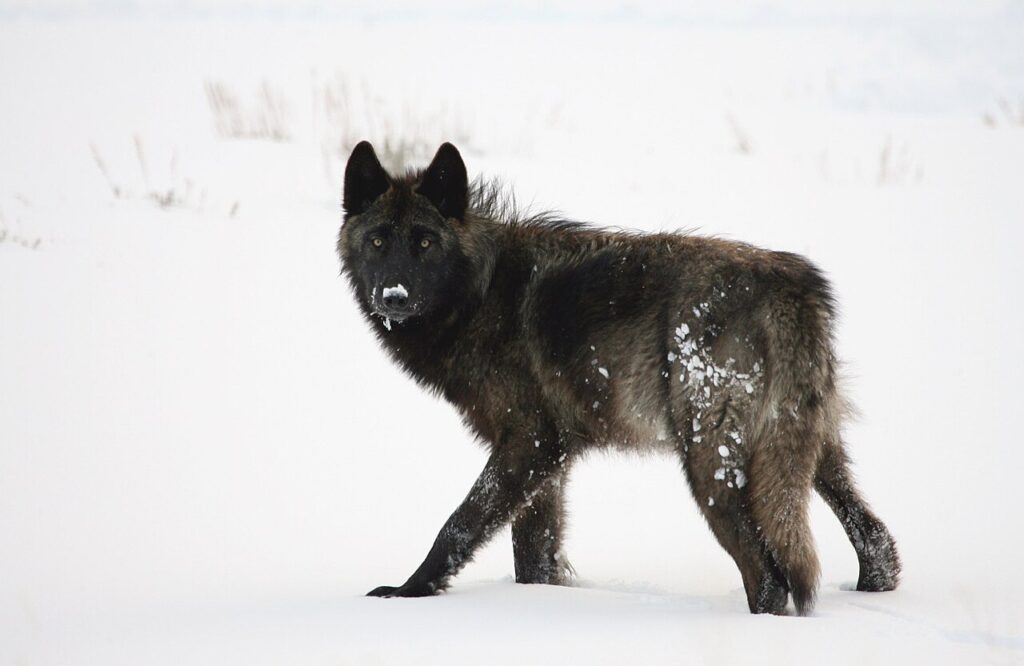
The Lamar Valley, in the north-east of Yellowstone National Park, is often called “America’s Serengeti” for its herds of bison and elk. It is also the best place in the world to watch wild grey wolves. Since wolves were reintroduced to Yellowstone in 1995 and 1996, generations of packs have been studied here, and visitors with spotting scopes can often watch wolves hunting, playing and travelling across the open valley.
At a glance
| Best time | December to March (winter) and May to June |
| Getting there | Fly to Bozeman (about 2.5 to 3 hours) and enter through the North Entrance at Gardiner |
| Time needed | 3 to 5 days |
| Big draws | Wolves, bison, elk, pronghorn, bears (in summer) |
| Good for | Patient wildlife watchers, photographers |
Wolves in Yellowstone
- Wolves were eliminated from Yellowstone by the 1920s. In 1995 and 1996, 41 wolves from Canada and Montana were released. Numbers grew, and the park typically holds around 100 wolves in about ten packs today. See our grey wolf profile.
- Their return has reshaped the ecosystem, influencing elk behaviour and numbers, and providing carrion for other species, although scientists still debate the full extent of these “trophic cascade” effects.
- The Yellowstone Wolf Project has tracked wolves for decades, and some individual wolves have become famous.
How to see wolves
- Go in winter: snow makes wolves easy to see against the white landscape, and they are concentrated in the valley with elk and bison.
- Start at dawn: wolves are most active early in the morning and at dusk.
- Bring or rent a spotting scope: wolves are often seen at a distance of a kilometre or more.
- Join the wolf watchers: groups of regular wolf watchers gather at pull-outs along the road; they are usually happy to share scope views and information. Radio signals from collared wolves help trackers locate packs.
- Hire a guide: local wildlife guides know recent wolf activity and provide scopes.
Other wildlife
- Bison: huge herds year-round. See our American bison profile.
- Elk, pronghorn, bighorn sheep, mule deer and coyotes. See our pronghorn profile.
- Grizzly and black bears from spring to autumn.
- Bald and golden eagles, red foxes and river otters.
When to go
- December to March: the best time for wolves; cold (often below -20°C) but spectacular. The road from Gardiner through Lamar to Cooke City is the only road in the park open to cars in winter.
- May to June: wolves at dens (from a distance), bears emerging, bison calves.
- July to September: busy summer; wolves harder to see.
- October to November: rutting elk; fewer visitors.
Where to stay
Gardiner, Mammoth Hot Springs, Silver Gate and Cooke City are the closest bases.
Frequently asked questions
When is the best time to see wolves in Yellowstone? Winter, especially January and February, in the Lamar Valley.
Do I need a spotting scope? It greatly improves your chances. Wolf watchers often share, but bringing or renting one is best.
Can I drive into Lamar Valley in winter? Yes. The road from the North Entrance to Cooke City is kept open year-round, weather permitting.
How many wolves live in Yellowstone? Usually around 100 in the park, in about ten packs, though numbers vary each year.
Related guides
- Yellowstone wildlife guide
- Grand Teton wildlife guide
- Wolf watching in Spain’s Sierra de la Culebra
- Animal profiles: Grey wolf, American bison, Elk (wapiti)
Cover photo: Yellowstone National Park, Public domain, via Wikimedia Commons