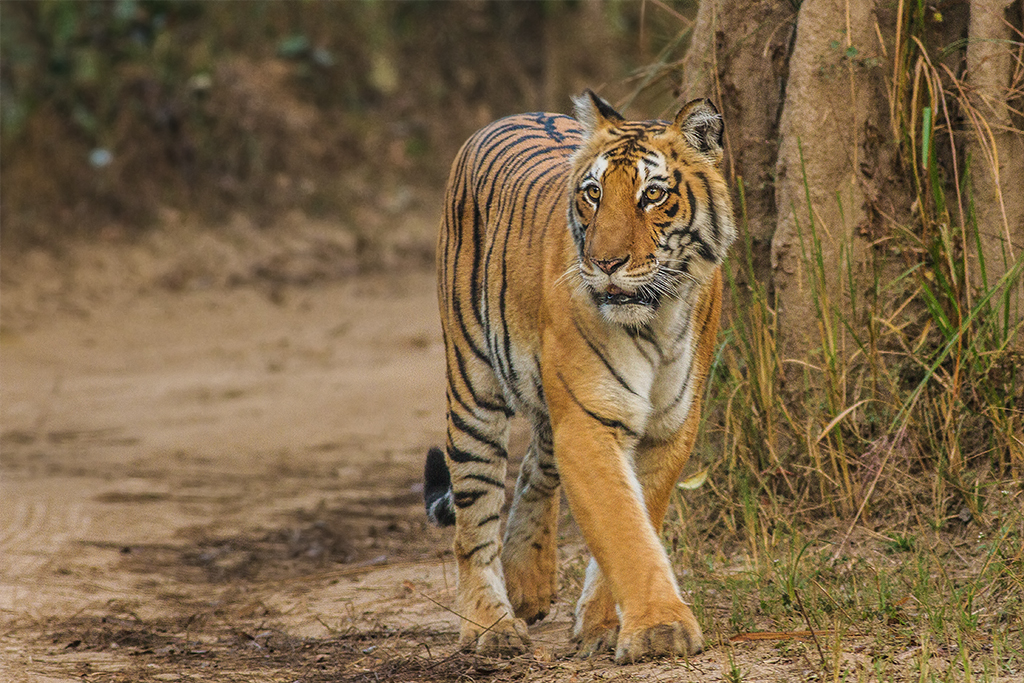
Jim Corbett National Park, in the foothills of the Himalayas in Uttarakhand, was India’s first national park, created in 1936 as Hailey National Park and later renamed after the hunter-turned-conservationist Jim Corbett. In 1973, it became the launch site of Project Tiger, India’s flagship tiger conservation programme. Today it combines tigers, large herds of Asian elephants and one of India’s richest bird lists with forested hills and the broad Ramganga River valley.
At a glance
| Best time | November to June |
| Getting there | About 5 to 7 hours by road or train from Delhi to Ramnagar |
| Time needed | 3 to 4 nights, ideally including a night inside the park |
| Big draws | Tigers, elephants, birding, river landscapes |
| Good for | Visitors from Delhi, birders, photographers |
Wildlife
- Tigers: Corbett Tiger Reserve has one of the highest tiger densities in India. See our tiger profile.
- Asian elephants: large herds gather on the Ramganga grasslands, especially in summer. See our Asian elephant profile.
- Leopards, sloth bears, Himalayan black bears (in higher areas), yellow-throated martens, otters, chital, sambar, hog deer and barking deer.
- Gharials and mugger crocodiles in the Ramganga River. See our gharial profile.
- Birds: around 600 species, including great hornbills, Pallas’s fish eagles, wallcreepers and ibisbills along the rivers in winter.
Safari zones
| Zone | Notes |
|---|---|
| Dhikala | The largest and most famous zone, with grasslands and the Ramganga reservoir. Visitors can stay overnight inside the park at forest rest houses |
| Bijrani | Mixed forest and grassland, good for tigers; day safaris |
| Jhirna | Drier forest; usually open year-round |
| Dhela | Newer zone, often open year-round |
| Durga Devi | Hilly, good for birding and mahseer fish in the river |
| Garjia and Sitabani | Additional zones, including the buffer area |
Staying inside Dhikala
A night at the Dhikala forest rest house, deep inside the park, is one of Corbett’s highlights. Accommodation is simple, and bookings are made through the official Corbett Tiger Reserve website, opening well in advance and selling out quickly.
When to go
- November to February: cool, misty mornings; excellent for birds and landscapes.
- March to June: hot and dry; the best time for tigers and elephants near water.
- July to October: monsoon. Dhikala and Bijrani close; Jhirna and Dhela usually stay open. Check current opening dates.
Getting there
Ramnagar, the gateway town, is about 250 km from Delhi, a drive of 5 to 7 hours, and has an overnight train connection. The nearest airport is Pantnagar.
Where to stay
Resorts along the Kosi River near Ramnagar and around Dhikuli, from budget to luxury, plus the forest rest houses inside the park.
Tips
- Book Dhikala accommodation and safaris as early as possible.
- Hire a bird guide for a morning along the Kosi River.
- Visit Corbett’s former home at Kaladhungi, now a museum.
- Wear warm layers for winter safaris.
Frequently asked questions
Is Corbett good for tiger sightings? Yes, though its denser forests mean sightings can be harder than in central Indian parks. Dhikala and Bijrani offer the best chances.
How far is Jim Corbett from Delhi? About 250 km, or 5 to 7 hours by road or train.
Can I stay inside Corbett National Park? Yes, at forest rest houses in Dhikala and other zones, booked on the official website.
Which zone is best? Dhikala, for its grasslands, elephants and overnight stays.
Related guides
- Best places to see tigers in India
- Birdwatching in Nepal
- Ranthambore National Park guide
- Animal profiles: Tiger, Asian elephant, Gharial
Cover photo: Soumyajit Nandy, CC BY-SA 3.0, via Wikimedia Commons