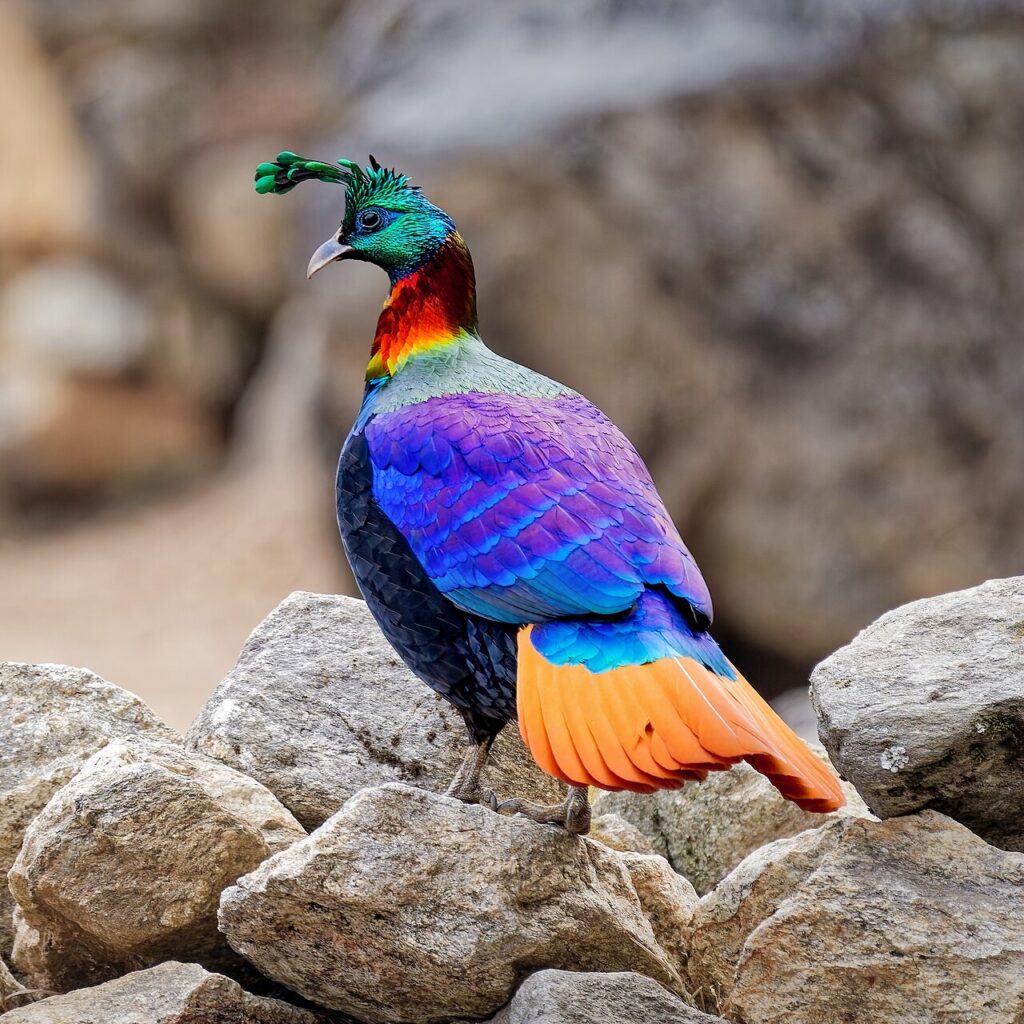
Nepal is small, but its altitude range, from about 60 metres above sea level in the Terai to 8,849 metres on the summit of Everest, creates an extraordinary variety of habitats. Nearly 900 bird species have been recorded in the country, around 8 percent of the world’s total. They range from grassland specialists such as the Bengal florican to high-altitude birds such as the Himalayan monal, Nepal’s national bird, and the spiny babbler, the country’s only endemic bird.
Nepal birding at a glance
| Species recorded | Around 890 |
| Endemic | Spiny babbler (Turdoides nipalensis) |
| National bird | Himalayan monal, locally called Danphe |
| Best time | October to April; March to May for breeding hill birds |
| Key habitats | Terai grasslands and wetlands, subtropical forest, temperate forest, alpine meadows |
| Globally threatened | Around 40 species, including Bengal florican, sarus crane and several vultures |
The best birding sites
Koshi Tappu Wildlife Reserve and Koshi Barrage (east Terai)
A Ramsar wetland on the Sapta Koshi River and the country’s top waterbird site, with nearly 500 recorded species. Winter brings huge numbers of ducks, geese and waders, as well as the swamp francolin, Bengal florican (rare), striated grassbird and black-necked stork. The Koshi Barrage is excellent for gulls, terns, skimmers and river specialists.
Chitwan National Park (central Terai)
Nepal’s most visited park has more than 540 recorded species. Birding by jeep, canoe and on foot can produce great hornbills, Bengal floricans in the grasslands, lesser adjutants, many kingfishers and, in the monsoon, pittas. The Bis Hajar Tal wetlands in the buffer zone are excellent. See our Chitwan National Park safari guide.
Bardia National Park and Shuklaphanta National Park (west Terai)
Bardia’s riverine forest and grasslands host hornbills, sarus cranes and the Bengal florican. Shuklaphanta’s vast phanta grasslands are among the best places in the world for Bengal floricans, along with swamp francolins, Jerdon’s babbler and finn’s weaver.
Lumbini (west-central Terai)
The birthplace of the Buddha is also a haven for sarus cranes, the world’s tallest flying bird, which breed in the surrounding wetlands and farmland. A crane sanctuary protects part of this area.
Kathmandu Valley: Phulchoki and Shivapuri
- Phulchoki Hill (2,782 m), the valley’s highest point, has a rich temperate forest with laughingthrushes, sunbirds, minivets and the spiny babbler on its lower slopes.
- Shivapuri Nagarjun National Park offers easy day trips for barbets, woodpeckers and Himalayan forest birds.
- Taudaha Lake is good for winter waterfowl.
Annapurna and Ghorepani
Rhododendron forests around Ghorepani and Poon Hill are superb in April, with kalij pheasants, Himalayan monals, fire-tailed sunbirds and many warblers. The Pokhara lakes are excellent for waterbirds.
Everest region (Khumbu) and Langtang
High-altitude specialities include the Himalayan monal, blood pheasant, snow partridge, Tibetan snowcock, lammergeier, Himalayan griffon, grandala, wallcreeper and various rosefinches and accentors.
Seasons
| Season | Months | Highlights |
|---|---|---|
| Winter | November to February | Migratory waterfowl, raptors and Siberian migrants in the Terai; altitudinal migrants in the lowlands |
| Spring | March to May | Breeding season; rhododendron forests alive with song; Bengal florican displays in the grasslands |
| Monsoon | June to September | Heavy rain, leeches and difficult travel; some breeding species |
| Autumn | October | Clear skies, trekking season, raptor migration over the Himalaya |
Key species to look for
- Bengal florican: a Critically Endangered bustard whose males leap in display over grasslands from March to May.
- Spiny babbler: Nepal’s only endemic bird, a skulking resident of scrub in the mid-hills.
- Himalayan monal: a spectacular iridescent pheasant.
- Great hornbill in lowland forests.
- Ibisbill, a unique wader of Himalayan shingle rivers.
- Vultures: Nepal’s “vulture safe zones” and community-run “vulture restaurants” have helped white-rumped vultures begin to recover after the diclofenac crisis.
Practical tips
- Hire a local bird guide. Nepal has a strong community of skilled bird guides, and many parks require a licensed guide.
- Bring good binoculars and a field guide or app with Nepal’s birds.
- Combine lowland and highland sites for the widest variety.
- Respect wildlife: do not play recordings excessively, particularly for threatened species during breeding.
- Record your sightings on eBird to support citizen science.
Learn more
For detailed distribution maps and flyway information, see the Nepal Bird Atlas by The Ornithology at theornithology.com.
Frequently asked questions
When is the best time for birdwatching in Nepal? November to April is best overall, with wintering waterbirds in the Terai and birds moving down from the mountains. March to May is excellent for breeding birds in the hills and for Bengal florican displays.
Where can I see the Bengal florican in Nepal? The grasslands of Shuklaphanta, Bardia and Chitwan national parks and Koshi Tappu Wildlife Reserve. Spring, when males display, is the best time.
Do I need a guide for birding in Nepal? A local bird guide is strongly recommended, and guides are required inside many national parks. Nepal has many skilled bird guides who know calls and sites well.
How many days do I need? A two-week trip can combine Kathmandu Valley hills, Chitwan and Koshi Tappu with a short trek in the Annapurna foothills for Himalayan species.
Related guides
- Chitwan National Park safari guide
- Kaziranga National Park guide
- Wildlife of Asia
- Animal profiles: Great Hornbill, Peregrine Falcon
Cover photo: Pratap Gurung, CC BY-SA 4.0, via Wikimedia Commons