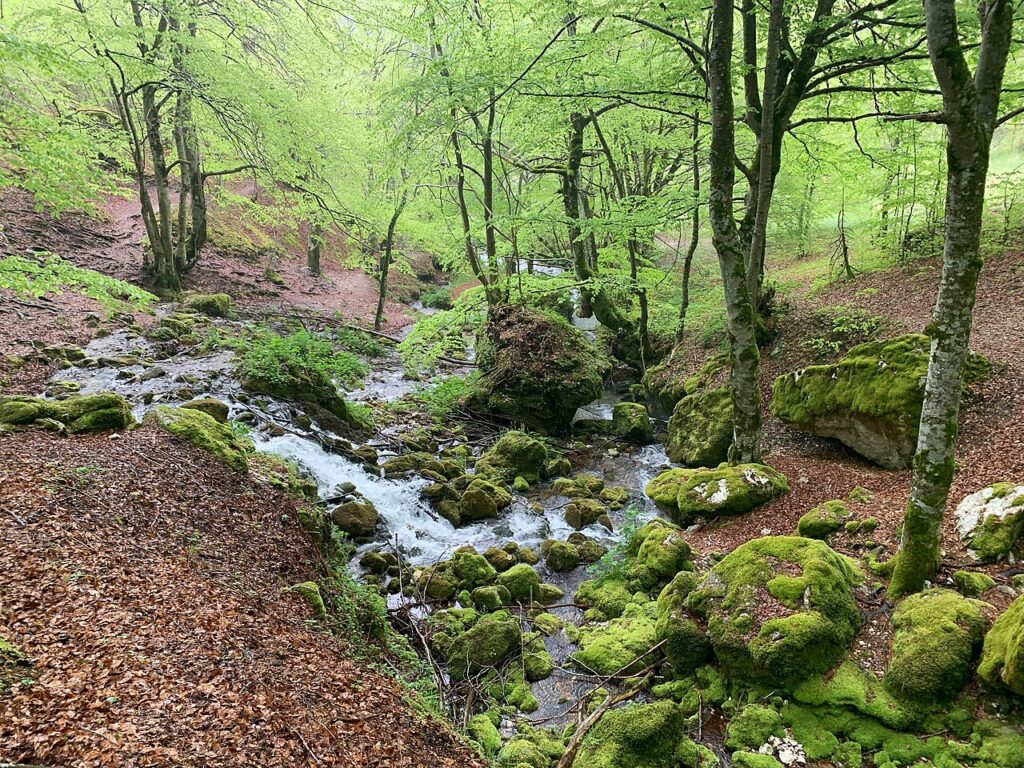
Abruzzo, Lazio and Molise National Park, founded in 1923, protects the rugged Apennine mountains of central Italy, just a couple of hours from Rome. It is the stronghold of the Marsican brown bear, a critically endangered subspecies with only around 60 individuals, and of the Apennine wolf, which recovered from near extinction to spread across Italy.
At a glance
| Best time | May to June and September to October |
| Getting there | About 2 to 2.5 hours by road from Rome |
| Time needed | 3 to 4 days |
| Big draws | Marsican bears, wolves, Apennine chamois, beech forests |
| Good for | Hikers, wildlife enthusiasts, combining with Rome |
Marsican brown bears
- The Marsican bear is a small, isolated subspecies of the brown bear, living mainly in and around the park. See our brown bear profile.
- Around 60 bears remain. Threats include road accidents, poaching, disease from livestock and the small population size.
- Bears are mostly seen at dawn and dusk from a distance, often on slopes eating berries and buckthorn in late summer and autumn.
- Some bears, such as the famous female Amarena, killed in 2023, became known for visiting villages. Villagers and park staff work to reduce conflicts with fences and bear-proof bins.
Apennine wolves
By the 1970s, only about 100 wolves survived in Italy, many in Abruzzo. Legal protection allowed them to recover, and wolves now live across the Apennines and into the Alps. They are elusive, but guided dawn watches sometimes find them. See our grey wolf profile.
Other wildlife
- Apennine chamois: once reduced to a few dozen, now recovering; easily seen on the slopes of Val di Rose and Camosciara.
- Red deer, roe deer, wild boar, golden eagles and white-backed woodpeckers.
- Ancient beech forests: part of a UNESCO World Heritage Site of primeval beech forests.
Guided wildlife watching
Local guides lead dawn and dusk watches from viewpoints, keeping a respectful distance from bears and wolves. Guides know the best areas and help avoid disturbing wildlife, especially in sensitive seasons.
When to go
- May to June: spring flowers, bears feeding in meadows, chamois with kids.
- July to August: busy; some trails to chamois areas limited to protect them.
- September to October: bears feeding on buckthorn berries; red deer rut; autumn colours.
- Winter: snowy landscapes, wolf tracking.
Where to stay
Villages such as Pescasseroli, Civitella Alfedena, Villetta Barrea and Opi have guesthouses, agriturismi and small hotels.
Frequently asked questions
Can I see Marsican bears? Yes, with patience and a local guide, especially in late summer and autumn.
How many Marsican bears are left? Around 60.
Can I see wolves in Abruzzo? Sometimes, on guided dawn watches, but they are elusive.
Is Abruzzo easy to reach from Rome? Yes, about 2 to 2.5 hours by road.
Related guides
- Gran Paradiso: Alpine ibex and marmots
- Wolf watching in Spain’s Sierra de la Culebra
- Rewilding Europe
- Animal profiles: Brown bear, Grey wolf, Red deer
Cover photo: Bouke ten Cate, CC BY 4.0, via Wikimedia Commons