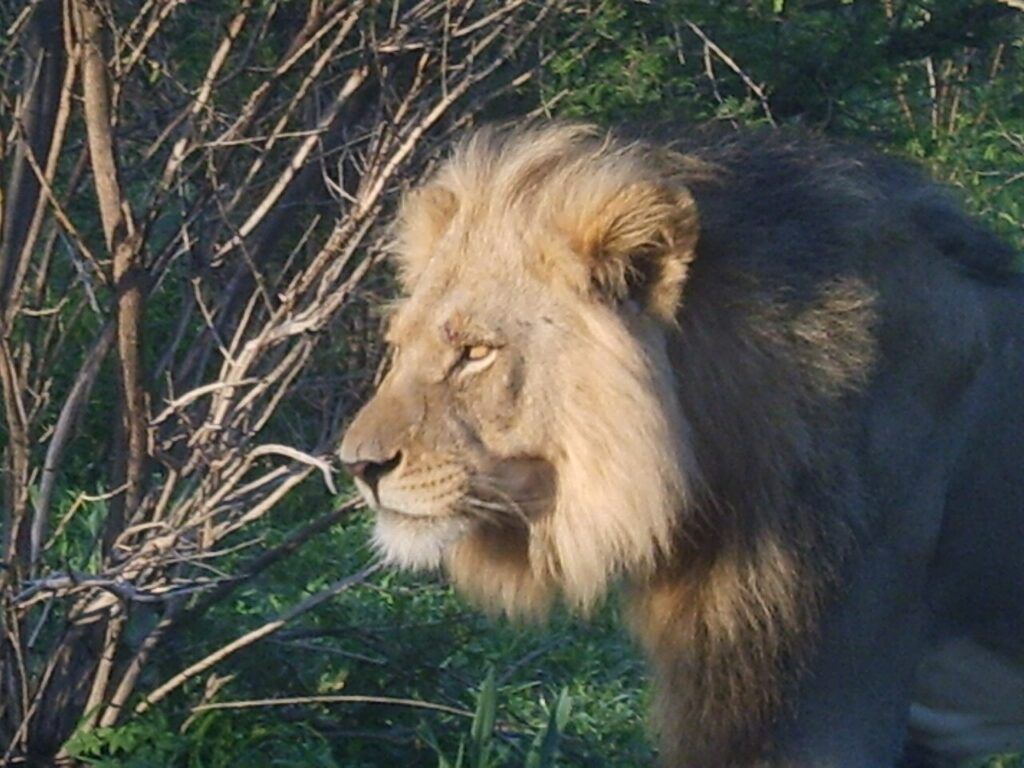
At about 52,800 km², the Central Kalahari Game Reserve (CKGR) is one of the largest protected areas in Africa, bigger than Denmark. For most of the year it is dry and quiet. But after the summer rains, the ancient fossil river valleys fill with sweet grass, and springbok, gemsbok, wildebeest and hartebeest gather in their thousands, followed by the famous black-maned Kalahari lions.
At a glance
| Best time | December to April (green season) |
| Getting there | Light aircraft from Maun, or a 4×4 expedition |
| Time needed | 3 to 5 nights |
| Big draws | Kalahari lions, cheetahs, brown hyenas, green-season herds, solitude |
| Good for | Second safaris, self-drive adventurers, photographers |
Wildlife
- Lions: Kalahari lions are large, and males often have impressive dark manes. See our lion profile.
- Cheetahs, leopards, brown hyenas, wild dogs and bat-eared foxes.
- Antelope: gemsbok, springbok, red hartebeest, blue wildebeest, eland and steenbok.
- Birds: kori bustards, secretary birds, raptors and, after rain, many migrants.
- Honey badgers, ground squirrels and meerkats at their burrows.
Deception Valley and the pans
Most wildlife viewing takes place around the reserve’s fossil valleys and pans, such as Deception Valley, Sunday Pan, Piper Pan, Passarge Valley and Tau Pan. Deception Valley became famous through Cry of the Kalahari, the account of Mark and Delia Owens’ research on lions and brown hyenas in the 1970s.
When to go
- December to April (green season): the best time. Antelope herds gather on the short grass of the valleys, many animals have young, and predators are active. Thunderstorms are dramatic, and some tracks become sticky.
- May to August: dry, cool and quiet; animals disperse and the landscape turns golden.
- September to November: very hot and dry, with few animals except around the pans.
The San people
The Kalahari is the ancestral land of the San (Basarwa). Many were moved out of the reserve in the late 1990s and early 2000s, and in 2006 Botswana’s High Court ruled that the removals had been unlawful. Access and rights remain sensitive. Some camps offer guided walks with San trackers; choose experiences that are respectfully run and benefit San communities.
Getting there
- By air: light aircraft from Maun land at airstrips near the lodges in about an hour.
- Self-drive: the reserve’s main gate (Matswere) is reached via Rakops, and the drive from Maun takes most of a day. You must be completely self-sufficient.
Where to stay
A few small lodges operate in and near the reserve, and campsites are scattered across it. Campsites are basic, often just a clearing with a fire pit and perhaps a long-drop toilet, and must be booked in advance.
Self-drive essentials
- Use a fully equipped 4×4, ideally travelling in convoy with a second vehicle.
- Carry all water (at least 5 litres per person per day), food and fuel for the whole trip, plus spare tyres and recovery equipment.
- Book campsites and permits in advance and carry proof.
- Tell someone your route and expected return.
Frequently asked questions
Is the Central Kalahari worth visiting? Yes, for travellers who value solitude, big skies and predators. It is not the place for the Big Five or large elephant herds.
When is the best time to visit the CKGR? The green season from December to April, when herds gather and predators follow.
Are there elephants in the Central Kalahari? Very few. The reserve’s highlights are predators, antelope, birds and landscapes.
Can I visit on a day trip? No. Distances are too great; plan at least three nights.
Related guides
- Makgadikgadi Pans and the zebra migration
- Kgalagadi Transfrontier Park
- Green season safaris
- Animal profiles: Lion, Gemsbok, Honey badger
Cover photo: DVL2, CC BY-SA 3.0, via Wikimedia Commons