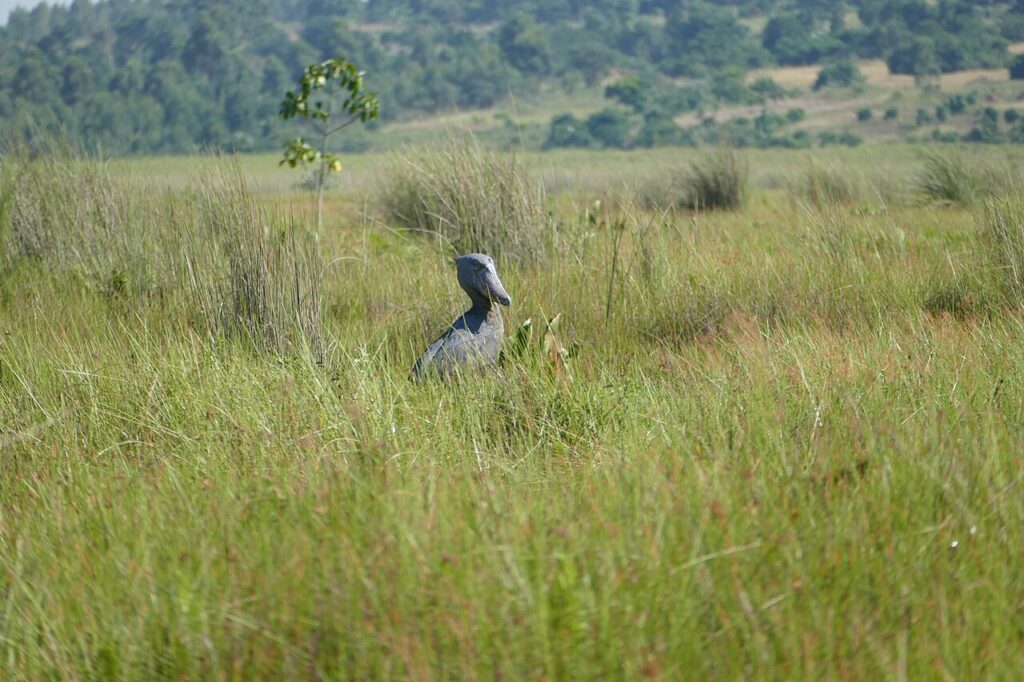
With its massive, clog-shaped bill, piercing stare and grey plumage, the shoebill looks like a creature from another age. It stands up to about 1.4 metres tall and waits motionless in papyrus swamps for lungfish and catfish, then lunges with surprising speed. The shoebill lives only in the wetlands of East and Central Africa and is listed as Vulnerable, with a few thousand remaining. See our shoebill profile.
The best places to see shoebills
Mabamba Swamp, Uganda
A wetland on the shores of Lake Victoria, about an hour from Entebbe. Local guides paddle you through the papyrus channels by canoe, and shoebills are seen on most trips. It is the easiest place to see one, and a perfect first or last morning in Uganda. Community guides and fees help protect the swamp.
Murchison Falls National Park, Uganda
The delta where the Victoria Nile enters Lake Albert is one of the best shoebill sites, reached on a morning boat trip from Paraa. See our Murchison Falls guide.
Bangweulu Wetlands, Zambia
A vast wetland in northern Zambia, managed by African Parks with local communities. Shoebills breed here, and local fishermen are employed as nest guardians. Viewing is usually best from about March to July, when the water is high enough for boats but the birds are active. Black lechwe gather in their tens of thousands.
Other sites
- Lake Mburo and Queen Elizabeth national parks (Uganda): occasional sightings.
- Akagera (Rwanda): shoebills are sometimes seen in the lakes and swamps.
- Makanaga and other Lake Victoria swamps (Uganda).
- South Sudan’s Sudd: the largest population, but not currently a practical destination.
Tips for seeing shoebills
- Go early: mornings are best, before heat haze and wind.
- Take a boat or canoe: shoebills live deep in papyrus, often out of sight from land.
- Bring binoculars and a long lens.
- Be patient: shoebills can stand still for long periods; once you find one, you may get prolonged views.
- Keep your distance, especially near nests.
Threats
Shoebills are threatened by the draining and burning of wetlands, disturbance, and the capture of chicks for the illegal bird trade. Community-based protection, such as the nest guardian programme in Bangweulu, has helped improve breeding success.
Frequently asked questions
Where is the best place to see a shoebill? Mabamba Swamp near Entebbe in Uganda is the easiest and most reliable, followed by the Murchison Falls delta and Zambia’s Bangweulu Wetlands.
How rare is the shoebill? It is listed as Vulnerable, with an estimated population of a few thousand birds.
When is the best time to see shoebills? Year-round in Uganda. In Bangweulu, roughly March to July.
Is the shoebill a stork? It was once grouped with storks but is now placed in its own family, and is thought to be more closely related to pelicans.
Related guides
- Murchison Falls National Park guide
- Kasanka bat migration
- Birdwatching in Nepal
- Animal profiles: Shoebill, Great white pelican, Marabou stork
Cover photo: Sjoerdug, CC BY-SA 4.0, via Wikimedia Commons