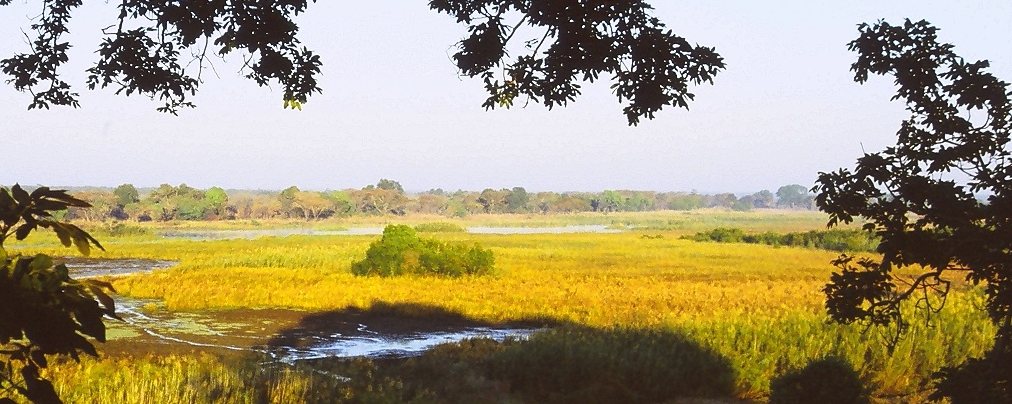
Every year, from about late October to December, millions of straw-coloured fruit bats arrive in Kasanka National Park in northern Zambia. By some estimates as many as ten million roost in a small area of swamp forest, making this the largest mammal migration in the world by number. At dusk, the bats pour out of the trees to feed, filling the sky for up to half an hour.
At a glance
| Best time | Mid-November to mid-December |
| Getting there | About 6 to 8 hours by road from Lusaka, or a charter flight |
| Time needed | 2 to 3 nights |
| Big draws | The bat migration, sitatunga, birding |
| Good for | Wildlife enthusiasts, photographers, combining with Bangweulu |
The bats
- Straw-coloured fruit bats are large fruit bats with a wingspan of up to about 80 cm. They travel from across Central Africa to feast on seasonal fruit, such as masuku (wild loquat), that ripens in the surrounding woodland at this time. See our fruit bat profile.
- They roost by day in a patch of evergreen forest along the Musola stream, so densely that branches break under their weight.
- At dusk they leave the roost in a vast stream, and at dawn they return.
- Eagles, vultures and other predators gather to hunt them, and crocodiles pick off bats that fall into the water.
How to watch
Hides and platforms at the edge of the roost let you watch the dusk emergence and dawn return without disturbing the bats. Guided visits are managed by the Kasanka Trust, which has run the park with the government since the 1980s, making it one of Zambia’s first privately supported parks.
Other wildlife
- Sitatunga: Kasanka is one of the best places in Africa to see this shy swamp antelope, especially from the Fibwe hide, a platform high in a mahogany tree.
- Puku, hippos, crocodiles and blue monkeys.
- Birds: over 400 species, including Pel’s fishing owl, Ross’s turaco and wattled cranes.
Combine with the Bangweulu Wetlands
A few hours away, the Bangweulu Wetlands are one of the best places in the world to see the shoebill, as well as tens of thousands of black lechwe. The wetlands are managed by African Parks with local communities. Shoebill viewing is usually best from about March to July, so combining both trips in November is a trade-off; ask local operators about current conditions.
When to go
The bats begin arriving in late October, peak from about mid-November to mid-December and leave by early January. The rains begin in November, so expect heat and storms.
Getting there
Kasanka is about 500 km north-east of Lusaka along the Great North Road, a long day’s drive. Charter flights can reach the park’s airstrip.
Where to stay
The park has a main lodge and campsites run by the Kasanka Trust. Book early for the bat season, as space is limited.
Frequently asked questions
How many bats are at Kasanka? Estimates vary, but up to around ten million at the peak, making it one of the largest gatherings of mammals on Earth.
When is the best time to see the bat migration? From about mid-November to mid-December.
Is it safe? Yes. The bats are fruit eaters and pose no danger. Visitors are advised to wear a hat, as the bats can be messy.
Can I see other wildlife at Kasanka? Yes, especially sitatunga, puku, hippos and many birds.
Related guides
- Shoebill safari: where to find Africa’s strangest bird
- Liuwa Plain: Africa’s second-largest wildebeest migration
- South Luangwa walking safaris
- Animal profiles: Flying fox fruit bat, Shoebill
Cover photo: Mehmet Karatay, CC BY-SA 4.0, via Wikimedia Commons