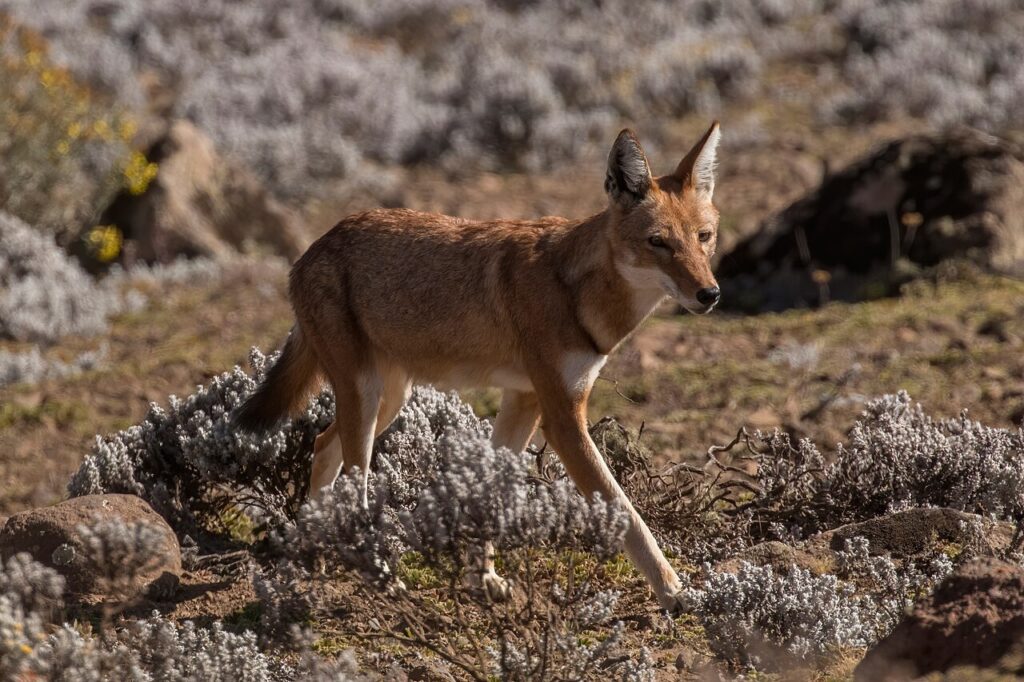
Ethiopia’s highlands, the “roof of Africa”, rise above 4,000 metres and hold wildlife found nowhere else on Earth. In the Bale Mountains in the south, the Ethiopian wolf hunts giant mole-rats on an Afro-alpine plateau. In the Simien Mountains in the north, troops of geladas graze on cliff-top meadows above dramatic escarpments.
At a glance
| Best time | October to February (dry season) |
| Getting there | Bale: road or flight from Addis Ababa. Simien: via Gondar |
| Time needed | 3 to 4 nights in each area |
| Big draws | Ethiopian wolves, geladas, mountain nyala, Walia ibex, lammergeiers |
| Good for | Wildlife enthusiasts, trekkers, birders |
The Ethiopian wolf
- The Ethiopian wolf is the world’s rarest canid, with fewer than 500 adults, living in a handful of mountain ranges. More than half live in the Bale Mountains.
- Wolves live in packs but hunt alone, mostly by day, stalking rodents such as the giant mole-rat.
- The main threats are habitat loss, and rabies and distemper caught from domestic dogs. The Ethiopian Wolf Conservation Programme vaccinates wolves and village dogs.
Bale Mountains National Park
- Sanetti Plateau: a road crosses this Afro-alpine plateau at about 4,000 m, and wolves are often seen from the vehicle or on short walks, especially in the morning.
- Web Valley: another excellent wolf area, reached on foot or horseback.
- Mountain nyala: an endemic antelope, easily seen around the park headquarters at Dinsho.
- Harenna Forest: a cloud forest on the southern escarpment with Bale monkeys and giant forest hogs.
- Birds: many Ethiopian endemics, including the blue-winged goose, Rouget’s rail and Abyssinian catbird.
Simien Mountains National Park
A UNESCO World Heritage Site of jagged peaks and sheer cliffs.
- Geladas: grass-eating monkeys that live in large groups, sometimes hundreds strong. Males have a bright red patch on their chests. Troops are habituated and easy to watch at close range.
- Walia ibex: an endemic wild goat of the cliffs, recovering from fewer than 200 animals.
- Lammergeiers (bearded vultures) soar along the escarpment. See our bearded vulture profile.
- Trekking: routes from one to ten days, with an armed scout (compulsory) and often mules to carry gear.
When to go
- October to February: dry, clear and sunny days, with cold nights. Wildflowers bloom after the rains in October.
- March to May: short rains.
- June to September: the main rains; trekking is wet and cloudy, but the landscapes are green.
Getting there
- Bale: about 7 to 8 hours by road from Addis Ababa, or fly to Robe or Goba.
- Simien: fly to Gondar and drive about 2 to 3 hours to Debark, the park headquarters.
Safety and access
Parts of northern Ethiopia, including the Amhara region where the Simien Mountains lie, have been affected by conflict in recent years. Check your government’s current travel advice and speak to local operators before planning a visit. Bale’s situation should also be checked before travel.
Frequently asked questions
Where is the best place to see Ethiopian wolves? The Sanetti Plateau and Web Valley in the Bale Mountains, where sightings are very likely.
How close can you get to geladas? Habituated troops in the Simien Mountains let visitors watch from a few metres away. Keep a respectful distance and do not feed them.
Do I need to be fit? Moderately. Altitude is high (3,000 to 4,500 m), so allow time to acclimatise.
Is it safe to visit the Simien Mountains? It depends on the current situation. Check government travel advice and consult local operators.
Related guides
- Where to see African wild dogs
- Madagascar wildlife guide
- Animal profiles: Ethiopian wolf, Bearded vulture, Grey wolf
Cover photo: Charles J. Sharp, CC BY-SA 4.0, via Wikimedia Commons