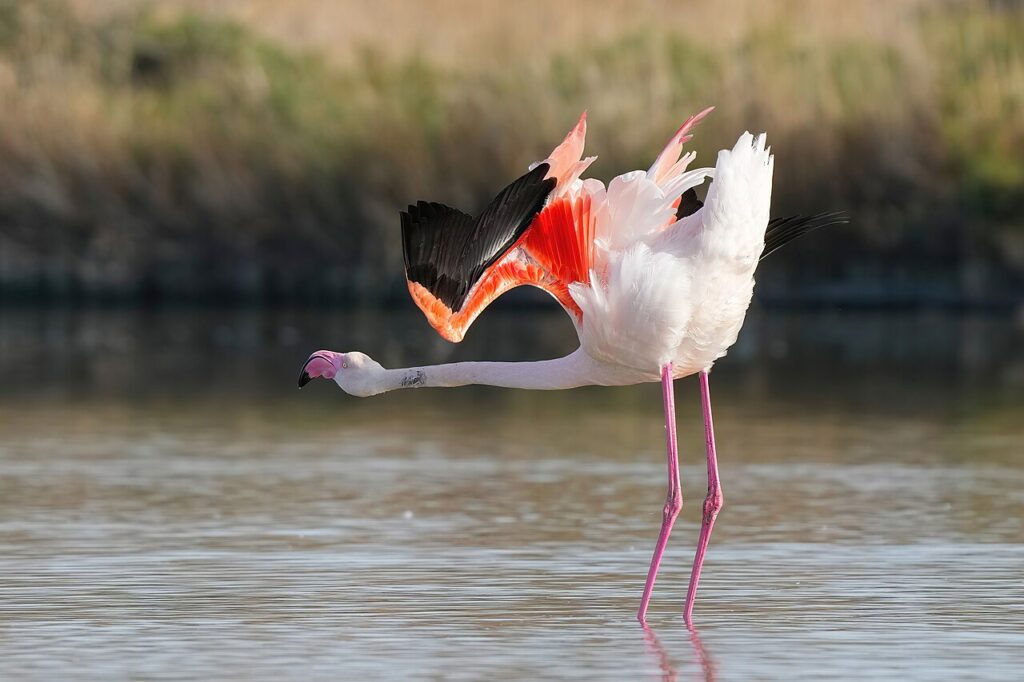
The Camargue, where the Rhône River meets the Mediterranean in southern France, is one of Europe’s most important wetlands: a landscape of salt lagoons, marshes, reed beds and dunes covering about 930 km². It is famous for its greater flamingos, which breed nowhere else in France, its semi-wild white horses and its black fighting bulls.
At a glance
| Best time | April to June and September to October |
| Getting there | About 30 to 45 minutes from Arles; 1 hour from Nîmes or Montpellier |
| Time needed | 2 to 3 days |
| Big draws | Flamingos, Camargue horses, herons, bee-eaters |
| Good for | Families, birders, photographers |
Flamingos
- The Camargue hosts one of the largest breeding colonies of greater flamingos in the Mediterranean, on the Étang du Fangassier. Tens of thousands of flamingos can be present. See our greater flamingo profile.
- The Parc Ornithologique du Pont de Gau, near Saintes-Maries-de-la-Mer, has trails and hides where wild flamingos feed at close range.
- Flamingos are present year-round, with breeding from about March to July.
Camargue horses and bulls
- Camargue horses: small, hardy white horses (born dark, turning white with age) that have lived in the delta for centuries. They are semi-wild, managed by local herdsmen called gardians.
- Black Camargue bulls graze the marshes. They are raised for the local course camarguaise, a bloodless bull game in which the bulls are not killed.
- Horse riding through the marshes is a popular way to explore.
Birds
More than 350 species have been recorded, including purple herons, squacco herons, glossy ibises, spoonbills, pied avocets, black-winged stilts, European bee-eaters, rollers, collared pratincoles and slender-billed gulls. See our European bee-eater profile. In winter, huge numbers of ducks and waders arrive.
Other wildlife
Beavers along the Rhône, coypu, wild boar, European pond turtles and dragonflies.
Protected areas
- Camargue Regional Natural Park: most of the delta.
- Réserve Nationale de Camargue: around the Étang de Vaccarès, with a visitor centre at La Capelière.
- Tour du Valat: a research station for Mediterranean wetlands.
When to go
- April to June: breeding birds, flamingo colonies, flowers.
- July to August: hot and busy, with mosquitoes.
- September to October: migration, fewer visitors.
- Winter: ducks, flamingos and waders; quiet.
Tips
- Bring insect repellent in summer.
- Start early for the best light and wildlife.
- Cycle or walk the dyke roads (such as the Digue à la Mer) for quiet birding.
- Visit Arles, Aigues-Mortes and Saintes-Maries-de-la-Mer for culture.
Frequently asked questions
Where is the best place to see flamingos in the Camargue? The Parc Ornithologique du Pont de Gau, where wild flamingos feed close to the paths.
Are Camargue horses wild? They are semi-wild, living outdoors year-round but owned and managed by local breeders.
When is the best time to visit the Camargue? Spring (April to June) and autumn (September to October).
Is the Camargue good for birdwatching? Yes, it is one of the best wetlands in Europe for birds.
Related guides
- Danube Delta birding guide
- Raptor migration at the Strait of Gibraltar
- Rewilding Europe
- Animal profiles: Greater flamingo, European bee-eater, Grey heron
Cover photo: Giles Laurent, CC BY-SA 4.0, via Wikimedia Commons