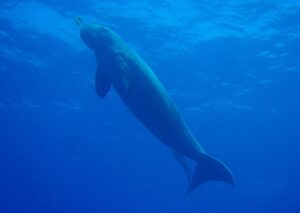
The West Indian manatee is a large, slow-moving marine mammal sometimes called a sea cow. It grazes on seagrass beds and freshwater plants and spends its life in warm, shallow waters. Gentle and curious, it has no natural predators but faces many human threats.
Interesting facts
- Manatees’ closest living relatives are elephants and hyraxes.
- They cannot survive long in water colder than about 20 °C, so in winter Florida manatees gather in warm springs and power plant outflows.
- Many adult manatees in Florida bear scars from boat propellers.
- Manatees can hold their breath for up to about 20 minutes while resting.
- There are two subspecies: the Florida manatee and the Antillean manatee.
- In 2021, more than 1,100 manatees died in Florida, largely from starvation after seagrass died off.
Behaviour
Manatees are mostly solitary or found in loose groups, except for mothers and calves. They spend much of the day feeding and resting, surfacing every few minutes to breathe. They communicate with chirps and squeaks.
Breeding and young
After a gestation of about 12–13 months, a single calf is born underwater. Calves nurse for one to two years and learn migration routes and warm-water sites from their mothers.
Threats and conservation
Collisions with boats, loss of seagrass from pollution and algal blooms, cold stress, red tide toxins, entanglement in fishing gear, and habitat loss.
Where to see it
- Crystal River and Three Sisters Springs, Florida, in winter
- Blue Spring State Park, Florida
- Swallow Caye Wildlife Sanctuary, Belize
- Choose responsible tours that follow ‘passive observation’ rules
Status source: IUCN Red List. Profile last reviewed September 2026.
Where to see the west indian manatee
 Belize Wildlife: Jaguars, Reefs and Howler MonkeysBelize packs rainforest, Maya ruins and the second-longest barrier reef in the world into a small, English-speaking country.
 Everglades National Park Wildlife GuideThe Everglades is the only place on Earth where alligators and crocodiles live side by side. How to…
 Swimming with Manatees in Crystal River ResponsiblyCrystal River is the only place in the US where you can legally swim with manatees. How to…