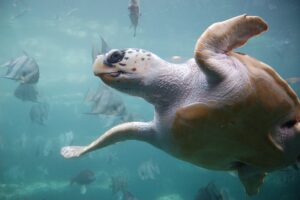
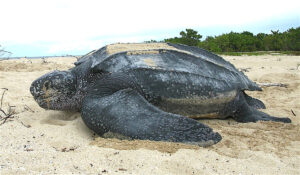
The green turtle is one of the largest sea turtles. By grazing seagrass, it keeps seagrass meadows healthy, benefiting fish and other marine life. Populations have declined through harvesting of eggs and adults, but some nesting sites are recovering under protection.
Interesting facts
- It is named for the greenish colour of its fat, not its shell.
- Green turtles are the only herbivorous sea turtles as adults.
- They can rest underwater for several hours.
- The sex of hatchlings depends on sand temperature; warmer sand produces more females.
- A female may lay several clutches of around 100 eggs in a single season.
- Only about one in a thousand hatchlings is thought to survive to adulthood.
Behaviour
Adults migrate between feeding grounds and nesting beaches every two to four years. Hatchlings spend their early years drifting in the open ocean before settling in coastal feeding areas.
Breeding and young
Females haul themselves up beaches at night, dig a nest and lay eggs that incubate for about two months in the sand. Hatchlings emerge together, usually at night, and head for the brightest horizon, normally the sea.
Threats and conservation
Egg collection and hunting, bycatch in fishing gear, plastic pollution, loss of nesting beaches, artificial lights that disorient hatchlings, and climate change skewing sex ratios.
Where to see it
- Tortuguero, Costa Rica (nesting July–October)
- Heron Island and Raine Island, Great Barrier Reef
- Ras al Jinz, Oman
- Hawaii and the Galápagos (feeding)
Status source: IUCN Red List. Profile last reviewed September 2026.
Where to see the green sea turtle
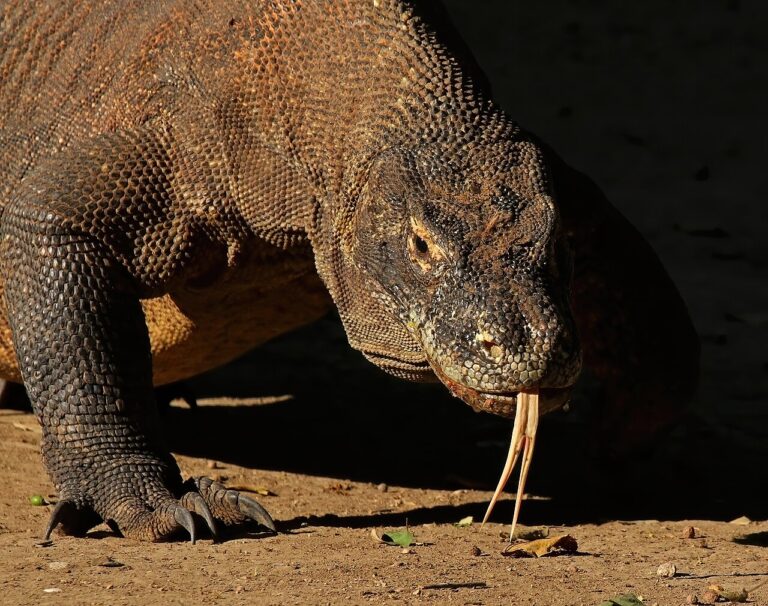 Komodo National Park Guide: Dragons, Diving and Island HoppingSee the world's largest lizard, snorkel with manta rays and hike Padar's viewpoints. How to plan a responsible…
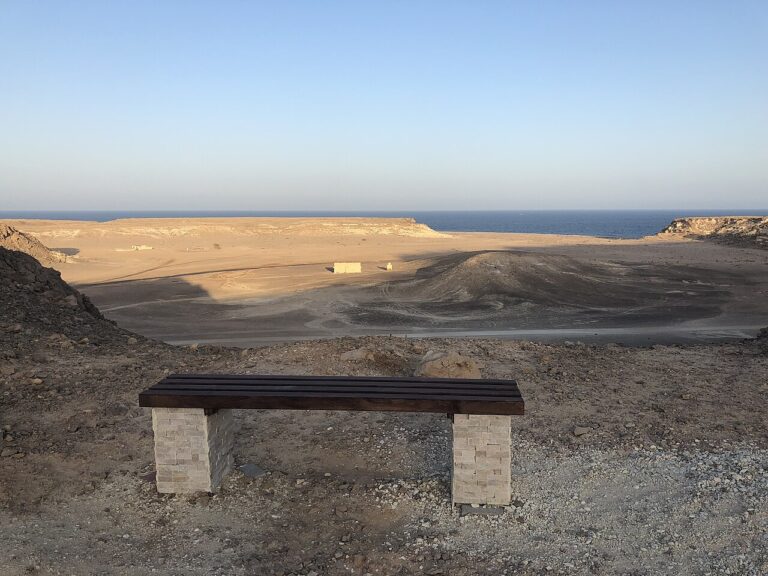 Oman Wildlife: Turtle Nesting at Ras al JinzOn the easternmost tip of Arabia, green turtles haul up the beach to nest at night. How to…
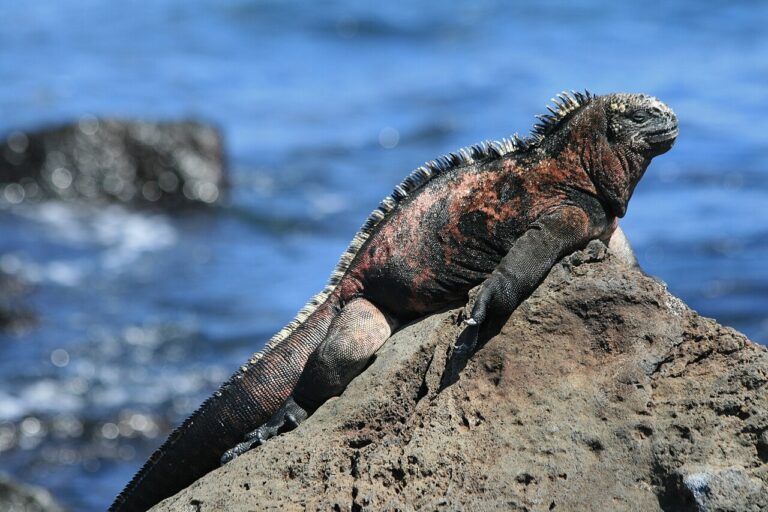 Galápagos Islands Wildlife GuideWhere to see giant tortoises, marine iguanas, blue-footed boobies, penguins and sea lions in the Galápagos, the best…