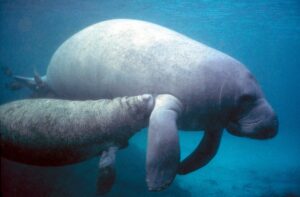
The dugong is a large, gentle marine mammal related to manatees and, more distantly, to elephants. It feeds on seagrass in shallow tropical seas, and its health is closely linked to the health of seagrass meadows.
Interesting facts
- Unlike manatees, dugongs have a fluked, whale-like tail.
- Northern Australia holds the world’s largest dugong population.
- Dugongs have lived to over 70 years, estimated from growth layers in their tusks.
- Male dugongs develop short tusks.
- Sailors’ sightings of dugongs and manatees may have inspired mermaid legends.
- A 2022 study concluded that dugongs are probably functionally extinct in China.
Behaviour
Dugongs are found alone, in pairs or in herds that can number in the hundreds in parts of Australia. They feed by rooting up whole seagrass plants with their muscular, bristly lips.
Breeding and young
Dugongs breed slowly. Females give birth to a single calf after a gestation of about 13–15 months, and only every three to seven years. Calves stay with their mothers for about 18 months.
Threats and conservation
Accidental capture in fishing nets, hunting, boat strikes, and loss of seagrass from coastal development, pollution and extreme weather.
Where to see it
- Shark Bay, Western Australia
- Moreton Bay, Queensland, Australia
- Marsa Alam, Egypt (Abu Dabbab Bay)
- Coron, Palawan, Philippines
Status source: IUCN Red List. Profile last reviewed September 2026.
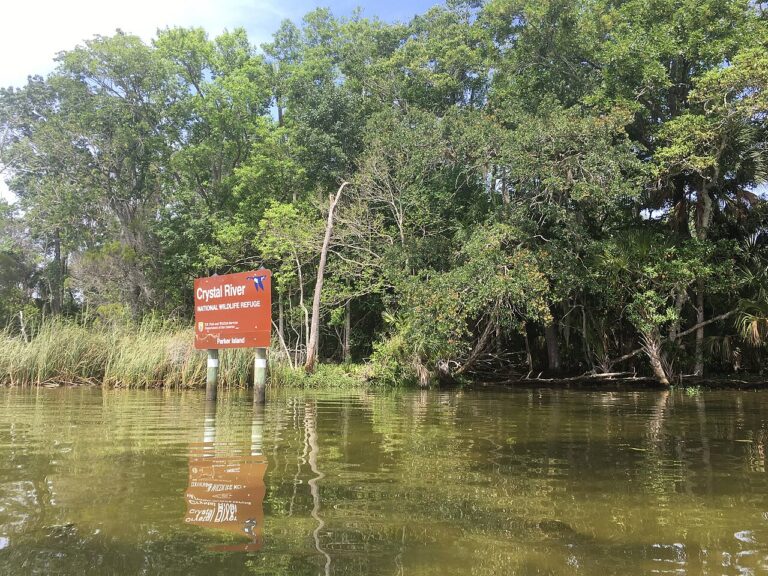 Swimming with Manatees in Crystal River Responsibly
 Swimming with Whale Sharks at Ningaloo Reef