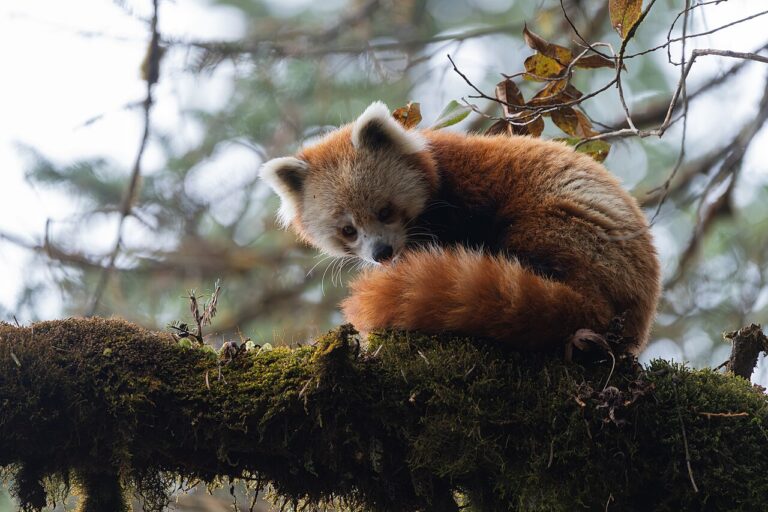
The red panda is a small, tree-dwelling mammal of the eastern Himalaya and southwest China. Its closest relatives are skunks, raccoons and weasels. It depends on bamboo-rich forests, which are being cleared and fragmented.
Interesting facts
- Like the giant panda, it has an extended wrist bone that acts like a false thumb.
- Its thick, ringed tail is used for balance and as a blanket in the cold.
- Red pandas can rotate their ankles to climb head-first down trees.
- They are mostly active at dawn, dusk and night.
- Fewer than 10,000 are estimated to remain in the wild, possibly far fewer.
- Genetic studies suggest there are two species: the Himalayan and the Chinese red panda.
Behaviour
Red pandas are solitary and spend most of their time in trees, sleeping curled on branches. They mark territories with scent glands and urine.
Breeding and young
Females give birth to 1 to 4 cubs in spring or summer after about 135 days, in a nest in a tree hollow or rock crevice.
Threats and conservation
Habitat loss from logging, farming and livestock grazing, poaching and snares, and illegal trade as pets.
Where to see it
- Singalila National Park, India
- Eastern Nepal (Ilam, Taplejung)
- Bhutan’s forests
- Padmaja Naidu Himalayan Zoological Park, Darjeeling (captive)
Status source: IUCN Red List. Profile last reviewed September 2026.
Where to see the red panda
 Red Panda Trekking in NepalSeeing a wild red panda in a Himalayan forest is a rare privilege. Where to look in Nepal,…
 Wildlife of Bhutan: Takins, Tigers and Black-necked CranesBhutan protects more than half its land and has made conservation part of its constitution. Where to see…
 Where to See Giant Pandas in China (Wild and Captive)Most people see giant pandas at breeding centres near Chengdu, but it is possible, with patience, to see…