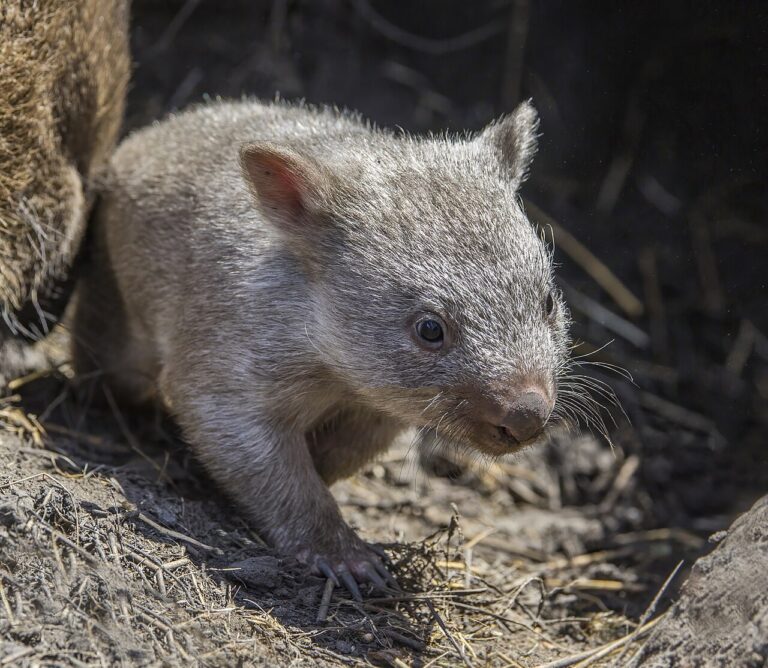
The common wombat is a stocky, burrowing marsupial of southeastern Australia and Tasmania. It is a powerful digger and plays an important role in soil health, while its burrows provide shelter for many other animals.
Interesting facts
- A female wombat’s pouch opens backwards, so it does not fill with soil while she digs.
- Wombats dig extensive burrows that can be many metres long.
- A tough, cartilage-covered rump helps them block burrow entrances against predators.
- Despite their stocky build, wombats can sprint surprisingly fast.
- Their teeth grow continuously, like a rodent’s, and are worn down by tough grasses.
- During bushfires, other animals sometimes shelter in wombat burrows.
Behaviour
Wombats are solitary and mostly nocturnal, spending the day in burrows and emerging to graze at dusk. They have a slow metabolism, which helps them survive on tough, low-nutrient food.
Breeding and young
After a gestation of about a month, a tiny joey crawls into the pouch, where it stays for about six to ten months. It remains with its mother for over a year.
Threats and conservation
Sarcoptic mange, road deaths, habitat clearing and conflict with farmers over fences and burrows.
Where to see it
- Wilsons Promontory National Park, Victoria
- Maria Island and Cradle Mountain, Tasmania
- Kangaroo Valley (Bendeela), New South Wales
- Look for them grazing at dusk
Status source: IUCN Red List. Profile last reviewed September 2026.
 Tasmania Wildlife Guide: Devils, Wombats and Platypuses
 Where to See Koalas in the Wild