South Georgia, a remote, mountainous island in the South Atlantic about 1,400 km east of the Falklands, is often described as one of the greatest wildlife destinations on Earth. Its beaches hold hundreds of thousands of king penguins, elephant seals and fur seals, and wandering albatrosses nest on its tussock-covered slopes. It is visited mainly on longer Antarctic expedition cruises.
At a glance
| Season | November to March |
| Getting there | By expedition ship, usually combined with the Falklands and Antarctica |
| Time on the island | 3 to 5 days of landings |
| Big draws | King penguins, elephant seals, fur seals, albatrosses, Shackleton history |
| Good for | Wildlife photographers, polar enthusiasts |
King penguins
- South Georgia has some of the world’s largest king penguin colonies. St Andrews Bay and Salisbury Plain hold hundreds of thousands of birds, a sea of orange, black and white. See our king penguin profile.
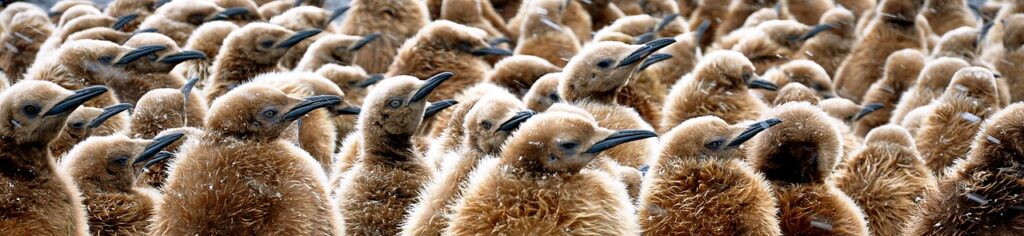
- King penguins have a breeding cycle of more than a year, so colonies contain adults, eggs and fluffy brown chicks (once mistaken for a separate species) at the same time.
- Gold Harbour and Fortuna Bay are other famous sites.
Seals
- Southern elephant seals: huge males (up to about 4 tonnes) fight for harems from September to November; weaned pups crowd the beaches later in the season. See our southern elephant seal profile.
- Antarctic fur seals: hunted almost to extinction, they now number in the millions, and the breeding season beaches can be crowded with territorial males in November and December.
Birds
- Wandering albatrosses: the largest wingspan of any living bird, up to about 3.5 metres, nest at Prion Island and Albatross Island. See our wandering albatross profile.
- Light-mantled albatrosses, giant petrels, macaroni and gentoo penguins, and the South Georgia pipit, the world’s southernmost songbird.
Rat eradication
Rats introduced by sealers and whalers devastated ground-nesting birds. Between 2011 and 2015, the South Georgia Heritage Trust carried out the world’s largest rodent eradication, and in 2018 the island was declared rat-free. Pipits and pintails are now recovering. Strict biosecurity checks protect the island.
Shackleton and history
- Grytviken: an abandoned whaling station with a museum, a church and the grave of the explorer Sir Ernest Shackleton, where visitors traditionally toast “the Boss”.
- Shackleton’s epic 1916 crossing of South Georgia’s mountains, after the loss of the Endurance, ended at the whaling station of Stromness. Some voyages offer a hike along the final stretch.
When to go
- November: elephant seals and fur seals breeding; fresh snow.
- December to January: penguin chicks, long days, peak wildlife.
- February to March: fur seal pups, elephant seal weaners, fewer crowds.
Frequently asked questions
How do I get to South Georgia? On an expedition cruise, usually 18 to 23 days combining the Falklands, South Georgia and the Antarctic Peninsula.
How many king penguins are on South Georgia? Hundreds of thousands of pairs, with the largest colonies at St Andrews Bay and Salisbury Plain.
Can I visit Shackleton’s grave? Yes, at Grytviken, a standard stop on most voyages.
Is South Georgia worth the longer voyage? For wildlife, absolutely. Many travellers consider it the highlight of their trip.
Related guides
- Choosing an Antarctica expedition ship
- Falkland Islands wildlife guide
- Antarctica expedition cruise guide
- Animal profiles: King penguin, Southern elephant seal, Wandering albatross
Cover photo: Butterfly austral, CC BY-SA 3.0, via Wikimedia Commons