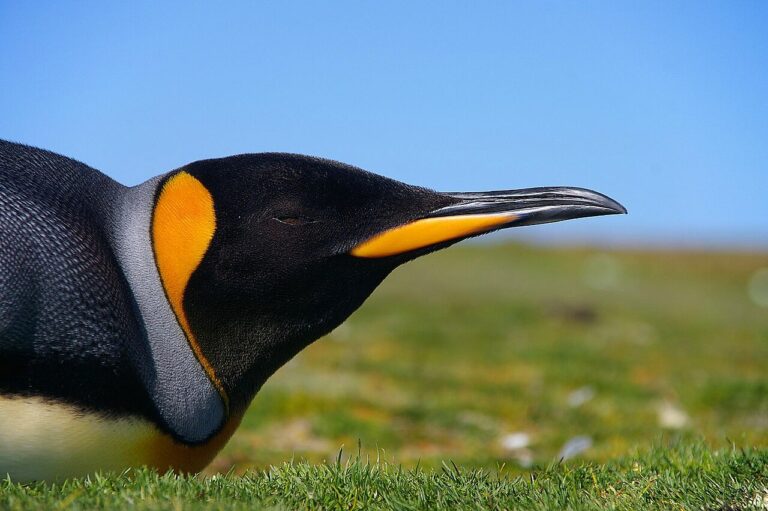
The king penguin is a tall, elegant penguin with bright orange patches on its head and chest. It breeds in huge, noisy colonies on sub-Antarctic islands and makes long foraging trips into the Southern Ocean.
Interesting facts
- It is the second-largest penguin, after the emperor penguin.
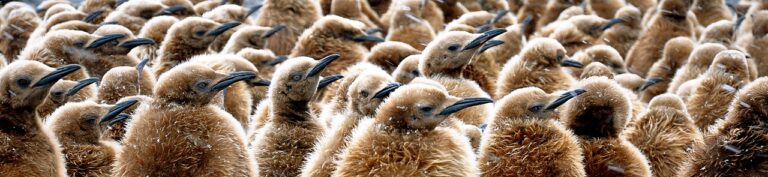
- Chicks have thick, brown, fluffy down; early explorers thought they were a separate species, the ‘woolly penguin’.
- King penguins can dive deeper than 300 metres.
- They do not build nests. The egg is balanced on the parent’s feet under a fold of skin.
- Some colonies number hundreds of thousands of birds.
- South Georgia’s St Andrews Bay has one of the largest colonies.
Behaviour
King penguins travel hundreds of kilometres to feed at the Antarctic Polar Front, where lanternfish are abundant. Colonies are packed and noisy, and each penguin recognises its partner and chick by voice.
Breeding and young
The female lays one egg, and both parents take turns incubating it on their feet for about 55 days. Chicks huddle together in crèches through the winter, fed only occasionally, before fledging after 10–13 months.
Threats and conservation
The species is abundant, but climate change may push its feeding grounds further south, away from breeding islands. Some colonies, such as on Île aux Cochons, have declined sharply.
Where to see it
- Salisbury Plain, St Andrews Bay and Gold Harbour, South Georgia
- Volunteer Point, Falkland Islands
- Parque Pingüino Rey, Tierra del Fuego, Chile
- Crozet and Kerguelen islands (French Southern Territories)
Status source: IUCN Red List. Profile last reviewed September 2026.
Where to see the king penguin
 South Georgia: King Penguins and Elephant SealsSouth Georgia may be the greatest wildlife spectacle on Earth, with hundreds of thousands of king penguins on…
 Falkland Islands Wildlife GuideThe Falklands have five penguin species, huge albatross colonies and remarkably tame wildlife. How to visit by air…