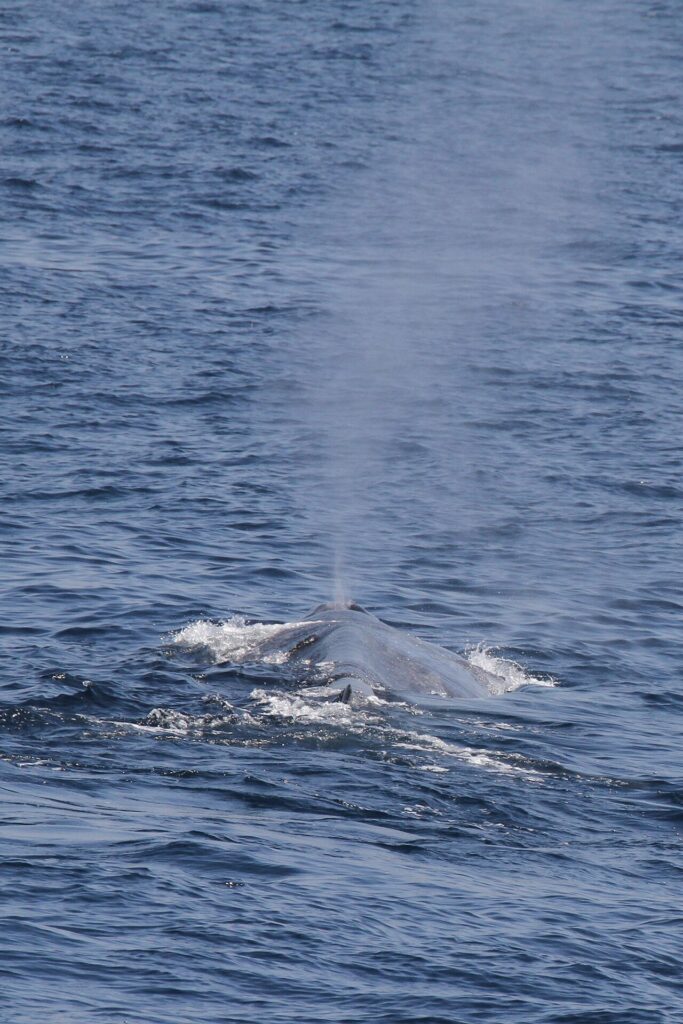
Sri Lanka’s southern coast is one of the most reliable places in the world to see the blue whale, the largest animal that has ever lived. From the small beach town of Mirissa, boats head out to where the continental shelf drops away steeply, bringing deep-water whales close to shore.
At a glance
| Best time | December to April (Mirissa); May to October (Trincomalee on the east coast) |
| Getting there | Mirissa is about 2.5 to 3 hours by road from Colombo |
| Time needed | A half-day boat trip (often 4 to 6 hours) |
| Big draws | Blue whales, sperm whales, dolphins, flying fish |
| Good for | Whale lovers, beach holidays |
The whales
- Blue whales: a population of pygmy blue whales lives year-round in the northern Indian Ocean, moving around Sri Lanka with the monsoons. They can reach more than 20 metres in length here. See our blue whale profile.
- Sperm whales: often seen, sometimes in large groups. See our sperm whale profile.
- Spinner dolphins, Bryde’s whales and, occasionally, orcas and fin whales.
What a trip is like
- Boats usually leave Mirissa harbour early in the morning (around 6 to 7 am).
- It can take one to two hours to reach the whales, and trips often last four to six hours.
- Seas can be rough; take motion-sickness medication in advance if you are prone to seasickness.
- Most operators offer a free second trip if you see no whales.
Choosing a responsible operator
Whale watching off Mirissa has been criticised for crowding: in busy seasons, dozens of boats may surround a single whale. Sri Lanka has whale-watching regulations on distances and speed, but enforcement varies.
- Choose operators that follow the rules on distance (at least 100 m) and speed, and limit the number of boats around a whale.
- Look for operators with trained naturalists and a commitment to research.
- Avoid boats that chase or cut across whales’ paths.
- Speak up if your boat approaches too closely.
Trincomalee: the alternative season
From about May to October, when the southern monsoon makes the south coast rough, whale watching shifts to Trincomalee on the north-east coast, where blue and sperm whales are also seen, with fewer boats.
When to go
- December to April: Mirissa season, with the calmest seas from about January to March.
- May to October: Trincomalee season.
Frequently asked questions
When is the best time to see blue whales in Mirissa? December to April, especially January to March.
How likely am I to see a blue whale? Very likely in season. Sighting rates are high, and many operators offer a second trip if you miss out.
Is whale watching in Mirissa ethical? It can be, with a responsible operator. Crowding by boats is a real problem, so choose carefully.
Can I combine whale watching with a safari? Yes. Yala and Udawalawe national parks are a few hours from Mirissa.
Related guides
- Yala National Park: leopards and sloth bears
- The elephant gathering at Minneriya
- Where to see whales in North America
- Animal profiles: Blue whale, Sperm whale, Bottlenose dolphin
Cover photo: Peyman Zehtab Fard, CC BY 2.0, via Wikimedia Commons