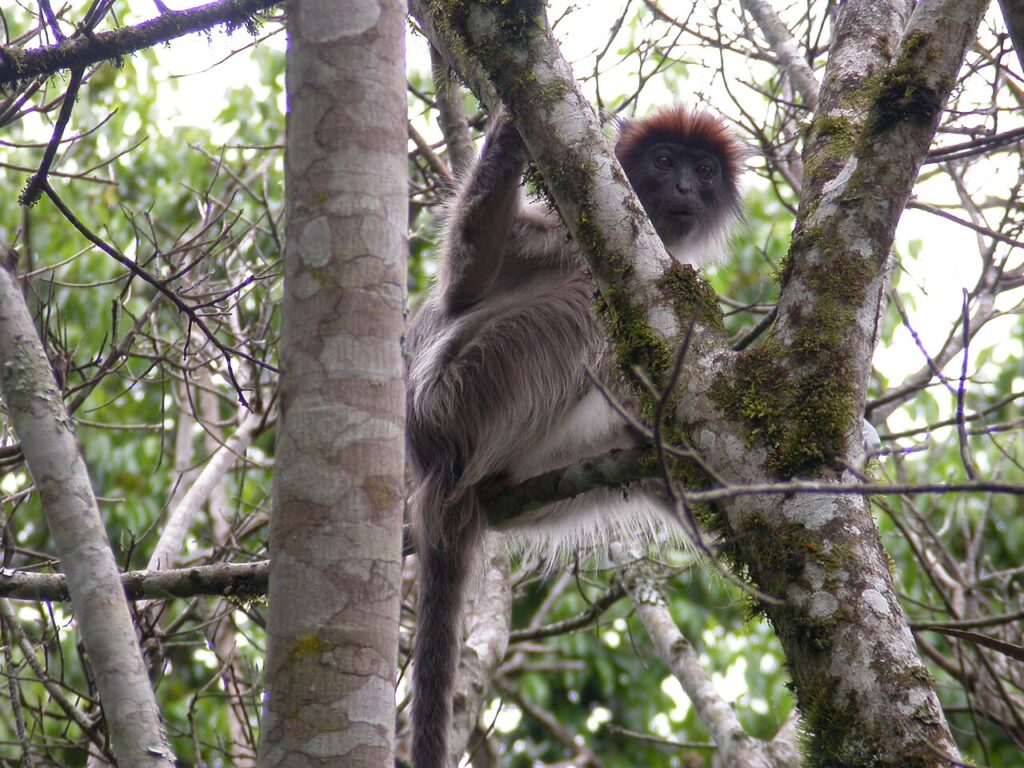
Kibale National Park, in western Uganda, protects about 795 km² of rainforest and is often called the primate capital of the world. Thirteen primate species live here, including around 1,500 chimpanzees, and a trek to find a habituated community has one of the highest success rates in Africa. Combine it with the crater lakes around Fort Portal and a safari in Queen Elizabeth National Park.
At a glance
| Best time | June to September and December to February |
| Getting there | About 5 to 6 hours by road from Kampala, or fly to Kasese |
| Time needed | 2 nights |
| Big draws | Chimpanzees, red colobus and other primates, Bigodi Wetland |
| Good for | Primate lovers, combining with gorillas and Queen Elizabeth |
Chimpanzee trekking
- Treks start from the Kanyanchu visitor centre, in the morning or afternoon, in groups of up to about eight people.
- Once you find the chimpanzees, you spend one hour with them. Chimps move quickly and often feed high in fig trees, but they also come down to the ground to travel.
- At the time of writing, a trekking permit costs US$250 for foreign non-residents. Book through the Uganda Wildlife Authority or a tour operator.
- Minimum age is usually 12. Masks may be required, and you must keep at least 8 metres away.
The chimpanzee habituation experience
For a deeper encounter, join researchers and trackers following a community that is still being habituated. You spend several hours with the chimpanzees, often from the time they leave their nests at dawn. Numbers are limited and it costs more than a standard permit.
Other primates
Kibale’s forest is also home to red colobus (a key study species for researchers here), black-and-white colobus, L’Hoest’s monkeys, grey-cheeked mangabeys, red-tailed and blue monkeys, olive baboons and, at night, bushbabies and pottos.
Bigodi Wetland Sanctuary
Next to the park, this community-run swamp walk is one of Uganda’s best birding and primate walks. Look for the great blue turaco, papyrus gonolek and several monkey species. Fees support local schools and projects.
When to go
- June to September and December to February: drier trails.
- March to May and October to November: wetter, but trekking continues and the forest is lush. Chimpanzees are found on most days year-round.
Getting there
Kibale lies about 300 km west of Kampala, near Fort Portal. The drive takes 5 to 6 hours. Scheduled flights serve Kasese, about 1.5 hours away. Queen Elizabeth National Park is about two to three hours south.
Where to stay
Lodges range from budget bandas near Kanyanchu to comfortable lodges on the crater lakes, which make a beautiful base.
Tips
- Wear long trousers tucked into socks against ants, and sturdy shoes.
- Morning treks tend to find chimps more active.
- Bring binoculars for primates and birds in the canopy.
- Add a day for the crater lakes and a Bigodi walk.
Frequently asked questions
How likely am I to see chimpanzees in Kibale? Very likely. Success rates are over 90%, as trackers follow the habituated communities daily.
Is Kibale better than Budongo or Kyambura for chimpanzees? Kibale has the highest density of chimpanzees and the most reliable sightings. Budongo (near Murchison Falls) and Kyambura Gorge (in Queen Elizabeth) are good alternatives on those routes.
How long is a chimpanzee trek? Usually two to four hours in total, including one hour with the chimpanzees.
Can children go chimpanzee trekking? The usual minimum age is 12. Younger children can enjoy the Bigodi Wetland walk.
Related guides
- Queen Elizabeth National Park
- Bwindi gorilla trekking guide
- Chimpanzee trekking in Mahale and Gombe
- Animal profiles: Chimpanzee, Olive baboon
Cover photo: Picture by Duncan Wright ( Sabine's Sunbird at en.wikipedia ), CC BY-SA 3.0, via Wikimedia Commons