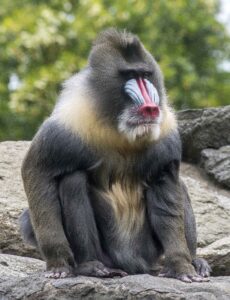
The olive baboon is a large, adaptable monkey found across much of Africa. It lives in complex societies and has been studied for decades to understand social behaviour and stress.
Interesting facts
- It has the widest range of any baboon species.
- Troops can number from about 15 to 150 baboons.
- Males have a thick mane and large canine teeth.
- Baboons are highly adaptable and can raid crops and campsites.
- The name comes from its olive-green-grey coat.
- Baboons spend a lot of time grooming each other to strengthen social bonds.
Behaviour
Olive baboons live in large troops with dominance hierarchies. They forage mainly on the ground and sleep in trees or on cliffs at night.
Breeding and young
After about six months, females give birth to a single infant, which clings to its mother’s belly and later rides on her back.
Threats and conservation
The species is widespread, but it is often killed in conflicts with farmers.
Where to see it
- Gombe Stream National Park, Tanzania
- Maasai Mara, Kenya
- Lake Manyara National Park, Tanzania
- Queen Elizabeth National Park, Uganda
Status source: IUCN Red List. Profile last reviewed September 2026.
 Kibale Forest Chimpanzee Trekking Guide