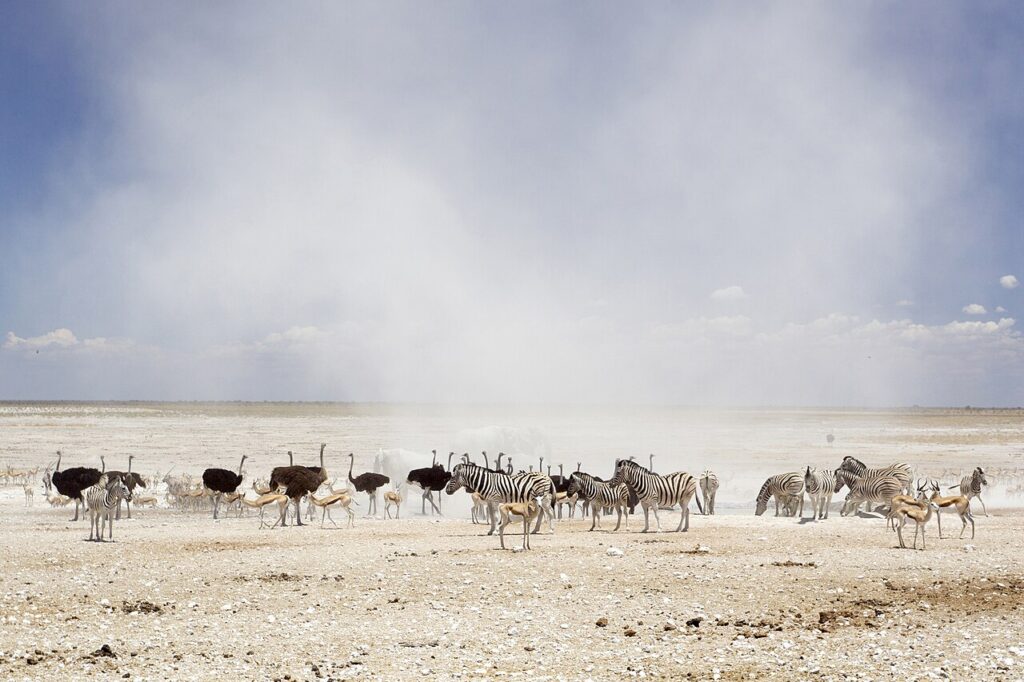
Etosha National Park in northern Namibia is built around a vast, shimmering salt pan about 4,800 km² in size, so large it can be seen from space. Around its edges, springs and waterholes attract elephants, lions, rhinos, giraffes, zebras and huge numbers of antelope, especially in the dry season. With good roads and floodlit waterholes at the rest camps, it is one of Africa’s best parks for self-drive safaris.
How Etosha works
For most of the year, the pan itself is a dry, white expanse. Wildlife depends on natural springs and artificial waterholes around its southern edge. In the dry season (about June to October), animals must drink, so sitting quietly at a waterhole can bring a procession of species over an hour or two.
Rest camps and waterholes
- Okaukuejo (southwest): the most famous floodlit waterhole in Africa, where black rhinos, elephants and lions often drink after dark.
- Halali (centre): the Moringa floodlit waterhole is known for leopards and rhinos.
- Namutoni (east): a historic fort, near excellent waterholes such as Chudob and Klein Namutoni.
- Dolomite Camp (west): quieter and more remote.
- Onkoshi (east): on the edge of the pan, with sweeping views.
Private lodges just outside the park’s gates offer more choice and often guided drives.
When to go
- June to October: dry season. Best game viewing at waterholes; cool mornings, hot afternoons.
- November to April: rains transform the landscape; animals disperse, birding is superb and the pan may hold water, attracting flamingos in good years. Fewer visitors and lower prices.
Wildlife highlights
- Black rhinos, often seen at night at floodlit waterholes.
- Elephants, which in Etosha are often coated white with dust.
- Lions, cheetahs, leopards and spotted hyenas.
- Springbok, gemsbok (oryx), kudu, red hartebeest, eland and the endemic black-faced impala.
- Birds: over 340 species, including kori bustards, ostriches and many raptors.
Driving tips
- Roads are gravel but generally good; a normal car is fine in the dry season, though a higher vehicle helps visibility.
- Speed limit is 60 km/h; driving slowly helps you spot wildlife and reduces dust.
- Gate times are strict; you must be in camp by sunset.
- Stay in your vehicle except at designated places.
- Plan routes between waterholes and spend time at each, rather than driving constantly.
A brief history
Etosha means “great white place” in the Oshiwambo language, after the vast salt pan. The area was proclaimed a game reserve in 1907, when it covered a much larger area than today. Its boundaries were reduced over the following decades, and the national park now covers about 22,270 km². Etosha is famous for its conservation work with black rhinos, and it has supplied animals to reintroduction projects elsewhere in Namibia.
Combining Etosha with the rest of Namibia
| Days | Route |
|---|---|
| 1–2 | Windhoek, then drive south to Sossusvlei (red dunes and Deadvlei) |
| 3–4 | Swakopmund on the coast: Walvis Bay lagoon, flamingos, Cape fur seals, dune activities |
| 5–6 | Damaraland: desert-adapted elephants, rock engravings at Twyfelfontein, dramatic scenery |
| 7–10 | Etosha: west (Dolomite or Okaukuejo), centre (Halali) and east (Namutoni or Onguma) |
| 11–12 | Waterberg Plateau or the Okonjima Nature Reserve, then return to Windhoek |
Namibia is well suited to self-drive trips, with good main roads, excellent maps and a wide range of lodges and campsites. Allow plenty of time, because distances are long.
Getting there
Etosha is about 400 to 500 km north of Windhoek, a long day’s drive on good tar roads. Many travellers combine it with Damaraland (desert-adapted elephants and rhinos), Sossusvlei’s dunes and the Skeleton Coast on a two-week self-drive trip.
Frequently asked questions
Can I drive Etosha in a normal car? Yes. The main gravel roads between Okaukuejo, Halali and Namutoni are suitable for a two-wheel-drive car in the dry season. A higher-clearance vehicle gives better views over the grass, and some minor loops can be rough after rain.
Which Etosha camp is best for wildlife? Okaukuejo’s floodlit waterhole is the most famous and is superb for black rhinos and elephants at night. Halali’s Moringa waterhole is good for leopards, and Namutoni is close to productive waterholes in the east. Staying in two camps gives the most variety.
How many days do I need in Etosha? Three to four nights is ideal, for example two nights in the west or centre and one or two in the east. This lets you cover the main waterholes without long drives every day.
Is Etosha malaria-free? Etosha lies in a low-risk area for malaria, with some seasonal risk during and after the rains (roughly November to April). Ask a travel clinic for current advice.
Related guides
- First African safari planning guide
- Where to see the Big Five
- Animal profiles: Black Rhinoceros, Giraffe, Cheetah
Cover photo: Yathin S Krishnappa, CC BY-SA 3.0, via Wikimedia Commons