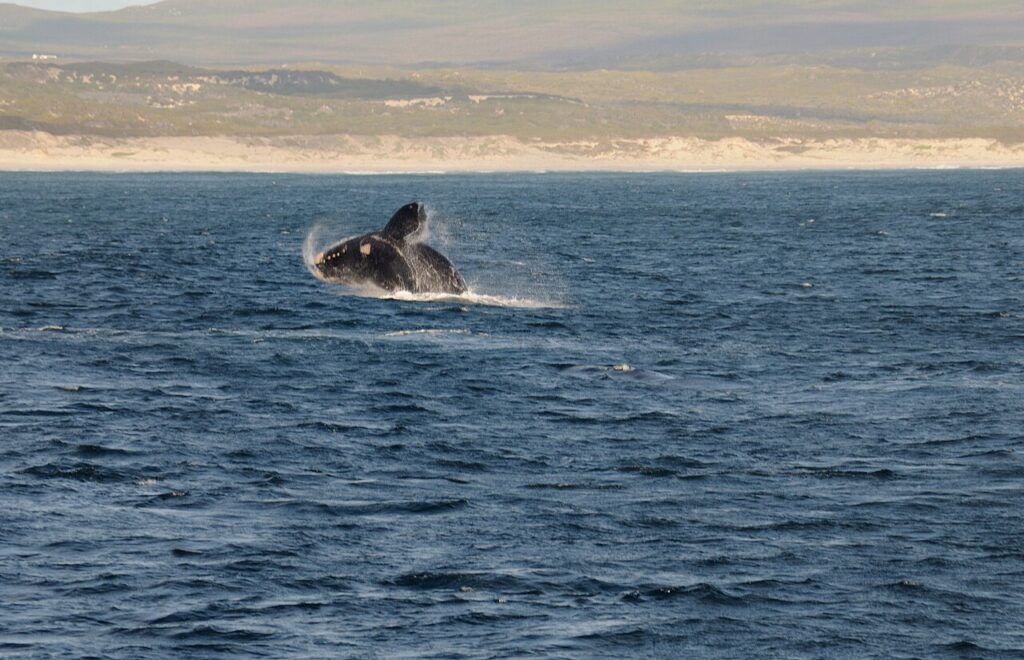
Hermanus, a seaside town about 120 km south-east of Cape Town, is often called one of the best places in the world for land-based whale watching. Every winter and spring, southern right whales come into the sheltered waters of Walker Bay to mate, give birth and nurse their calves, often just metres from the rocks.
At a glance
| Best time | June to November, peaking September to October |
| Getting there | About 1.5 hours by road from Cape Town |
| Time needed | 1 to 2 days |
| Big draws | Southern right whales from the shore, boat trips, De Hoop |
| Good for | Families, day trips from Cape Town, the Garden Route |
The whales
- Southern right whales migrate from their feeding grounds in the Southern Ocean to calve along South Africa’s southern coast. They were hunted almost to extinction but have recovered strongly since international protection. They are slow, curious and often stay near the surface, so you can watch them breaching, slapping their tails and resting with their calves.
- Humpback whales pass in smaller numbers, and Bryde’s whales and dusky dolphins are present year-round.
Where to watch from land
- The Cliff Path: a walking trail of about 12 km along the rocks from the New Harbour to the Klein River lagoon, with benches and viewpoints all the way.
- Gearing’s Point and Castle Rock: central viewpoints near the Old Harbour.
- Voëlklip and Kammabaai: quieter spots east of town.
- De Kelders, across the bay near Gansbaai, has high cliffs with excellent views.
Boat-based whale watching
A small number of licensed operators run boat trips from Hermanus New Harbour. They are allowed to approach whales to within set distances, and the whales often come closer themselves. Trips last about two hours. Choose a licensed operator and follow crew instructions.
The whale crier
Hermanus is known for its whale crier, who walks the town in season blowing a kelp horn to signal where whales have been seen.
The Hermanus Whale Festival
Held each year around late September, the festival celebrates the whales with music, food, markets and marine conservation displays.
De Hoop Nature Reserve
About two to three hours east of Hermanus, De Hoop’s coast is one of the most important calving grounds for southern right whales, and on good days dozens are visible at once from the dunes at Koppie Alleen. The reserve also has bontebok, eland, a vulture colony and fynbos. The multi-day Whale Trail is a famous hiking route.
When to go
- June to July: the first whales arrive.
- August to October: the peak, with mothers and calves in the bays.
- November: whales begin to leave.
Tips
- Bring binoculars and warm layers; winter weather can be cold and windy.
- Visit in the morning when the sea is often calmer and the light is good.
- Stay a night to walk the Cliff Path at leisure.
- Combine with a visit to the Stony Point penguin colony at Betty’s Bay on the way from Cape Town.
Frequently asked questions
When is the best time to see whales in Hermanus? September and October, when the most southern right whales, including mothers and calves, are in Walker Bay.
Can you see whales from land in Hermanus? Yes. Hermanus is famous for it, and the Cliff Path often gives views of whales very close to the shore.
Is a boat trip worth it? It can be, for close encounters and different angles, but land-based watching is free and often excellent.
Can I do Hermanus as a day trip from Cape Town? Yes. It is about 1.5 hours each way along a scenic coastal road.
Related guides
- Cape Town wildlife guide
- Where to see whales in North America
- Kaikōura whale watching
- Animal profiles: Humpback whale, Bottlenose dolphin
Cover photo: Josep M. Gracia, CC BY-SA 4.0, via Wikimedia Commons