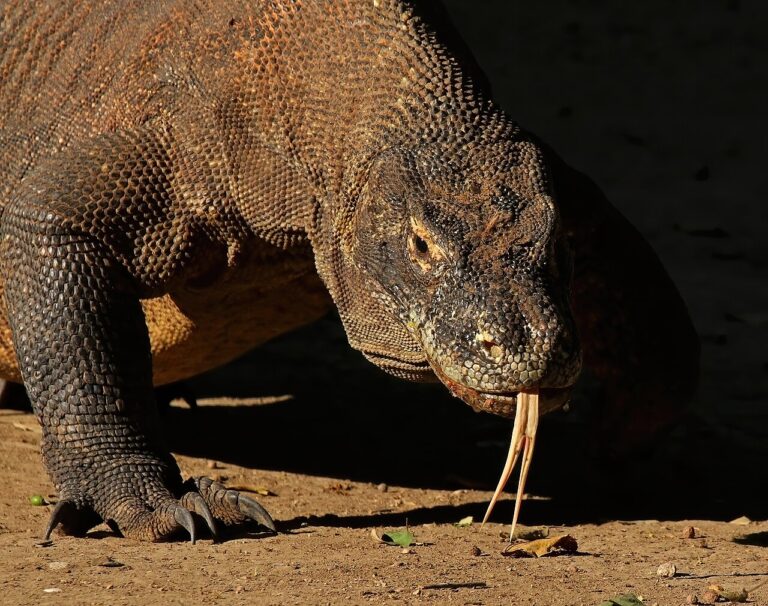
The Komodo dragon is a giant monitor lizard found on only a handful of Indonesian islands. Around 3,000 or more live in the wild, most of them within Komodo National Park, a UNESCO World Heritage Site.
Interesting facts
- The Komodo dragon is the largest living lizard.
- It can eat up to about 80 percent of its body weight in one meal.
- Females can reproduce without males through parthenogenesis.
- Its forked tongue picks up scent, allowing it to detect carrion several kilometres away.
- Young dragons live in trees to avoid being eaten by adults.
- The species was moved to Endangered in 2021 because of threats from rising sea levels.
Behaviour
Komodo dragons ambush prey from cover, delivering a deep bite, and may track wounded prey for days. Several dragons often gather to feed on a carcass.
Breeding and young
Females lay about 20 eggs, often in abandoned megapode bird nests, and incubation lasts seven to eight months.
Threats and conservation
Small range, climate change and sea-level rise, habitat loss on Flores, and poaching of their prey.
Where to see it
- Komodo National Park (Komodo and Rinca islands), Indonesia
Status source: IUCN Red List. Profile last reviewed September 2026.
 Komodo National Park Guide: Dragons, Diving and Island Hopping