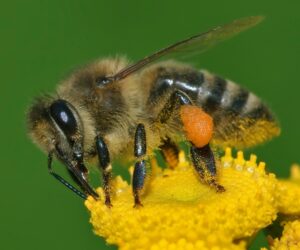
Bumblebees are large, furry bees found across much of the world. They are vital pollinators of wildflowers and crops, especially in cooler climates.
Interesting facts
- Bumblebees can fly in cool weather by shivering their flight muscles to warm up.
- In experiments, bumblebees rolled small balls for no reward, a behaviour that looks like play.
- Colonies are small, usually from about 50 to a few hundred bees.
- Only young queens survive the winter, hibernating alone underground.
- Bumblebees are used to pollinate greenhouse crops.
- The old claim that bumblebees ‘shouldn’t be able to fly’ was based on an oversimplified calculation.
Behaviour
Workers collect nectar and pollen, and they can learn to recognise the most rewarding flowers. They leave scent marks on flowers they have visited.
Breeding and young
In spring, a queen starts a new colony alone in a hole or grass tussock. By late summer, the colony produces new queens and males.
Threats and conservation
Habitat loss, pesticides, disease from commercial bees and climate change.
Where to see it
- Gardens, meadows and parks in spring and summer
- Mountain meadows and moorland
- Wildflower margins on farmland
- Plant spring and summer flowers to help them
Status source: IUCN Red List. Profile last reviewed September 2026.