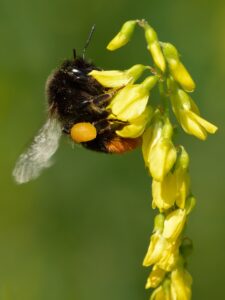
The western honey bee is one of the most important pollinators of crops and wild plants. It has been kept by people for thousands of years. While managed honey bee colonies are not at risk of extinction, beekeepers face heavy losses, and many wild bee species are declining.
Interesting facts
- A colony can contain 20,000 to 80,000 bees.
- Bees beat their wings about 200 times a second, producing their buzz.
- To make about 500 g of honey, bees may visit millions of flowers.
- Worker bees are all female; males, called drones, do not sting.
- Bees can see ultraviolet light, which reveals patterns on flowers invisible to us.
- Honey found in ancient Egyptian tombs was still edible after thousands of years.
Behaviour
Colonies are superorganisms with a division of labour: a single egg-laying queen, thousands of female workers and seasonal male drones. Workers change jobs as they age, from cleaning and nursing to guarding and foraging.
Breeding and young
The queen lays up to about 2,000 eggs a day in summer. New colonies form when the old queen leaves with a swarm of workers.
Threats and conservation
Varroa mites and the viruses they spread, pesticides, loss of flowers and habitat, poor nutrition and climate change.
Where to see it
- Gardens, meadows and farmland almost everywhere
- Bee farms and apiary tours
Status source: IUCN Red List. Profile last reviewed September 2026.