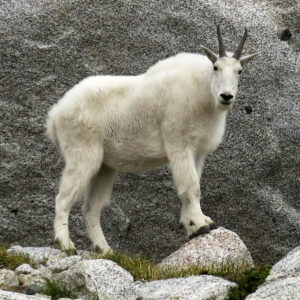
The bighorn sheep is a stocky wild sheep of western North America, famous for the massive curled horns of rams. It lives on steep cliffs where its climbing skill keeps it safe from predators.
Interesting facts
- Rams have a double-layered skull and strong neck tendons to absorb impacts.
- Hooves with rough, flexible pads give excellent grip on rock.
- Horn size shows a ram’s age and status.
- Ewes also have horns, but they are short and only slightly curved.
- Diseases caught from domestic sheep have killed many wild herds.
- Desert bighorn sheep can survive long periods without drinking.
Behaviour
Rams and ewes live in separate groups for most of the year. In the autumn rut, rams fight for mating rights by rearing up and crashing their horns together, sometimes for hours.
Breeding and young
After about six months, ewes give birth to a single lamb on a steep, secluded ledge. Lambs can climb within a day.
Threats and conservation
Pneumonia spread from domestic sheep and goats, habitat loss, hunting and roads. Numbers fell dramatically in the 1800s and 1900s but have partly recovered with reintroductions.
Where to see it
- Jasper and Banff national parks, Canada
- Glacier National Park, Montana
- Yellowstone National Park, near Gardiner
- Badlands National Park, South Dakota, and Death Valley, California
Status source: IUCN Red List. Profile last reviewed September 2026.
 Banff and Jasper Wildlife Guide