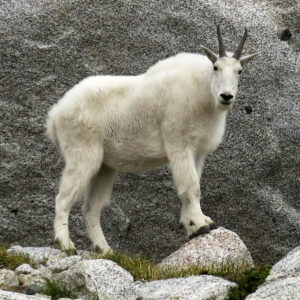
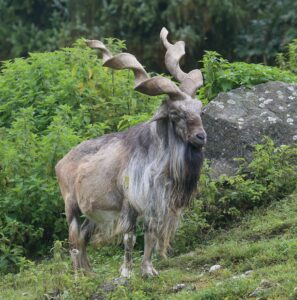
The alpine ibex is a wild goat of the European Alps, renowned for its huge curved horns and extraordinary climbing ability. Brought back from the brink of extinction, it is one of Europe’s great conservation successes.
Interesting facts
- By the early 1800s, only about 100 alpine ibex survived, in Italy’s Gran Paradiso area.
- A royal hunting reserve created by King Victor Emmanuel II helped save the species.
- Today there are more than 50,000 ibex across the Alps.
- Males’ long, curved horns have ridges that increase with age.
- Males clash horns in winter to win mating rights.
- Ibex come down to lower meadows in spring and climb higher in summer.
Behaviour
Males and females live in separate herds for most of the year and come together for the winter rut. Ibex rest on steep ledges, safe from predators, and graze in meadows.
Breeding and young
After about five and a half months, females give birth to a single kid in late spring. Kids can follow their mothers over steep terrain within a day.
Threats and conservation
The species is secure, but it has low genetic diversity because all ibex descend from a tiny population. Climate change and disease are concerns.
Where to see it
- Gran Paradiso National Park, Italy
- Swiss National Park, Switzerland
- Vanoise National Park, France
- Hohe Tauern National Park, Austria
Status source: IUCN Red List. Profile last reviewed September 2026.
 Gran Paradiso: Alpine Ibex and Marmots