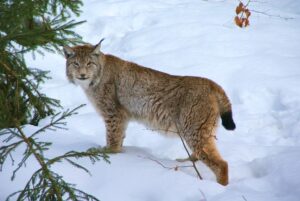
The roe deer is a small, elegant deer common across Europe. It has adapted well to farmland and forest edges and is often seen grazing in fields at dawn and dusk.
Interesting facts
- Roe deer bark like dogs when alarmed.
- Males have short antlers with usually three points each.
- Twin fawns are common.
- During the rut, males chase females in circles, leaving ‘roe rings’ in the grass.
- It is one of Europe’s most common deer.
- A white rump patch flashes when it runs away.
Behaviour
Roe deer are mostly solitary in summer and gather in small groups in winter. Bucks defend territories in spring and summer.
Breeding and young
Mating takes place in July and August, but because of delayed implantation, fawns are born the following May or June, usually as twins.
Threats and conservation
The species is abundant. It is hunted in many countries and suffers from road deaths.
Where to see it
- New Forest, England
- Scottish Highlands
- Białowieża Forest, Poland
- Farmland and woodland across Europe
Status source: IUCN Red List. Profile last reviewed September 2026.